The Mahābhārata verse 'श्रावयेच्चतुरो वर्णान्…' itself seems clear on the subject of letting all 4 varṇas hear Vedas if Brāhmaṇas are made to sit in the front row.
Śrī Karapātrī Svāmī has refuted such an interpretation by citing some verses from Mahābhārata. +

Śrī Karapātrī Svāmī has refuted such an interpretation by citing some verses from Mahābhārata. +
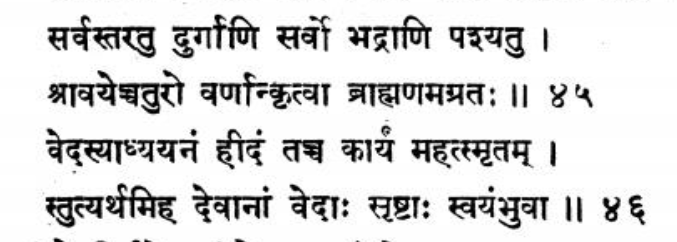

He finds it to be in contradiction with the verse 'मन्त्रः शूद्रे न विद्यते'. The complete verse is
'उक्तस्त्रयाणां वर्णानां यज्ञस्तस्य च भारत।
स्वाहाकारवषट्कारौ मन्त्रः शूद्रे न विद्यते॥'.
This verse is connected only with mantras which have 'svāhā' & 'vaṣaṭ'.+
'उक्तस्त्रयाणां वर्णानां यज्ञस्तस्य च भारत।
स्वाहाकारवषट्कारौ मन्त्रः शूद्रे न विद्यते॥'.
This verse is connected only with mantras which have 'svāhā' & 'vaṣaṭ'.+
Also, the context of the verse is performance of pākayajña. Hence, it does not contradict 'श्रावयेच्चतुरो वर्णान्…' as being an injunction of hearing of Vedas by all varṇas.
Then he cites 'न च तां प्राप्तवान् मूढः शूद्रो वेदश्रुतीमिव'. +
Then he cites 'न च तां प्राप्तवान् मूढः शूद्रो वेदश्रुतीमिव'. +
The complete verse is
'रुक्मिण्यामस्य मूढस्य प्रार्थनाऽऽसीन्मुमूर्षतः।
न च तां प्राप्तवान्मूढः शूद्रो वेदश्रुतीमिव।।'.
This is not a verse of injunction or prohibition, but only an example of Śiśupāla not receiving Rukmiṇī, just as a Śūdra does not receive Vedaśruti.+
'रुक्मिण्यामस्य मूढस्य प्रार्थनाऽऽसीन्मुमूर्षतः।
न च तां प्राप्तवान्मूढः शूद्रो वेदश्रुतीमिव।।'.
This is not a verse of injunction or prohibition, but only an example of Śiśupāla not receiving Rukmiṇī, just as a Śūdra does not receive Vedaśruti.+
An example can be given of something which is true about most cases, but where exceptions do exist. Also, the word 'mūḍha' can be taken as an adjective of 'śūdra'.
Then he cites 'भावं न चास्याहमनुप्रदातुमलं द्विजो मन्त्रमिवाद्विजाय' from Vālmīki Rāmāyaṇa.+
Then he cites 'भावं न चास्याहमनुप्रदातुमलं द्विजो मन्त्रमिवाद्विजाय' from Vālmīki Rāmāyaṇa.+
The complete verse is
'नैवास्ति दोषं मम नूनमत्र वध्याऽहमस्याप्रियदर्शनस्य ।
भावं न चास्याहमनुप्रदातुमलं द्विजो मन्त्रमिवाद्विजाय ।।'.
Here also, it is not an injunction or prohibition, but only an example that which Devī Sītā gives.+
'नैवास्ति दोषं मम नूनमत्र वध्याऽहमस्याप्रियदर्शनस्य ।
भावं न चास्याहमनुप्रदातुमलं द्विजो मन्त्रमिवाद्विजाय ।।'.
Here also, it is not an injunction or prohibition, but only an example that which Devī Sītā gives.+
Regarding 'ब्राह्मणायैव दातव्यं…', it would be in contradiction of injunctions which tell initiated Kṣatriyas and Vaiśyas to learn Vedas.
Also, there is a variant reading of this 'ब्राह्मणाय सदा देयं…'.+
jainqq.org/explore/004323…
Also, there is a variant reading of this 'ब्राह्मणाय सदा देयं…'.+
jainqq.org/explore/004323…

Hence, it seems that the verses which have been cited as contradictory to the direct interpretation of 'श्रावयेच्चतुरो वर्णान् कृत्वा ब्राह्मणमग्रतः' as an injunction which allows all varṇas to hear Vedas, do not contradict it.
• • •
Missing some Tweet in this thread? You can try to
force a refresh