
Why Read The Bible In Hebrew?
Let's talk about the most important figures *in history* for understanding the rise of monarchy—the prophet Samuel, King Saul...and of course, King David.
Why did Saul fail, but Samuel and David succeed?
A thread (for non-Hebrew readers too!) 🧵 1
Let's talk about the most important figures *in history* for understanding the rise of monarchy—the prophet Samuel, King Saul...and of course, King David.
Why did Saul fail, but Samuel and David succeed?
A thread (for non-Hebrew readers too!) 🧵 1
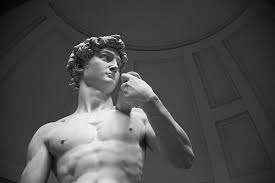
Monarchy is on the mind, of course, as our friends across the pond mourn the passing of Queen Elizabeth II.
Now you might assume we Americans, by contrast, wouldn't have much to say about monarchy. The American Revolution and all that...
You would, however, be wrong. 2
Now you might assume we Americans, by contrast, wouldn't have much to say about monarchy. The American Revolution and all that...
You would, however, be wrong. 2

First, per historian Eric Nelson, the Revolutionary attitude towards monarchy was complex. As Rufus King—a signatory to the US Constitution—put it:
"We began the quarrel which ended in the Revolution, not against the King, but against his parliament." 3
amazon.com/Royalist-Revol…
"We began the quarrel which ended in the Revolution, not against the King, but against his parliament." 3
amazon.com/Royalist-Revol…
But in a wider sense, the Biblical kings have long loomed large in the American imagination. And none more so than King David.
But what have Americans learned about leadership from David? Well, in recent times it's been how to cope with leaders who sin. 4 theatlantic.com/ideas/archive/…
But what have Americans learned about leadership from David? Well, in recent times it's been how to cope with leaders who sin. 4 theatlantic.com/ideas/archive/…
This takeaway from the David story has been popular since at least the 90s, when Bill Clinton's defenders, too, likened him to the Biblical ruler in the wake of the Lewinsky scandal.
Take a look at the Harvard Crimson, for crying out loud! 5 thecrimson.com/article/1998/1…
Take a look at the Harvard Crimson, for crying out loud! 5 thecrimson.com/article/1998/1…
Okay, but is that it? Is the only thing we can learn about leadership from David how to apologize for the bad parts?
...This would be a pretty boring thread if that were true! But to learn something positive and profound from David, we'll need help from his predecessors. 6
...This would be a pretty boring thread if that were true! But to learn something positive and profound from David, we'll need help from his predecessors. 6
The two Israelite leaders before David were the prophet Samuel, and Saul—first king of Israel.
And the Bible is *very* deliberate in tying all three of their respective stories together.
But before we go any further, let's do a quick narrative review. 7
And the Bible is *very* deliberate in tying all three of their respective stories together.
But before we go any further, let's do a quick narrative review. 7
Samuel is the last of the Biblical judges, who led the Israelites on an as-needed basis. When the Israelites ask for a permanent monarchy, God (though upset at the request) has Samuel select Saul as king. Eventually Saul sins terribly, and God raises up David in his place. 8
So much we could unpack here, of course, but bottom line: the Bible looks positively upon Samuel and David, but ultimately sees Saul as a failure.
So this gives us the clearest possible opportunity to ask the crucial question:
What, for the Bible, makes a good leader? 9
So this gives us the clearest possible opportunity to ask the crucial question:
What, for the Bible, makes a good leader? 9
To answer this we'll need to examine the Hebrew—in particular, one root that's EVERYWHERE in the stories of Samuel, Saul and David.
That root is sha'al (sh-'-l), which can be used to mean a couple of different things (as we'll see), but whose basic meaning is "ask". 10
That root is sha'al (sh-'-l), which can be used to mean a couple of different things (as we'll see), but whose basic meaning is "ask". 10
Okay so let's start with Samuel. His story actually begins with his mother, Hannah, who can't conceive. She prays to God for a child. Eventually the High Priest, Eli, blesses her: "The God of Israel grant the petition (shelatech) you have made (sha'alt) to him" (1 Samuel 1:17) 11

The words for "petition" and "you have made" are both formed with the same root, sha'al.
But there's more!
As part of her prayer Hannah pledged that should God grant her a child, she'd devote him to serving God. And this, we learn in v. 20, is why she names her son Samuel... 12
But there's more!
As part of her prayer Hannah pledged that should God grant her a child, she'd devote him to serving God. And this, we learn in v. 20, is why she names her son Samuel... 12
"She named him Samuel, for she said, 'I have asked him (she'iltiv) of the Lord.'"
Samuel's very name comes from the root sha'al! And it's used not in the sense of "asking", but "borrowing". Hannah borrows time with her son before she has to bring him to serve in the Temple. 13
Samuel's very name comes from the root sha'al! And it's used not in the sense of "asking", but "borrowing". Hannah borrows time with her son before she has to bring him to serve in the Temple. 13
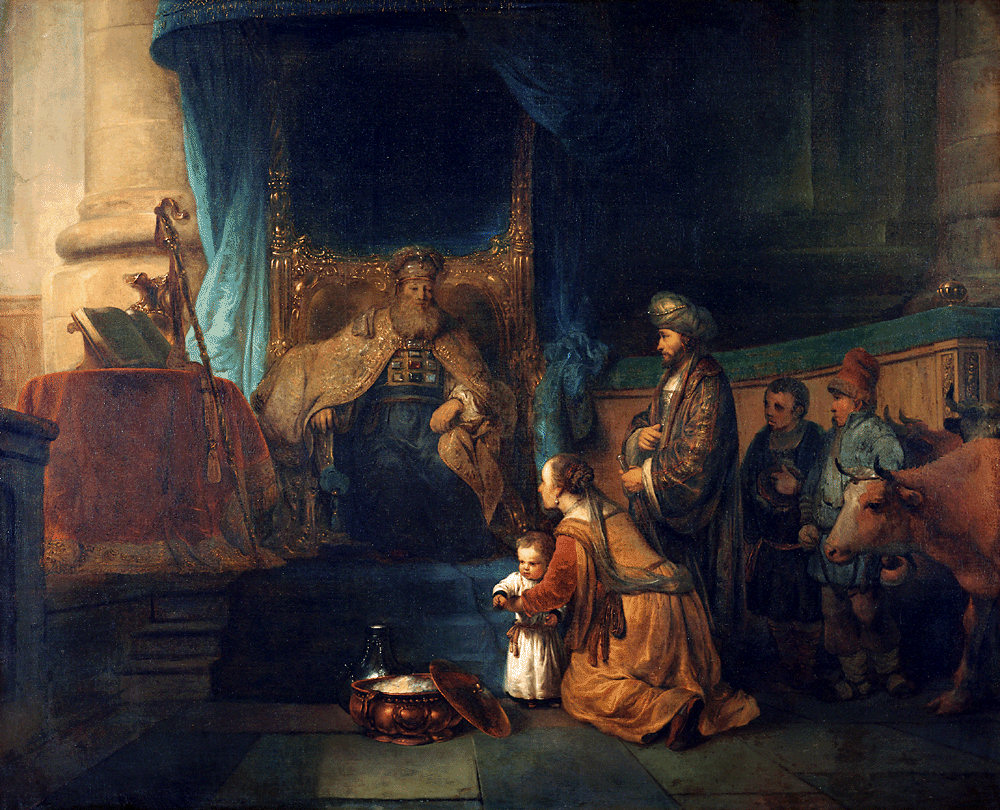
This meaning of sha'al is made famous in the law about borrowing another's property in the Book of Exodus:
"When someone borrows (yish'al) an animal from another and it is injured or dies, the owner not being present, full restitution shall be made" (22:14). 14
"When someone borrows (yish'al) an animal from another and it is injured or dies, the owner not being present, full restitution shall be made" (22:14). 14
And what happens once Hannah relinquished a young Samuel to Temple service?
"Therefore I have lent him to the Lord..." (1 Sam 1:28)
The word for "lent" is a form of sha'al too! Hannah has borrowed Samuel *from* God, and then in turn lends him *to* God. 15
"Therefore I have lent him to the Lord..." (1 Sam 1:28)
The word for "lent" is a form of sha'al too! Hannah has borrowed Samuel *from* God, and then in turn lends him *to* God. 15
So Samuel's entire origin story is structured around various forms of "sha'al". Hannah asks (sha'al) God for a child. When her request is granted, she acknowledges that the child is a gift borrowed (sha'al) from God. And she gladly lends (sha'al) him into God's service. 16
But now here's the thing:
Remember how the Bible presents Samuel's name as based on "sha'al"? Yeah, so that would be weird since while the word "Samuel" *does* have those letters in it, it has other seemingly unrelated letters too.
And the Bible itself seems to know this!... 17
Remember how the Bible presents Samuel's name as based on "sha'al"? Yeah, so that would be weird since while the word "Samuel" *does* have those letters in it, it has other seemingly unrelated letters too.
And the Bible itself seems to know this!... 17
So why does the Bible connect Samuel's name to sha'al?
The answer is: it wants the reader to associate Samuel with another character whose name is *definitely* based on the root "sha'al".
...Saul!
How do I know? Well, take a look at Hannah's last words in the chapter. 18
The answer is: it wants the reader to associate Samuel with another character whose name is *definitely* based on the root "sha'al".
...Saul!
How do I know? Well, take a look at Hannah's last words in the chapter. 18
"As long as he lives, he is given (sha'ul) to the Lord" (1:28).
The Hebrew here for "given" (sha'ul) not only contains the root sha'al...but is literally the exact Hebrew spelling of the name "Saul"!
The Hebrew is telling us clear as day to read this story in light of Saul. 19
The Hebrew here for "given" (sha'ul) not only contains the root sha'al...but is literally the exact Hebrew spelling of the name "Saul"!
The Hebrew is telling us clear as day to read this story in light of Saul. 19
So let's take a look at Saul. Does the root sha'al appear in his narrative? Well first of all, obviously yes because his literal name has that root in it.
But also...yeah, it's ALL over the Saul story.
The first time is when we learn about the origins of Saul's kingship. 20
But also...yeah, it's ALL over the Saul story.
The first time is when we learn about the origins of Saul's kingship. 20
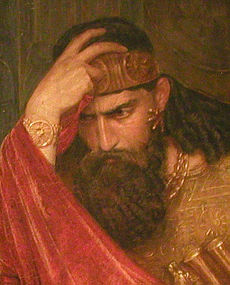
Why, after all, does Israel need a king at all? They hadn't had one until now, so what changed?
Well, what changes is that the Israelites *demand* Samuel relinquish his leadership and appoint a king! And what's the word Samuel uses to describe this demand?
You guessed it... 21
Well, what changes is that the Israelites *demand* Samuel relinquish his leadership and appoint a king! And what's the word Samuel uses to describe this demand?
You guessed it... 21
He refers to "the people who were asking (sha'al) him for a king" (8:10).
And he uses this same root multiple times in his farewell address to the Israelites, in describing their clamoring for a king.
He even ties it directly to Saul! Take a look at 1 Samuel 12:13.
22
And he uses this same root multiple times in his farewell address to the Israelites, in describing their clamoring for a king.
He even ties it directly to Saul! Take a look at 1 Samuel 12:13.
22
"See, here is the king whom you have chosen, for whom you have asked..."
The root for "asked", as you've guessed, is sha'al. The word for "chosen" is bachar. Why use both? Isn't this passage just redundant?
Answer: check out the first time the Bible ever describes Saul... 23
The root for "asked", as you've guessed, is sha'al. The word for "chosen" is bachar. Why use both? Isn't this passage just redundant?
Answer: check out the first time the Bible ever describes Saul... 23
"Saul, a handsome young man" (1 Sam 9:2). The root of the name Saul, as we've seen, is sha'al.
And the root of "young man"? That's right...bachar! Same as the root for "chosen" in 12:13.
The king Samuel excoriates the Israelites for choosing is...young Saul! 24
And the root of "young man"? That's right...bachar! Same as the root for "chosen" in 12:13.
The king Samuel excoriates the Israelites for choosing is...young Saul! 24
Consider the enormous differences between how "sha'al" is used in the Samuel and Saul stories.
For Samuel, "sha'al" refers to a relationship with God (prayer, borrowing, service).
In the case of Saul, it refers to people making loud demands.
And that brings us to David... 25
For Samuel, "sha'al" refers to a relationship with God (prayer, borrowing, service).
In the case of Saul, it refers to people making loud demands.
And that brings us to David... 25
David's narrative, too, is saturated with sha'al words. And, as in the case Samuel, the Bible deliberately contrasts it with the story of Saul.
Let's start with Saul here. The Bible portrays him as constantly asking the wrong questions, in the wrong way. 26
Let's start with Saul here. The Bible portrays him as constantly asking the wrong questions, in the wrong way. 26
As the Israelites prepare to battle the Philistines at Michmash (1 Sam 16), we keep expecting Saul to do the right thing and ask God for guidance. But he never does...until the priest accompanying him insists he must (16:36). At which point Saul "asks (sha'al) God" (16:37)... 27
But because of his rashness in the battle beforehand—including swearing a foolish oath—"[God] did not answer him that day" (16:37).
Throughout his life, this would be Saul's problem. He only ever remembered to ask God for help after it was too late. 28
Throughout his life, this would be Saul's problem. He only ever remembered to ask God for help after it was too late. 28
The most tragic example of this is Saul's behavior on the eve of his death, once again preparing to fight the Philistines.
Saul is desperate. And he finally decides to ask God for help. The only problem? He'd already killed the priests who could've helped him (22:18). 29
Saul is desperate. And he finally decides to ask God for help. The only problem? He'd already killed the priests who could've helped him (22:18). 29
He tries to cajole God, to no avail—"When Saul inquired (sha'al) of the Lord, the Lord did not answer him, not by dreams or by Urim or by prophets." (28:6).
So then he tries to force God, through necromancy: "Seek out for me a woman who is a medium..." (28:7). 30
So then he tries to force God, through necromancy: "Seek out for me a woman who is a medium..." (28:7). 30
And, via an idolatrous sacrifice, he forces Samuel back from the dead! But when Saul asks him for help the disgusted prophet replies, "Why then do you ask me (sha'al)..." (28:16).
Saul had abandoned all principles in his belated "sha'al" pursuits, and Samuel won't reward him. 31
Saul had abandoned all principles in his belated "sha'al" pursuits, and Samuel won't reward him. 31
All of this is in stark contrast to King David.
At nearly every single major moment in the course of his life, David's first impulse is to turn to God. And this is always expressed through the root "sha'al". 32
At nearly every single major moment in the course of his life, David's first impulse is to turn to God. And this is always expressed through the root "sha'al". 32
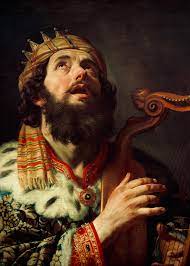
When David saves the city of Keilah, he doesn't do anything before asking God—"David inquired (sha'al) of the Lord, 'Shall I go and attack these Philistines?'" (23:2)
The Book of Samuel depicts David "sha'al"-ing God no less than nine times! 33
The Book of Samuel depicts David "sha'al"-ing God no less than nine times! 33
In fact, remember how we talked about Saul consulting (sha'al) a necromancer on the eve of his death?
The Bible inserts one story in between that event, and Saul's death in battle. The story of David avenging an attack on the city of Ziklag
The Bible describes it as follows. 34
The Bible inserts one story in between that event, and Saul's death in battle. The story of David avenging an attack on the city of Ziklag
The Bible describes it as follows. 34
David and his fellows wept over the attack "until they had no more strength (koach) to weep...and David was in great (me'od) danger (tzarar)" (30:4, 6).
This is the exact same language used to describe Saul's motivation for seeking out the necromancer! 35
This is the exact same language used to describe Saul's motivation for seeking out the necromancer! 35
"I am in great (me'od) distress (tzarar)...", says Saul (28:15). And we then learn "there was no strength (koach) in him".
Both David and Saul find themselves in the same situation. Both are terrified, both are on the brink. 36
Both David and Saul find themselves in the same situation. Both are terrified, both are on the brink. 36
Saul, in his desperation, turns to idolatry. But David? He never surrenders his principles.
"David inquired (sha'al) of the Lord..." (30:8).
And in the end, that was the difference between King Saul and King David. 37
"David inquired (sha'al) of the Lord..." (30:8).
And in the end, that was the difference between King Saul and King David. 37
So what do we learn about leadership from the last of the Judges and the first of the Kings?
What does it mean to be a good monarch? Or even beyond that, what does it mean to lead well? 38
What does it mean to be a good monarch? Or even beyond that, what does it mean to lead well? 38
For the Bible, a good leader must embody the best qualities of the root "sha'al".
From Hannah, Samuel's mother, we learn that good leaders are a gift given (sha'al) to us through divine mercy.
And like Samuel, a good leader should be devoted (sha'al) to a life of service. 39
From Hannah, Samuel's mother, we learn that good leaders are a gift given (sha'al) to us through divine mercy.
And like Samuel, a good leader should be devoted (sha'al) to a life of service. 39
And, also like Samuel, leadership may not be something we get to choose. It may be thrust upon us.
But it's precisely those unchosen obligations that are most sacred—that we must discharge with grace and honor. 40
But it's precisely those unchosen obligations that are most sacred—that we must discharge with grace and honor. 40
From David, we learn the importance of recognizing human dependence. As mighty as David was, he was always ready to ask (sha'al) God for help. Why? Because good leaders know that ultimately even their best efforts will be insufficient if they rely only on themselves. 41
When leadership fails, by contrast, we get Saul.
Instead of selfless devotion to God and people, we get a culture of making demands (sha'al)—a sense of entitlement.
And instead of patience in asking God for help, we get the idolatrous, necromantic desire to force God's hand. 42
Instead of selfless devotion to God and people, we get a culture of making demands (sha'al)—a sense of entitlement.
And instead of patience in asking God for help, we get the idolatrous, necromantic desire to force God's hand. 42
So in the end, our societal aspiration should be for leaders like Samuel and David who,
1) Acknowledge any gifts they have are not self-made.
2) Embrace unchosen obligations. Choice is not the highest virtue!
3) Recognize the importance of asking for help. 43
1) Acknowledge any gifts they have are not self-made.
2) Embrace unchosen obligations. Choice is not the highest virtue!
3) Recognize the importance of asking for help. 43
By all accounts, Queen Elizabeth was just such a leader. And though America doesn't have a monarchy—rightly, in light of our history—may we merit leaders with her grace and wisdom.
May her memory be for a blessing. And may God comfort the United Kingdom in their mourning. /end
May her memory be for a blessing. And may God comfort the United Kingdom in their mourning. /end

P.S. If you liked this, you should definitely check out my weekly podcast—called Good Faith Effort—on the Bible's influence in society! @gfaitheffort
Here's a recent episode about how the West re-discovered Biblical Hebrew during the Renaissance!
Enjoy! podcasts.apple.com/nl/podcast/dav…
Here's a recent episode about how the West re-discovered Biblical Hebrew during the Renaissance!
Enjoy! podcasts.apple.com/nl/podcast/dav…
P.P.S. I can't stop/won't stop thanking the @CatherineProj and the incredibly awesome @zenahitz for getting me started on doing these threads! I'm so grateful to them!!! 🔥🔥🔥
Coda:
Incredible point by @ewzucker noticing another seemingly extraneous—but in fact literally crucial—“sha’al” at a key moment in the David narrative!
Amazing 🔥🔥🔥
Incredible point by @ewzucker noticing another seemingly extraneous—but in fact literally crucial—“sha’al” at a key moment in the David narrative!
Amazing 🔥🔥🔥
https://twitter.com/ewzucker/status/1569171566289715201
• • •
Missing some Tweet in this thread? You can try to
force a refresh






