Here’s something quite amazing. The OLC wrote a powerful memo explaining why the Attorney General's independence is vital to our constitutional system. It reads as if it had been drafted this morning, in response to today’s political landscape, but …. /1 knightcolumbia.org/documents/jwhw…
It was written 40 years ago. Ted Olson, then the head of the OLC, wrote it in Feb 1982 for the then-AG, William French Smith, to describe the “responsibilities of the AG to the Constitution.” /2
The memo is one of more than five hundred OLC opinions that @knightcolumbia has obtained over the past months as a result of a settlement with the Justice Department. All of the opinions are here. /3 knightcolumbia.org/reading-room/o…
The most remarkable parts of this particular memo are about the independence of the AG, and about the responsibility of the AG to “establish justice.” “There is no more important goal in the Constitution or in the minds of the citizens of this nation,” the memo says. /4
The idea that the AG should be independent, and that s/he should establish justice, is hardly novel. Still, I’ve never seen the point made in such forceful terms: /5
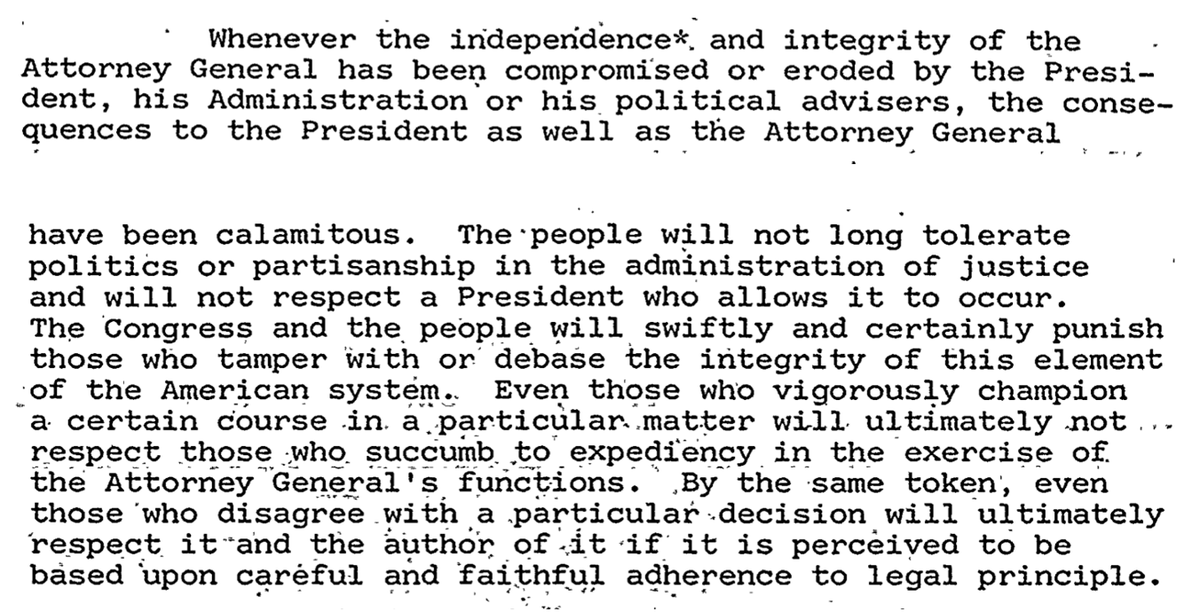
The memo’s warning has not always been heeded, to state the obvious. Whether Olson was right about what the people will tolerate, or what Congress will do… well, I guess we’re still finding out. More: /6
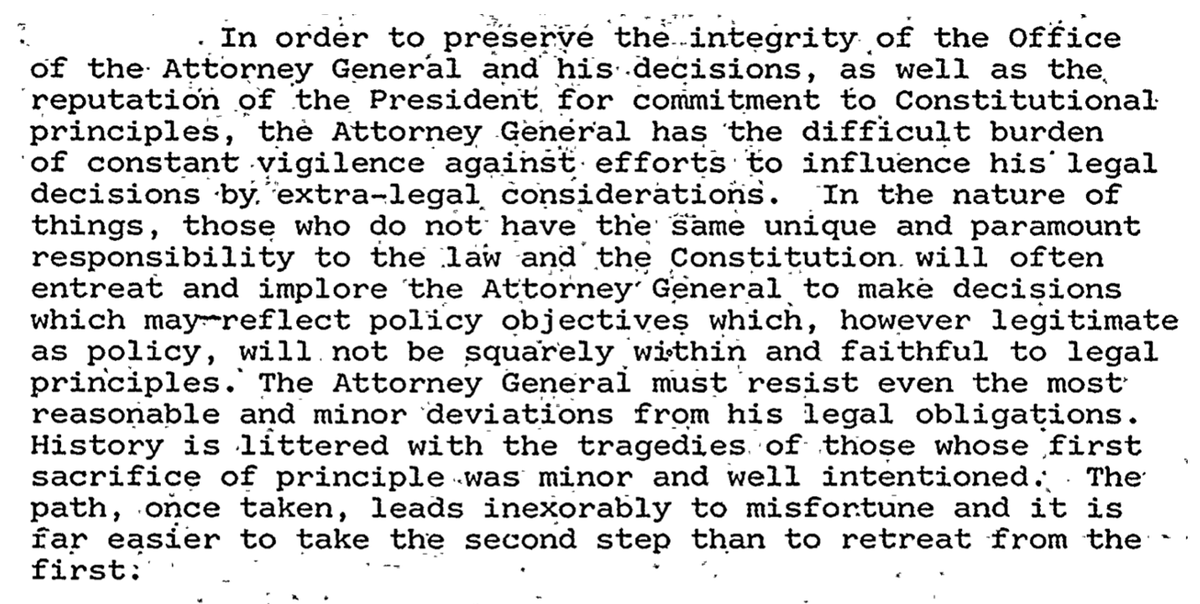
I don’t know why this eloquent defense of the rule of law has been withheld from the public for four decades. Seems like it should be a reading assignment in every civics class. Here’s how it closes: /7
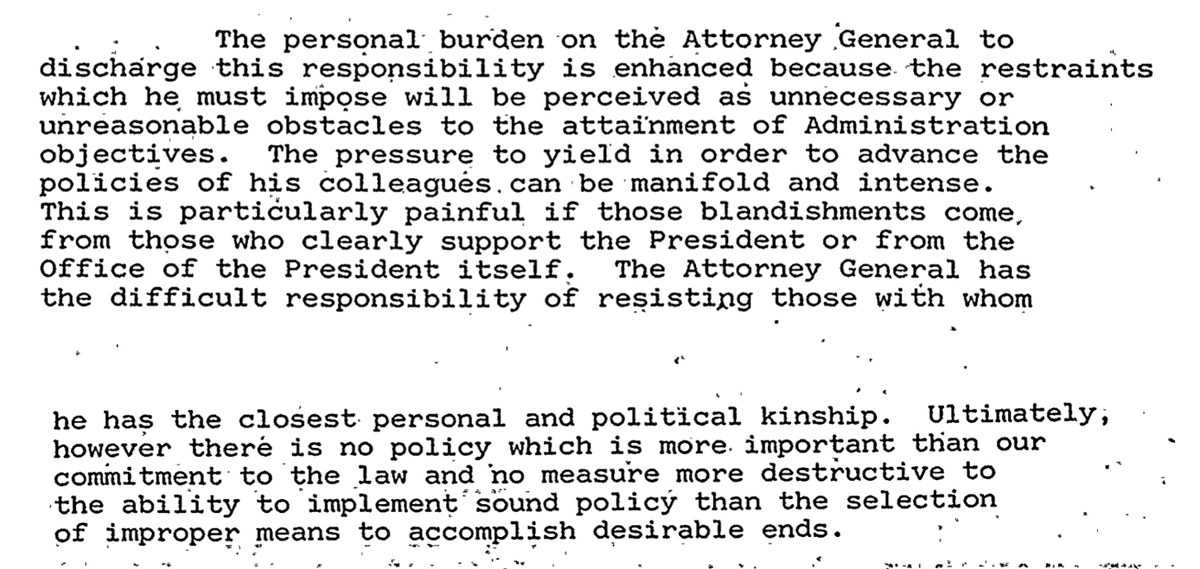
In sum: This is an extraordinary document, with important things to say about questions that have been especially salient over the past few years, and that are still salient now. It shouldn’t have been withheld for so long. /8
Disclosure: Ted Olson, who wrote the 1982 memo, is a @knightcolumbia board member. He didn’t have a role in the lawsuit mentioned above, and he hasn’t been involved in helping us review the memos we’ve obtained through the suit. /END
• • •
Missing some Tweet in this thread? You can try to
force a refresh

The large-scale deployment of armed officers to suppress peaceful protest on college campuses around the country is a shocking development. This response to peaceful protest is an assault on free speech–and it is also deeply reckless. (1/x)
Of course in some instances it may be necessary for universities to involve law enforcement where criminal conduct is at issue, but bringing armed officers into conflict with peaceful protesters creates situations that can escalate quickly and unpredictably. (2/x)
Political leaders and others demanding a militarized response to peaceful protest should consider more carefully the possible consequences of their demands. (3/x)
I don’t think Americans understand the extent to which the “foreign-intelligence exception” has hollowed out the Fourth Amendment. Most reporting about the current legislative debate is technical and incremental, and misses the forest for the trees. 1/
Here’s what's crucial: What was once an extremely narrow exception to ordinary constitutional principles has become, over time, a justification for warrantless surveillance on a staggering scale—not just of foreigners’ communications but of Americans’ communications too. 2/
With respect to Americans’ international communications, the Fourth Amendment has been made essentially a dead letter. 3/
Over the past months, @knightcolumbia has obtained hundreds of previously secret Office of Legal Counsel opinions on issues ranging from civil rights to national security. Yesterday we published a long-withheld set of opinions about the War Powers Act. /1 nytimes.com/2022/09/16/us/…
We were able to obtain these opinions by taking advantage of a 2016 law that limits the government’s ability to rely on the “deliberative process” privilege to withhold documents that are more than 25 years old. /2
The result has been an incredible wave of disclosure about an office that has been as secretive as it has been powerful. There is absolutely no precedent for the disclosure of OLC opinions on this scale. /3
This is actually a really hard set of questions. The government can't constitutionally coerce private publishers to censor speech. (There's a Supreme Court case about that.) But what should count as coercion is a really difficult question to answer.
For example, should the First Amendment be understood to prohibit a Senator from grilling a platform representative about the platform's editorial decisions? (@HawleyMO appears to think not.)
The Espionage Act is a much-abused law that casts a long shadow over press freedom in this country, and that impoverishes and distorts public debate about national security, foreign policy, and war. But is the EA being abused here, in Trump’s case? /1
I don’t think so. Even a narrower EA—an EA that accounted for the First Amendment interests of whistleblowers, news organizations, and the public—would apply to the facts here, if the facts are as they’re asserted to be. /2
Trump isn’t a would-be whistleblower or publisher who decided to disclose classified information to inform the public about grave government misconduct. There’s no plausible First Amendment defense of his (alleged) actions. /3



