Overall mortality in the UK in 2020, adjusted for the increase and age of the population, was the twelfth lowest since records began in 1942. The last time the mortality rate was this high was 2008. So how did the Government turn this into a civilisation-threatening ‘pandemic’? 

The answer is by changes to: 1) disease taxonomy, 2) the criteria for attributing a death to COVID-19, 3) identifying the underlying cause of death, 4) identifying infection with SARS-CoV-2, and 5) identifying the clinical presence of COVID-19.
architectsforsocialhousing.co.uk/2020/05/01/man…
architectsforsocialhousing.co.uk/2020/05/01/man…
Given these changes, how do we establish how many people actually died of COVID-19 in the UK in 2020, or, to the contrary, how many deaths from cancer, heart disease, dementia, diabetes, influenza and the other primary causes of death were incorrectly attributed to COVID-19 ?
NHS record show that, by 20 January 2021, 11 months into the ‘pandemic’, 61,414 of the 64,111 deaths in England attributed to COVID-19, 95% of the total, had at least one pre-existing health condition. Of the 2,697 deaths that hadn’t, just 486 were under 60 years of age.

Of those with at least one health condition, 26% had diabetes, 17% has dementia, 17% had kidney disease, 16% had pulmonary disease, 13% had heart disease, and 72% had some other health condition. But under changes to certification, all these deaths were attributed to COVID-19.

In addition to this systemic misdiagnosis, there are the reports of organisations monitoring health and mortality in the UK, which predict and record the deaths not attributed to COVID-19 resulting from the withdrawal of medical diagnosis, treatment and care under lockdown.
In March 2020, the NHS freed up 30,000 hospital beds for general and acute care, postponed all non-urgent operations, and discharged all hospital inpatients medically fit to leave. This resulted in up to 25,000 hospital patients being sent into care homes. england.nhs.uk/coronavirus/wp…
In April 2020, NHS England reported a total of 916,581 attendances at A&E that month, compared with 2,112,165 in the same month the previous year, a reduction of 57%; and 326,581 emergency admissions, compared with 535,226 in 2019, a reduction of 39%.
england.nhs.uk/statistics/sta…
england.nhs.uk/statistics/sta…
In June 2020, a survey of 128 care homes by the Alzheimer’s Society revealed that 79% reported a lack of social contact was causing a deterioration in the health and well-being of residents with dementia, and 75% reported GPs had been reluctant to visit.
theguardian.com/world/2020/jun…
theguardian.com/world/2020/jun…
In July 2020, the ONS reported 16,000 excess deaths in March-April not attributed to COVID-19 resulting from changes to emergency and social care under lockdown. It estimated a further 26,000 excess deaths in 2020, and 1,400 deaths from withdrawn care.
assets.publishing.service.gov.uk/government/upl…
assets.publishing.service.gov.uk/government/upl…
The same month, July 2020, the Nursing Times reported that, between March and May, deaths from diabetes at home and in care homes had risen by 47%.
nursingtimes.net/news/diabetes/…
nursingtimes.net/news/diabetes/…
In August 2020, the Institute of Cancer Research reported that a delay of 3 months across all 94,912 patients who were due to have surgery to remove their cancer over the course of the year would lead to an additional 4,755 deaths.
annalsofoncology.org/article/S0923-…
annalsofoncology.org/article/S0923-…
In September 2020, Cancer Research UK reported that, in 6 months of lockdown, cancer screening was cancelled for 3.2 million people. From April-August, 350,000 fewer people than normal in the UK were referred with suspected cancer symptoms.
news.cancerresearchuk.org/2020/09/11/wha…
news.cancerresearchuk.org/2020/09/11/wha…
In October 2020, the ONS reported that, between March and September, there were 2,095 excess deaths at home from dementia and Alzheimer’s disease above the 5-year average for England and Wales, an increase of 79.3%.
ons.gov.uk/peoplepopulati…
ons.gov.uk/peoplepopulati…
Also in October, the British Heart Foundation reported that, between March and September 2020, there were 26,000 excess deaths in private homes, representing an increase of 25.9% in deaths from heart disease in England and of 22.7% in Wales.
bhf.org.uk/what-we-do/new…
bhf.org.uk/what-we-do/new…
In November 2020, the BMJ reported that even a month’s delay in cancer surgery increases the risk of death by 6-13% across all common forms of cancer, with a 3-month delay increasing the risk by approximately 25%, rising to 44% for some treatments.
bmj.com/content/371/bm…
bmj.com/content/371/bm…
In December 2020, the NHS reported that, in the 10 months since March, attendances at A&E in hospitals in England were down by 6,887,183 from the same 10 months in 2019, a 32% reduction; and admissions to A&E were down by 1,052,807, a 20% reduction.
england.nhs.uk/statistics/sta…
england.nhs.uk/statistics/sta…
In January 2021, the Journal of the American College of Cardiology reported that, during the first UK lockdown, daily hospital admissions for heart attack and failure decreased by 54%, with a correlation between lockdown and reduction in medical care. jacc.org/doi/10.1016/j.…
In January 2021, the ONS published ‘Deaths registered by place of occurrence’, in which it records, in the accompanying dataset, deaths between 7 March, 2020 (week 11 of the year) and 1 January, 2021 (week 53).
ons.gov.uk/peoplepopulati…
ons.gov.uk/peoplepopulati…
This recorded 40,114 excess deaths occurring at home in the last 43 weeks of 2020, only 3,881 of which were attributed to COVID-19. There were also 26,202 excess deaths in care homes, 20,574 of which were swept under the COVID-19 carpet. That’s 41,861 unaccounted excess deaths.

In January 2021, the ONS published ‘Provisional leading causes of death for 2020’, showing the age-standardised mortality rate for leading causes of death in England between 1 January-31 December 2020, compared to the 5-year average between 2015 and 2019. ons.gov.uk/peoplepopulati…
Unsurprisingly, in a year in which 25,000 patients were evicted from hospital into care homes in which 70% of residents have dementia, yet were denied medical care and family visits under lockdown, deaths from these diseases were 4,132 above the 5-year average of 61,928 deaths.

Yet, incredibly, in a year in which cancer screening was cancelled for 3.2 million people in the 6 months up to September 2020, and surgery for 94,912 patients was postponed or cancelled, deaths from lung and throat cancer were down 1,537 from the 5-year average of 28,108 deaths.
Just as incredibly, although the British Heart Foundation reported that, from March-September 2020, deaths at home from heart disease were up 25.9% in England due to lockdown restrictions, deaths from heart disease in 2020 were 1,450 below the 5-year average of 53,429 deaths.
More incredibly, deaths from chronic lower respiratory diseases were down by 2,764 from the 5-year average of 29,681, a 9% reduction. And even more incredibly, deaths from cerebrovascular diseases were down by 2,263 deaths from the 5-year average of 29,943, a fall of 13.2%.
Most incredibly of all, there were 7,313 fewer deaths from influenza and pneumonia in 2020 than the 5-year average of 25,969 deaths, a 28% reduction. These figures are not credible as accurate records of the effects of withdrawing healthcare to 60 million people for 10 months.
Given the criteria for attributing a death to COVID-19, what is credible is that these thousands of ‘lost’ deaths, and the thousands more caused by lockdown, have been misdiagnosed and incorrectly recorded as ‘COVID-deaths’. But how do we corroborate this thesis with facts?
On 14 January, Public Health England (PHE) published its analysis of deaths between 21 March, 2020 and 1 January, 2021. These show 7,511 excess deaths in which other health conditions were listed recorded as ‘COVID-19 deaths’. fingertips.phe.org.uk/static-reports…
Deaths from causes other than COVID-19 numbered 11,013 over the 5-year average; yet 5,057 of these were listed as ‘COVID-deaths’. Even when deaths from the underlying cause were below the 5-year average, 2,454 deaths were still registered as ‘COVID-19 deaths’.
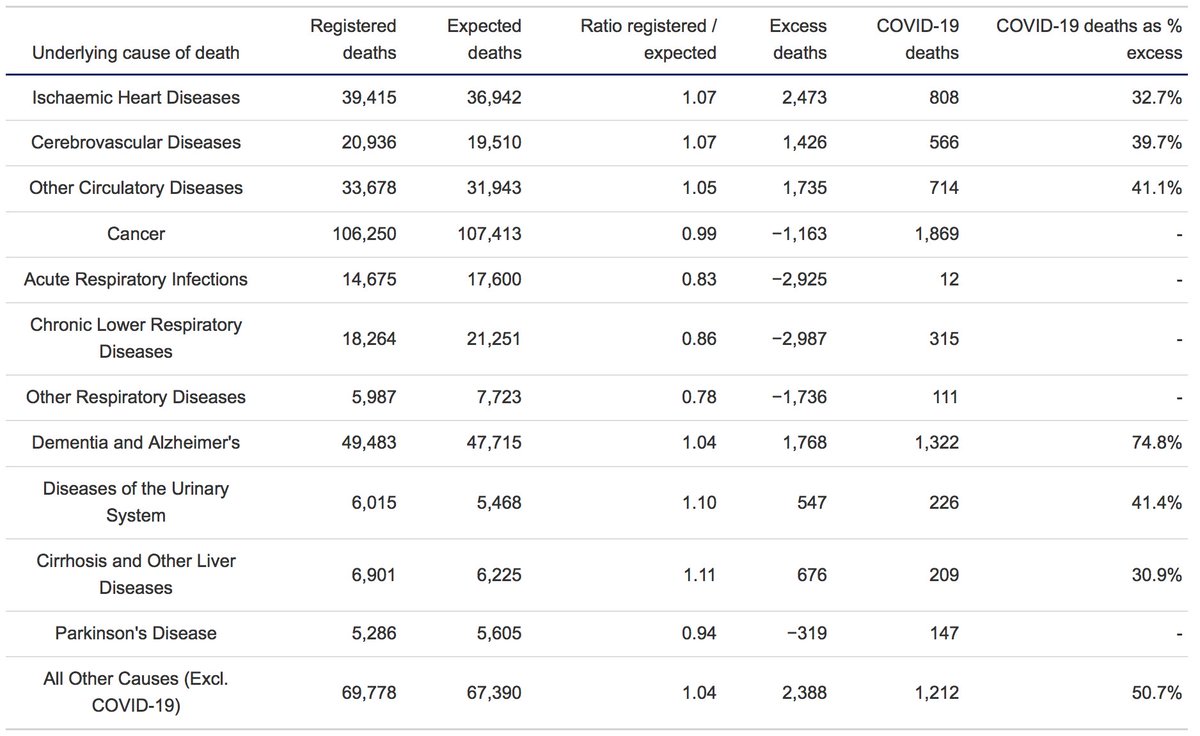
75% of excess deaths in which the underlying cause was dementia were recorded as COVID-19 deaths; 41% from urinary diseases; 40% from cerebrovascular diseases; 41% from other circulatory diseases; 33% from heart diseases; 31% from liver diseases, and 50% from all other causes.
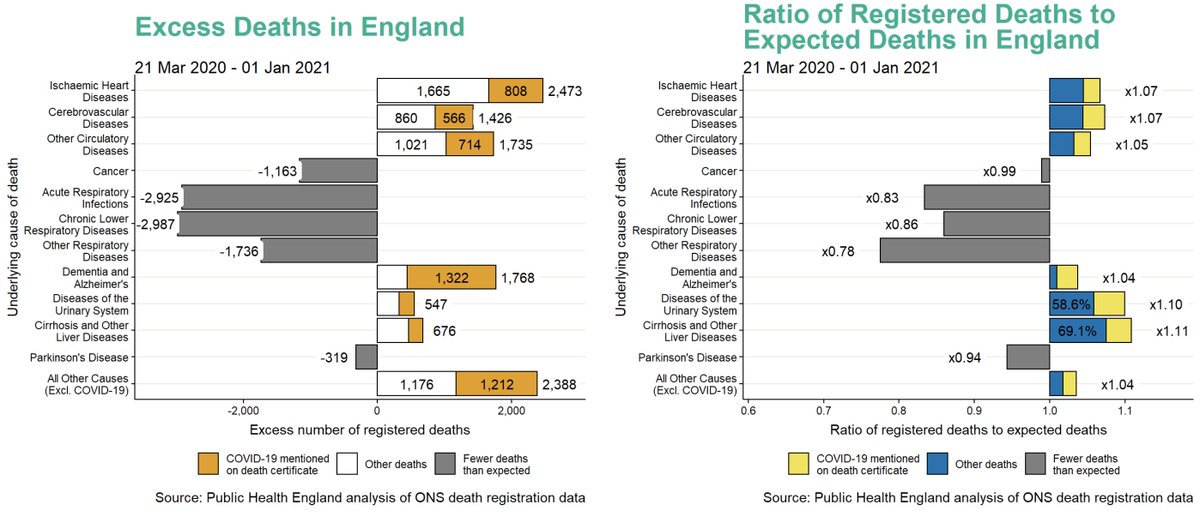
If COVID-19 had been listed as the ‘underlying cause’ on any of these death certificates, they would all have been recorded as COVID-19 deaths. What these figures don’t show is how many deaths from these diseases not in excess of the 5-year average were attributed to COVID-19.
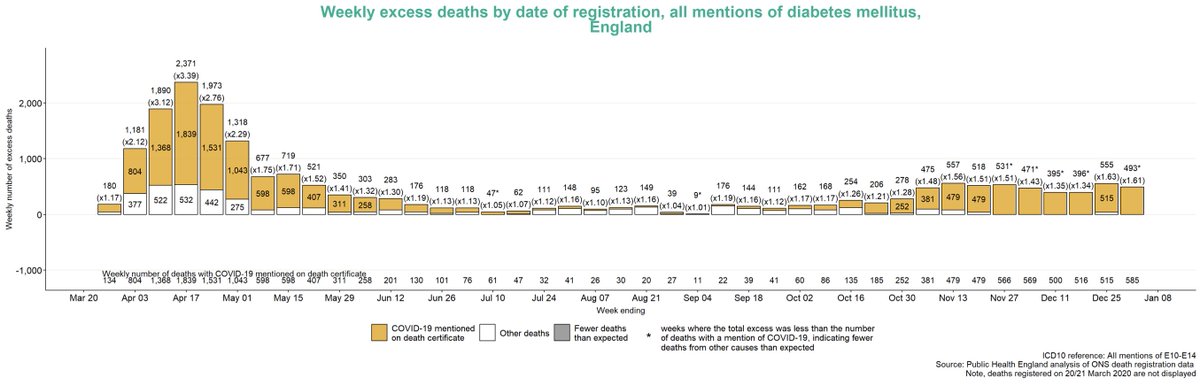
However, PHE additionally revealed that, between 21 March, 2020 and 1 January, 2021, there were 18,851 excess deaths in England in which diabetes was mentioned on the death certificate, of which 15,589 were recorded as COVID-19 deaths, nearly 83% of the total.
There were also 22,081 excess deaths attributed to COVID-19 in which dementia and Alzheimer’s disease were mentioned on the death certificate. That’s the more than the 20,574 deaths in care homes that were attributed to COVID-19 on nothing more than the suspicion of the managers.

Finally, there were an astonishing 35,133 excess deaths attributed to COVID-19 in which acute respiratory infections were mentioned on the death certificate. If you’re wondering, as many people have been, where all the deaths from flu disappeared to in 2020, here’s your answer.

The 76,065 excess deaths in which 1 of these 3 diseases appeared on the death certificate equal the 76,553 deaths in England attributed to COVID-19 in 2020. So why, given the fatality of these conditions in other years, was COVID-19 recorded as the cause in so many in 2020?
The most logical answer is the changes to disease taxonomy, protocol on completing death certificates, criteria for attributing a death to COVID-19, the false positives produced by the RT-PCR testing programme, and the equation of such a positives with symptoms of COVID-19.
It’s not possible for deaths consequent upon changes to the NHS in 2020 not to show up in the overall mortality. Yet if we deduct the 81,653 deaths attributed to COVID-19 from the 608,002 deaths in 2020, we’re left with 526,349 deaths from all other causes.blog.ons.gov.uk/2021/01/12/cou…
That’s 12,734 fewer than the previous 5-year average of 539,083 deaths, when mortality rates between 2015 and 2019 were at historically low levels. ons.gov.uk/peoplepopulati…
Even with nearly 5 million fewer diagnoses for cancer, withdrawn medical care and treatment, delayed and cancelled operations, 8,000 fewer hospital beds for general and acute care due to social distancing, the medical staff quarantined on the basis of false positives . . .
7 million people too terrorised to attend hospital, more than 1 million people who didn’t receive emergency care, and the assault on the physical and mental health of the population, the number of deaths in 2020 other than those attributed to COVID-19 were lower than since 2016.
So where have all those excess deaths gone? Again, the only answer that makes sense of these otherwise inexplicable figures is that they have been misdiagnosed or inaccurately recorded as COVID-19 deaths, and that the only epidemic we suffered in 2020 was an epidemic of tests.
Between 21 March 2020 and 1 January 2021 there were 376,668 deaths in England attributed to causes other than COVID-19. If even 20% of them were misdiagnosed as COVID-19, the 76,553 deaths in England officially attributed to COVID-19 last year would vanish.
84% of the deaths attributed to COVID-19 in 2020, over 68,000 deceased, were of people aged 70 years and over. 61% were aged 80 years and over, the average life expectancy in the UK. 90% had at least one pre-existing health condition, with most having two.
ons.gov.uk/peoplepopulati…
ons.gov.uk/peoplepopulati…
To put these figures into context, in 2020 there were 9,189,000 people 70 years of age or over in the UK, and 412,408 of them, 4.48%, died of causes not attributed to COVID-19. 0.7% of them officially died of COVID-19.
statista.com/statistics/749…
statista.com/statistics/749…
It wouldn’t take much to push a population of such elderly and frail people into a life-threatening situation. Deny them human contact on pain of arrest and fines. Withdraw medical treatment. Quarantine their carers. Terrorise them with propaganda about a killer disease.
Order them to stay at home and avoid contact with other people like the plague. Tell them hospitals standing empty are being overwhelmed. Turn medical centres into places to fear, the breeding grounds of a deadly new disease. That should be enough. It was more than enough.
Then change the medical protocol and criteria for identifying and recording the cause of death, and use a medically meaningless test to turn traces of a virus amplified over a trillion times into proof of infection and cause of death. This is how the ‘pandemic’ was manufactured.
What these figures show is that lockdown restrictions, far from halting the spread of a respiratory virus, were responsible for a huge percentage of the excess deaths in 2020 that pushed the mortality rate higher than it had been for a dozen years.
The evidence indicates that at least half the 80,000 deaths attributed to COVID-19 in 2020 were caused by lockdown restrictions. But that’s a conservative estimate, and doesn’t include the more than 20,000 excess deaths in care homes swept under the COVID-19 carpet.
If you’d like to read about this evidene in greater detail, this is the article from which this information is taken, which I published in January 2021.
architectsforsocialhousing.co.uk/2021/01/27/lie…
architectsforsocialhousing.co.uk/2021/01/27/lie…
And if you’re asking yourself, as so many are, why the UK state went to such lengths to manufacture a threat to public health that never existed and in doing so killed tens of thousands of UK citizens, you may be interested in my book, The Road to Fascism.
architectsforsocialhousing.co.uk/2022/09/28/the…
architectsforsocialhousing.co.uk/2022/09/28/the…
• • •
Missing some Tweet in this thread? You can try to
force a refresh