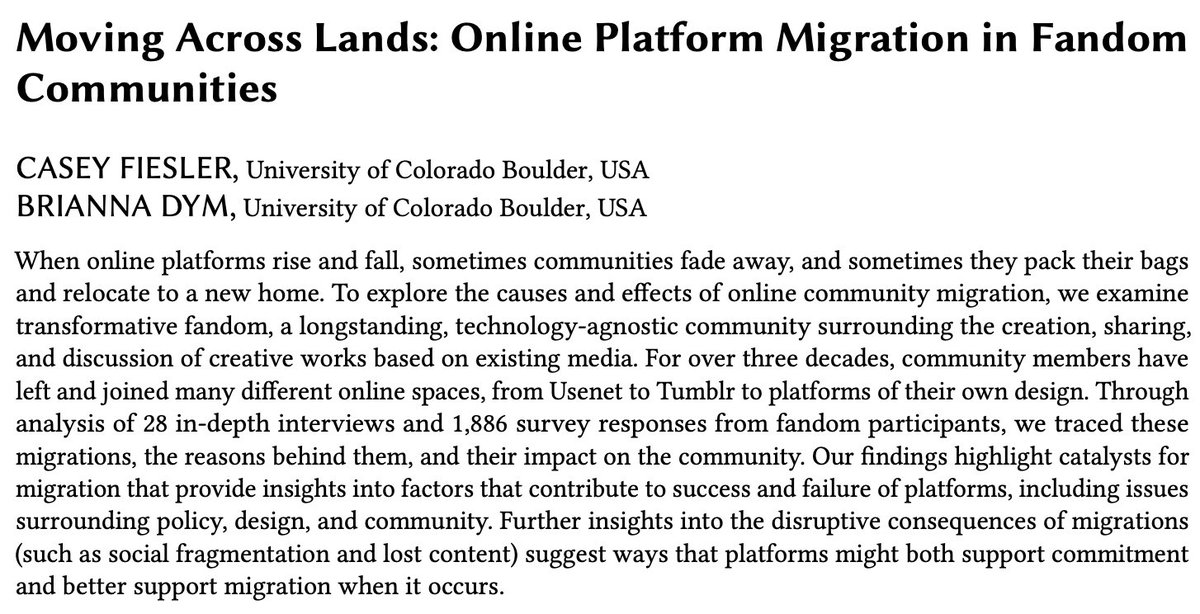
Two years ago we published a paper about online community migration, and I think the findings and recommendations are relevant to what I'm seeing right now on Twitter. Especially the barriers and challenges to relocating (and maybe some solutions). 🧵cmci.colorado.edu/~cafi5706/CSCW… 
Here are some bad things that are likely to happen when people pack their bags and leave a platform:
(1) content loss (which *might* be less of a big deal on a social platform like Twitter compared to a content creation platform like YouTube)
(1) content loss (which *might* be less of a big deal on a social platform like Twitter compared to a content creation platform like YouTube)
(2) fragmented communities - when some people move and some people don’t, the community necessarily splinters, or even “disintegrates” all together
(3) social changes - culture and norms of a community will inevitably shift in reaction to the broader culture of the new platform
(3) social changes - culture and norms of a community will inevitably shift in reaction to the broader culture of the new platform
(4) losing some people altogether, and any learning curve for a new platform can mean that this especially impacts people who are less tech-savvy (this is what I'm particularly worried about re: mastodon in particular)
One thing we are going to see if communities start leaving Twitter en masse is a "game of chicken." In the critical early stage of network effects for migration, individuals have to coordinate with each other to encourage contribution on the new platform. This is *hard*.
In addition to a compelling reason to leave, there HAS to be a viable alternative option. Commitment to a community can be a pull factor to bring people to a new platform, but also a barrier if there isn't critical mass on the new platform, making the cost of leaving too high.
Also "viable" does NOT just mean technically. The new platform has to be both socially appealing (e.g., reflect the values of the community) and also not incur social costs. For the most part a migration can only be successful if enough people go to the same place at once.
OK so let's say a community (e.g., academic twitter, black twitter) does decide to relocate. We offered some suggestions for ways new platforms might take advantage of attrition from another platform, and also ways the relocation can be less painful for the community.

First, a thing that WILL happen: a confusing, arduous period of overlap. Everyone hedging their bets. Maybe still posting on Twitter while trying out some new platforms. The obvious thing that helps here is cross-posting functionality.
I've already seen cross-posting happening between Twitter and Mastodon (e.g. moa.party ). But it's also important that any connection between platforms is carefully designed and sensitive to privacy and identity concerns users might have.
Also: LOSS PREVENTION. A significant barrier to migration is fear of leaving something behind. Unfortunately also a suggested strategy for encouraging commitment to a platform is to make it difficult for members to export or transfer assets...
But regardless, platforms should consider potential users who are not joining from nothing, but instead are bringing packed bags--supporting importing content and even social structures (e.g. following list). (Just make sure users have total control over whether to use this.)
Even something lightweight can be helpful: a welcome message and support for finding other migrants. And anything that provides some familiarity. Helping with learning (e.g. "a guide to how this platform is similar to and different from twitter").
Also it's good to remember that resettlement of an entire community brings up the challenge of not just socializing newcomers, but also socializing the existing community around those newcomers--which can be a recipe for norm clashes.
Also for the record: At the moment I am not planning on leaving Twitter. I'd like to see what happens and how things actually change. But I am open to cross-posting if my communities start to move elsewhere.
Also if you are interested in learning more about this platform migration research (without reading the paper), especially in the context of fandom history, check out this video essay! I'm really proud of it. :)
aaaaaand an example of cultivating familiarity to aid resettlement, the Mastodon app interface looks exactly like Twitter

• • •
Missing some Tweet in this thread? You can try to
force a refresh