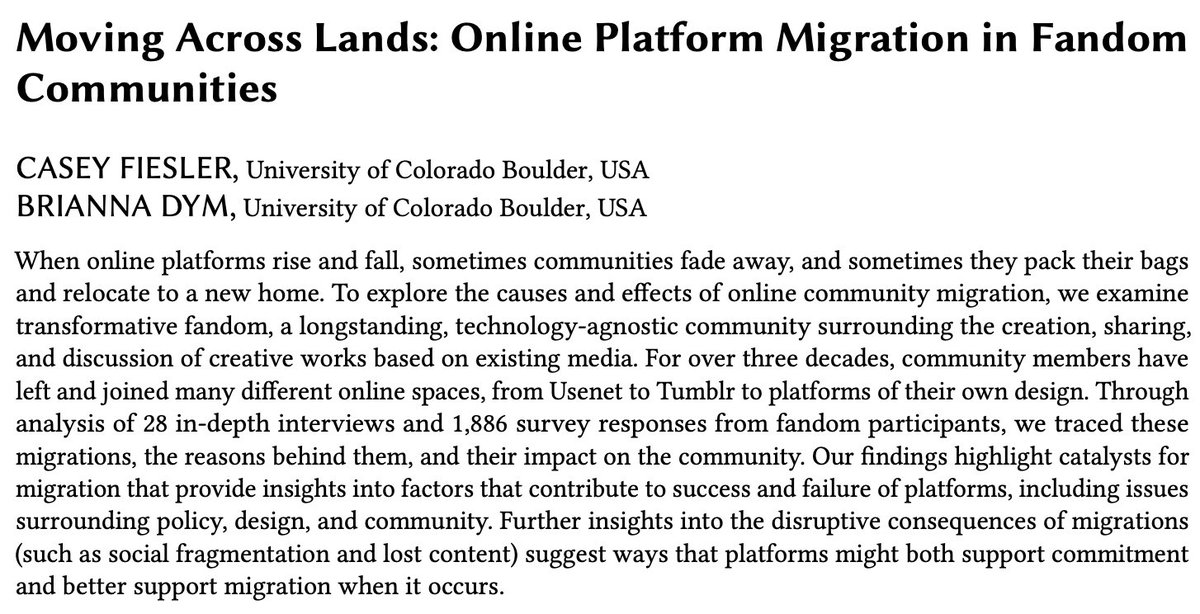
I'm playtesting #Mastodon explainers. Let me know if this makes sense please. :)
Imagine if your gmail account meant you could ONLY email gmail users. That would be silly! Especially if you don't want Google to have all your data. So why are social networks like that? (1/?)
Imagine if your gmail account meant you could ONLY email gmail users. That would be silly! Especially if you don't want Google to have all your data. So why are social networks like that? (1/?)
Mastodon isn't a platform- it's a protocol for anyone to run a platform that connects to others. So e.g., I'm on an "instance" set up by a prof friend, but my feed (like your Facebook feed or your Twitter feed) includes content from anyone I follow across any instance. (2/?)
Because if Facebook or Twitter go out of business tomorrow, or you decided to leave, you'd lose everything. But imagine instead if you decided to leave Twitter and go to Facebook instead, you could take your network with you--and also still talk to anyone still on Twitter. (3/?)
Or another option is you and your friends can start your own social network where you can create your own policies while still interacting with anyone on other platforms. Your data and your network aren't owned by a giant company - it can be owned by someone you trust. (4/?)
A lot of folks are getting hung up on choosing an instance. One thing to know is that even though you do have to pick one to start (because you need somewhere to be!) it doesn't matter as much as you might think because you can follow whoever you want. (5/?)
There seems to be a common misconception of Mastodon instances as "silos"--because I'm on the "hci academics" instance those are the only people I'm talking to. Not true! I see people from dozens of instances on my feeds and don't even need to know what instance they're on. (6/?)
There are actually different Mastodon feeds you can view--one that is based on the people you follow across any instance, one based on people in your instance, and one based on folks across lots of instances who are engaged with by people you engage with. (7/?) 

It's also not hard to switch Mastodon instances, and you can take your followers with you, so if you decide you made the wrong choice or you find a better one later, it might not be a big deal. So I recommend just choosing one (even at random) to try it out, to start. (8/?)
Think of a Mastodon instance as like, an after school club or marching band or something at your school. You can't control who's in it, but you do know when you choose to join the general types of people who are in it, but... (9/?)
Even though you can still be friends with whoever you want at your school, you know you'll see the folks in your club more than random people you don't know, and you're also more likely to meet people who are friends with people in your club. (10/?)
But also if you quit the club and join another club, you don't have to stop being friends with them, and you certainly don't have to stop being friends with everyone else at the school. Because like, quitting a club shouldn't dissolve all your friendships. :) (11/?)
This is a great explainer on picking an instance, using apps, the nuts and bolts of Mastodon (and also addressing some common misconceptions): fedi.tips/how-to-use-mas… (12/13)
To be clear: I am NOT saying that Mastodon is a solution to all our social media problems. I actually think that it creates a whole new slew of problems and some of them are going to be big ones.
But I think it's very good to be exploring other ways of doing things. (13/13? ☺️)
But I think it's very good to be exploring other ways of doing things. (13/13? ☺️)
• • •
Missing some Tweet in this thread? You can try to
force a refresh