BOWTIED VITAMINS GUIDE TO BOOSTING IMMUNITY
Winter is coming.
Here’s how to optimize your supplement stack to boost your immune system & stop getting sick. 🧵👇
#vitamins #supplements #health #wellness #biohacking #fitness #nutrition
Winter is coming.
Here’s how to optimize your supplement stack to boost your immune system & stop getting sick. 🧵👇
#vitamins #supplements #health #wellness #biohacking #fitness #nutrition
Taking care of your immune system means eating healthy, getting enough quality sleep, and managing daily stress.
We can also use an immune boosting protocol to give us that extra edge against infections.
We can also use an immune boosting protocol to give us that extra edge against infections.

The best immune support supplements provide targeted support to help strengthen immune function, protect cells & boost energy levels.
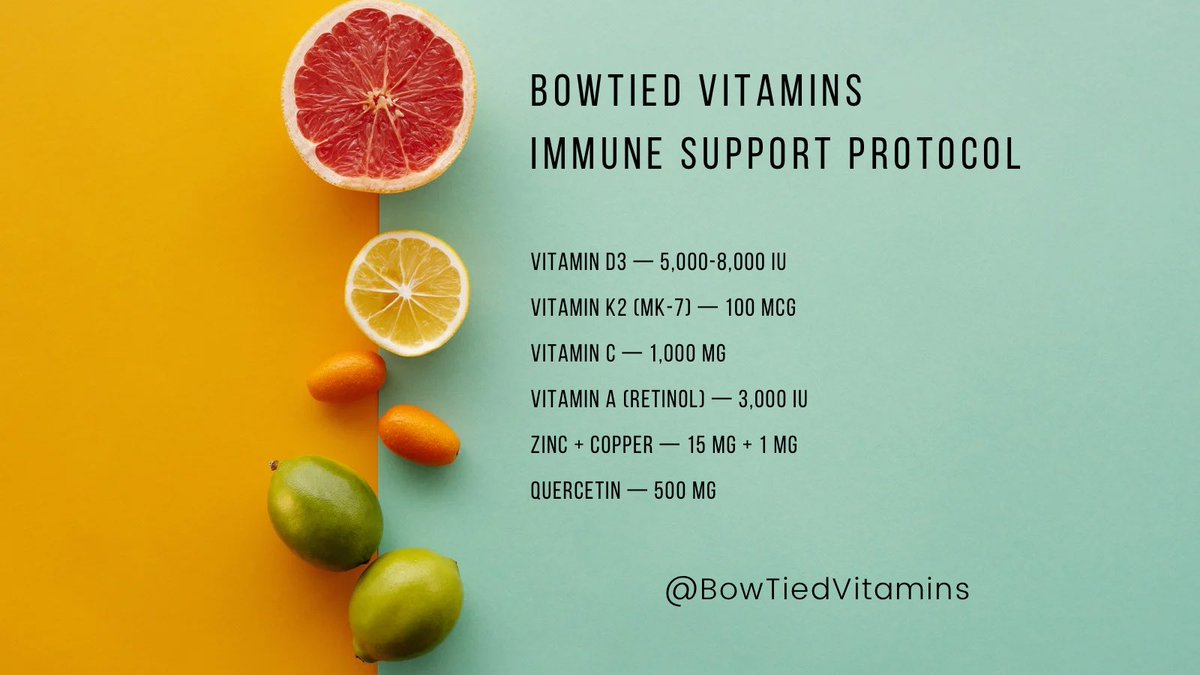
To do this, we’re going to stack:
Vitamin D
Vitamin K
Vitamin C
Vitamin A
Zinc + copper
Quercetin
Let’s dig in 👇👇👇
To do this, we’re going to stack:
Vitamin D
Vitamin K
Vitamin C
Vitamin A
Zinc + copper
Quercetin
Let’s dig in 👇👇👇
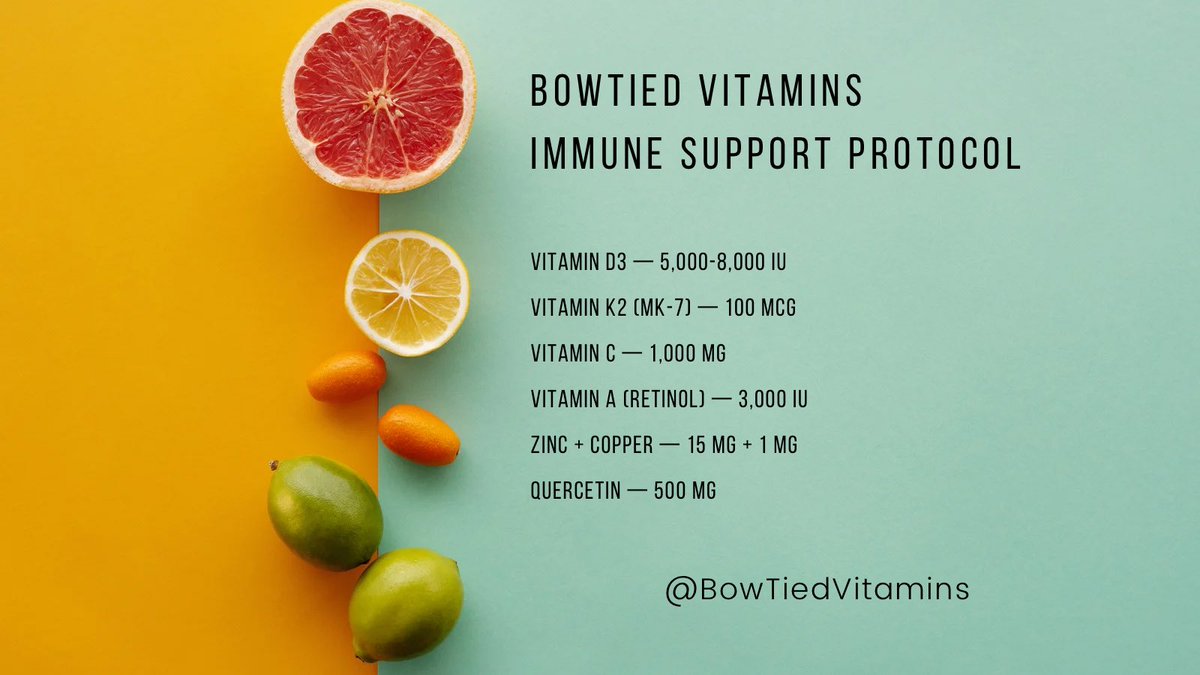
1. Vitamin D3 — 5,000-10,000 IU
Vitamin D is 1 of 24 micronutrients critical for human survival & the effectiveness of vitamin D depends on maintaining blood levels within the proper range (70-100 ng/ml).
Vitamin D is 1 of 24 micronutrients critical for human survival & the effectiveness of vitamin D depends on maintaining blood levels within the proper range (70-100 ng/ml).
Vitamin D enhances the function of immune cells, including T cells & macrophages, as well as suppresses inflammation associated with overactive cytokines.
Low levels of D are associated with increased susceptibility to infection, disease & immune-related disorders…
Low levels of D are associated with increased susceptibility to infection, disease & immune-related disorders…
Especially respiratory diseases such as tuberculosis, asthma, COPD & viral & bacterial respiratory infections. D deficiency has also been linked to decreased lung function.
Up to 75% of U.S. adults & teens suffer from D deficiency.
Up to 75% of U.S. adults & teens suffer from D deficiency.
Most people spend too much time inside, and when they do go outside, they cover their bodies & wear sunscreen, which blocks the body’s ability to absorb UVB light.
In norther latitudes, between November & March, the angle of the sun prevents the majority of UVB light…
In norther latitudes, between November & March, the angle of the sun prevents the majority of UVB light…
From getting through the atmosphere, making it physically impossible to produce vitamin D via sun exposure.
A recent review showed that supplementing with vitamin D decreased the risk of acute respiratory infections in both those who had deficient & adequate levels of D.
A recent review showed that supplementing with vitamin D decreased the risk of acute respiratory infections in both those who had deficient & adequate levels of D.
You should take 1,000 IU per 25 lbs of body weight in order to get your blood levels above 70 ng/ml.
This is the best: amzn.to/3zXaJTA
This is the best: amzn.to/3zXaJTA
2. Vitamin K2 (MK-7) — 100 mcg
Vitamins D & K work synergistically to properly regulate calcium metabolism. Higher D levels increase calcium absorption & K2 prevents calcium from being deposited in soft tissue like arteries & lungs instead of bones.
Vitamins D & K work synergistically to properly regulate calcium metabolism. Higher D levels increase calcium absorption & K2 prevents calcium from being deposited in soft tissue like arteries & lungs instead of bones.
Studies conducted in the last 2 years show that vitamin K is a primary modulator of inflammation & that K deficiency leads to worse Covid outcomes.
You want to get at least 100 mcg of the MK-7 form of K2. I like this one to cover all the K bases: amzn.to/3zUUera
You want to get at least 100 mcg of the MK-7 form of K2. I like this one to cover all the K bases: amzn.to/3zUUera
3. Vitamin C — 1,000 mg
C is a powerful antioxidant that can strengthen the immune system. It helps stimulate the production of white blood cell lymphocytes & phagocytes & protects them from damage by free radicals. Studies show that C also boosts the strength of T cells.
C is a powerful antioxidant that can strengthen the immune system. It helps stimulate the production of white blood cell lymphocytes & phagocytes & protects them from damage by free radicals. Studies show that C also boosts the strength of T cells.
Low vitamin C levels have repeatedly been linked to poor health outcomes.
Taking vitamin C supplements prior to a cold has been shown to reduce duration & severity.
There are some studies that suggest liposomal technology improves vitamin C absorption: amzn.to/3Tnq4DR
Taking vitamin C supplements prior to a cold has been shown to reduce duration & severity.
There are some studies that suggest liposomal technology improves vitamin C absorption: amzn.to/3Tnq4DR
4. Vitamin A (retinol) — 3,000 IU
There are 2 forms of vitamin A: retinol & carotenoids like beta-carotene. The latter is found in fruits & vegetables & needs to be converted into retinal in the body, which is a very inefficient process.
There are 2 forms of vitamin A: retinol & carotenoids like beta-carotene. The latter is found in fruits & vegetables & needs to be converted into retinal in the body, which is a very inefficient process.
Preformed vitamin A (retinol) occurs exclusively in animal products & is the most bioavailable form of A.
A is involved in the creation of B & T immune cells. A deficiency leads to increased levels of pro-inflammatory molecules that diminish immune system response & function.
A is involved in the creation of B & T immune cells. A deficiency leads to increased levels of pro-inflammatory molecules that diminish immune system response & function.
25% of Americans consume less than half the RDA of vitamin A.
I really like this one: amzn.to/3t92i3I
I really like this one: amzn.to/3t92i3I
5. Zinc + copper — 15 mg + 1 mg
Zinc acts as a gatekeeper for immune function: it helps regulate the signal between the body’s immune tolerance & defense systems, i.e. when to fight infection & when to back down.
Zinc acts as a gatekeeper for immune function: it helps regulate the signal between the body’s immune tolerance & defense systems, i.e. when to fight infection & when to back down.
Zinc is also a potent antiviral helper & not only modulates cell-mediated immunity but also has its own antioxidant & anti-inflammatory properties.
It is essential to the development of T cells & boosts the activity of both T & Natural Killer cells.
It is essential to the development of T cells & boosts the activity of both T & Natural Killer cells.
You need to have a proper balance of zinc & copper so make sure you are supplementing both in a 15:1 ratio. Copper deficiency can lead to muscle weakness, neurological problems & anemia.
amzn.to/3Ehkv5E
amzn.to/3Ehkv5E
6. Quercetin — 500 mg
Quercetin is a flavonoid with powerful antioxidant properties that plays an important role in fighting inflammation & boosting immunity.
It can help prevent the occurrence of upper respiratory infections & may stimulate immune cells like lymphocytes.
Quercetin is a flavonoid with powerful antioxidant properties that plays an important role in fighting inflammation & boosting immunity.
It can help prevent the occurrence of upper respiratory infections & may stimulate immune cells like lymphocytes.
Preliminary research also suggests that quercetin has the ability to inhibit viral replication at various stages.
Quercetin is the cheat code to this immunity stack.
It is a zinc ionophore, which means it helps move zinc into cells where it can help mitigate viral replication.
Quercetin is the cheat code to this immunity stack.
It is a zinc ionophore, which means it helps move zinc into cells where it can help mitigate viral replication.
Zinc is largely insoluble & has trouble getting through the cell walls on its own.
Quercetin also aids in vitamin C absorption & assists in recycling C, extending C’s ability to donate electrons & extinguish oxidation.
Quercetin also aids in vitamin C absorption & assists in recycling C, extending C’s ability to donate electrons & extinguish oxidation.
Quercetin itself is difficult for your body to absorb. Studies suggest that taking the Quercetin Phytosome form increases plasma levels up to 20x compared to standard quercetin:
amzn.to/3zUyaNh
amzn.to/3zUyaNh
As winter roles around, I suggest everyone consider adding this immunity protocol to your supplement routine.
I’ve personally used this exact stack to dramatically decrease the incidence, severity & length of illness.
#vitamins #supplements #health #wellness #biohacking
I’ve personally used this exact stack to dramatically decrease the incidence, severity & length of illness.
#vitamins #supplements #health #wellness #biohacking
If you found this thread helpful, please like and retweet the first tweet to help spread the word.
And don’t forget to smash that ‘follow’ button for more helpful tips on how to optimize your health!
And don’t forget to smash that ‘follow’ button for more helpful tips on how to optimize your health!
https://twitter.com/BowTiedVitamins/status/1590373243407732737
• • •
Missing some Tweet in this thread? You can try to
force a refresh