came across a discussion & there's a misconception between 'Trading For A Living' and being a 'Full-Time Trader'
TFAL is the ultimate grail. it is extremely difficult to achieve even being profitable to a 7-fig trading a/c for 8yrs (I'm in #fintwit for 12 yrs 😅)
let me explain
This thread is certainly not to dash your trading dream. Trading can certainly become a full-time career option.
Opportunities and accessibility in this era to trade execution, even sophisticated data that aids your edge, is dwindling it to a low barrier-to-entry profession
1/
It is life changing decision to halt yr ongoing career/biz to even attempting to trade full-time. this decision will affect;
i) yr career opportunities (there's time loss & progression in yr skills),
ii) yr family (no certainty in mthly income is a fact),
iii) your lifestyle
2/
When u made this decision as a career, u need measurable profitability of yr trading skill/strategy Qtr after Qtr, or Yr after Yr. I speak with 14 yrs experience, i've not witnessed anyone that is profitable every single month. (not day-trader)
Drawdown is always ahead of you
3/
Certainty in profitability require yr historical trades to pass quantifiable & measurable profitability metrics generated from yr realized trades. anything <300 trades, <24 mths period is random & will not give u mental peace during drawdown.
You need assurance on yr edge.
4/
Min of 300 trades & min 24 mths period = yr strategy needs to generate sufficient opportunities for law of large number
it is achievable even for positional trader. I'm certain of generating min. of 10 actionable swing ideas, stalk 30 impending swing ideas at any day in USmkt
5/
Do not backed on back-testing to find yr trading edge. There's no shortcut. U need to trade real money to undergo human errors, brokerage cost & dividends, spread widening on post-earnings open, slippages in turnaround & slippages that stop u out ahead of your sell stop order
6/
To give u an idea, slippages in turnaround alone in my 9 years with 4 diff brokers cost me almost 6-7% of my current equity. my risk is only 0.15%-0.25% per trade on current equity.
this is very substantial. back-testing is skewed and distorted, not reliable to prove yr edge
7/
Measurable metrics that can u could depend on are;
i) Trading Expectancy - a calculation that shows what the typical profit is for each trade placed
ii) Risk of Ruin - probability that money will be lost to the point where it is no longer possible to recover the losses 8/
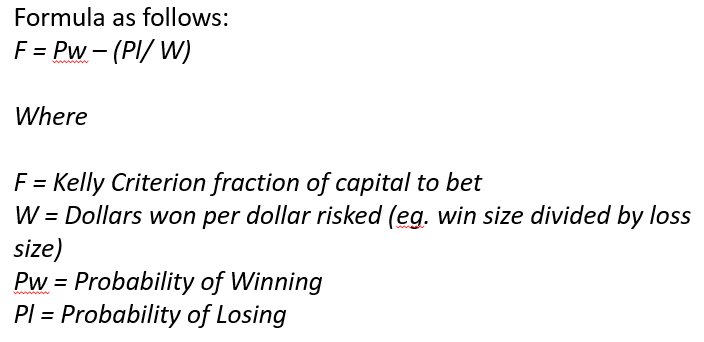
iii) Further risk optimization with Kelly Criterion - optimization of your risk appetite per trade based on the performance of the last 300 trades you initiated
9/
Only until u grind out the above experience and numbers to be assured of staying Full-Time with a proven edge, u will understand longevity in staying afloat in the trading career is not just solely dependent on chart analysis, tracking company earnings or risk management,
/10
it is also about data mining of yr own trading coupled with the real brokerage activities I mentioned above,
all this data is solely unique to u. and it is also some part of the reason why the same strategy can have vastly different performance from different traders.
/11
all the above is only sufficient to even consider full time until;
i) u have a sizable trading account that u could afford a quarter/annual withdrawal rate that is sufficient to cover u & yr fam expenses, mortgages but minimal enough to allow yr account to continue compound
/12
ii) u hv a side income to supplement living expenses to reach the goal of this lifestyle while nurturing yr trading skill. even via YT income, subscription etc. there are very good legit materials out there fm traders @PradeepBonde @TraderLion_ @PrimeTrading_ @JohnMuchow
/13
iii) u have an inheritance to fall back on, or spouse is supplementing income to offset the month-month measurable expense in exchange for your obligation as a stay home dad for kids/chores etc. this is real, no shame about it if things work out well for all parties
/14
as i have mentioned at the start, I consider myself a full-time trader and it is difficult to trade for a living.
this full-time career starts at a stage when i already had an ongoing mortgage and property expense of almost 3.5k mthly + 1.5k fixed variable expense.
/15
my equity of near 300k from my trading a/c in 2015-2016 will not be able to afford an annual withdrawal of 60k/y (that is a whooping 20% withdrawal rate. ideal is barely <10% of annualised return. with an annualised return of 30%, I could only afford a withdrawal of 9k/y
/16
to re-emphasis, annualised return is merely a geometric avg of %gain generated each year over a given time period. it is only when the variable of 'time' get stretched longer, the % return can become a reliable projection.
/17
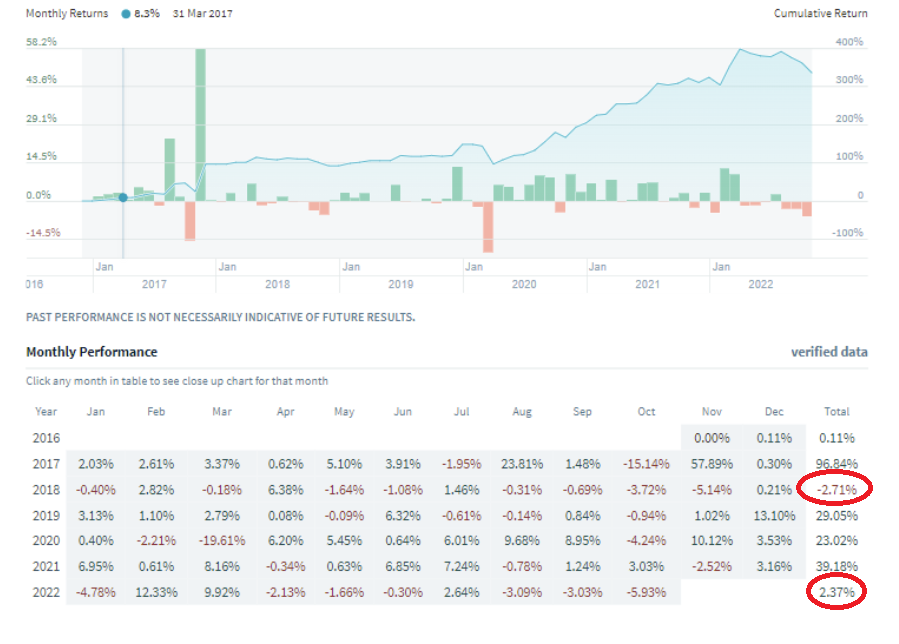
my performance in '18 and '20 is definitely a great example why most FT trader cannot depend on a % rate of withdrawal to sustain the annual expense.
again, unless u begin a trading a/c that is sizable at 7-fig sum where absolute $ for a mere % is sufficient & substantial
/18
even legendary trader like Stanley Druckenmiller, with a annualised return at 30%+/yr for 30 straight years (without a losing yr) may not have self-rewarded any withdrawal at the beginning years of his career to maintain such astronomical return over the long stretch
/19
so for my own case, I needed to create a series of income stream to supplement this career path.
I am fortunate to already have a strong industry following back in my own country (singapore), to be given opportunity as a speaker to share in financial spaces & events
/20

income creation includes; paid speaking events, referral fees for brokerage account opening, continual yield based investments (etc REITs),
also got into startups with my professional skills (boutique property development biz, land feasibility studies consultancy)
/21
all of the above is for survival needs, to put food on the table & have shelter over my head while engaging in this FT trading career
trading will never give u income visibility. the gains are meant to be compounded, or cushion a potential drawdown that is always ahead of u
/22
only over time that u continue to diligently save from your active side hustles, or get substantially rewarded from yr longer term investments (profitable sale of real estate), then u transit yrself to a stage of translating the 'active' income sources into 'passive' income
/23
at this stage, I have transited all the active income sources into 10 properties on (9 on mortgage but with triple nett positive rental) to generate that required income to offset the necessary life expenses, continual investment in REITs to further grind the annual $ yield.
/24
it is only when u are not reliant on any forms of active income/hustle to support yr expense, u can have all the time in any given day to fully focus on living as a full time trader
& if yr strategy has further proven edge over the period, u now have more time to refine it
/25
The true meaning of 'Trading For A Living' is being able to be solely reliant from the means of trading to foot every single bill, mortgages, kids education to support yr family life. there is a definite withdrawal rate required on the trading a/c
/26
this is not an easy feat in less than 10 yrs for most. even now, I'm still a work in progress even after 12 yrs & I'm definitely only comfortable at my current stage of Full-Time Trading bcos there is visible passive income that I could depend on.
This give me mental peace
/27
imho, u only attain 'Trading For A Living' when u can solely be reliant on yr trading a/c for all expense, and yet could still remain calm with mental peace during trading drawdowns, inflationary period, higher interest cost on your mortgage finance by the same trading a/c.
/28
i hope this summary gives everyone a better perspective of why 'Trading For A Living' is such a grail. Even top institutional traders find it extremely difficult to be solely on their own with no fallback.
Do help me to like, share or retweet!
• • •
Missing some Tweet in this thread? You can try to
force a refresh

I actually come across the exact same concept in @stamatoudism 2024 trader conference sharing
executing trade at a much tiger risk has a parabolical effect with R returns, and the drop in win rate% is not linear to the tightness of your entry execution. I thought of deep diving this based on actual data of my own last 500 trades but i need to literally map out R data on tighter entries 1 by 1, because there will be winners turned losers in tighter entries now. I am keen to explore on this topic if there's more ideas to generate around @BrianLeeTrades @stamatoudism @TMLitalia
@LoneStockTrader @BrianLeeTrades @stamatoudism what im exploring is how prolonged the drawdown will be now with the reduced win rate % before recovering with an expansive winning trade. tighter entries may also end up with multiple re-entries within the initial 1 trade execution
@LoneStockTrader @BrianLeeTrades @stamatoudism and there may be fund constrain to the following trades executed in the actual data since tighter risk entry is equivalent to higher capital locked in
can be an avoidance to losing trades, but also may offset some big winning opportunities
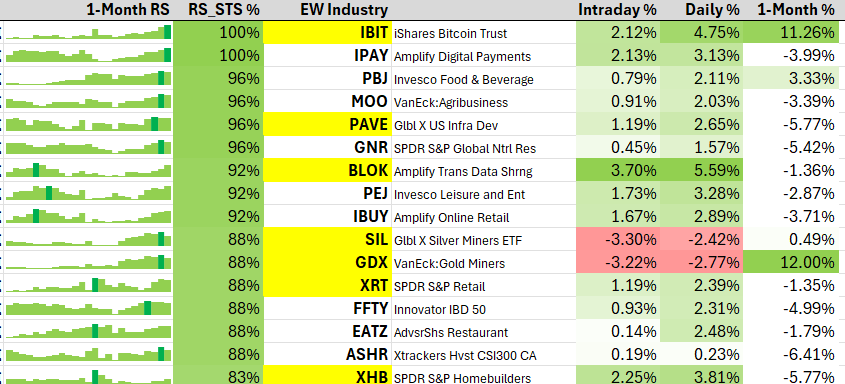
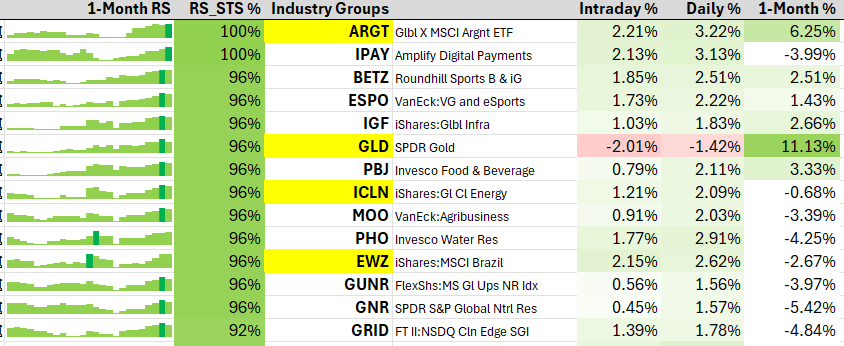
Market Overview: Analyzing the Last 30 Days through Index Breakdown, Relative Strength Segments, Sectors, Industry Groups, and Liquid Mega Caps
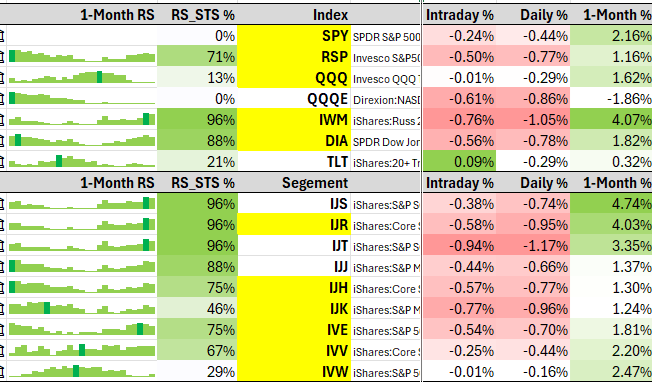
1. Segment
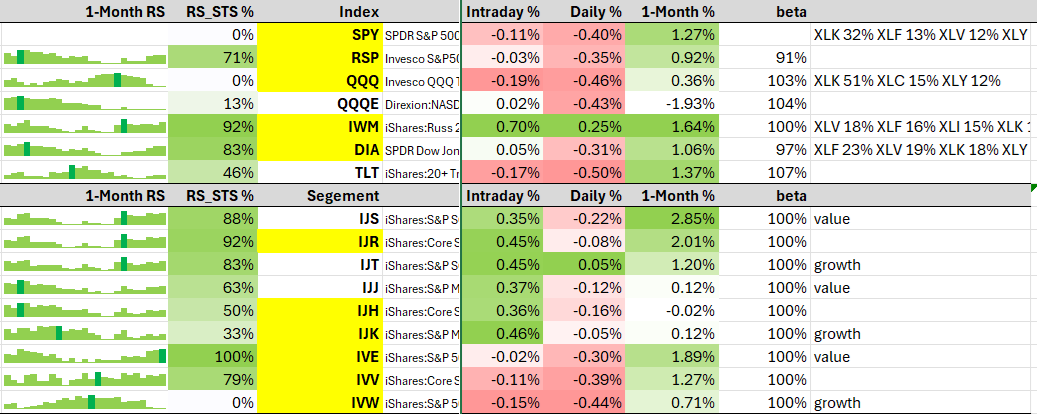
All segments across small, mid, large, and mega caps in value, core, and growth remain negative in 1-month % performance, but growth $IJK, $IJT, $IVW are outperforming their value and core counterparts within each market cap category.
1-month % comparison to index, $IVW is -5.47% vs $QQQ & $QQQE -6.33% and -6.84% respectively.
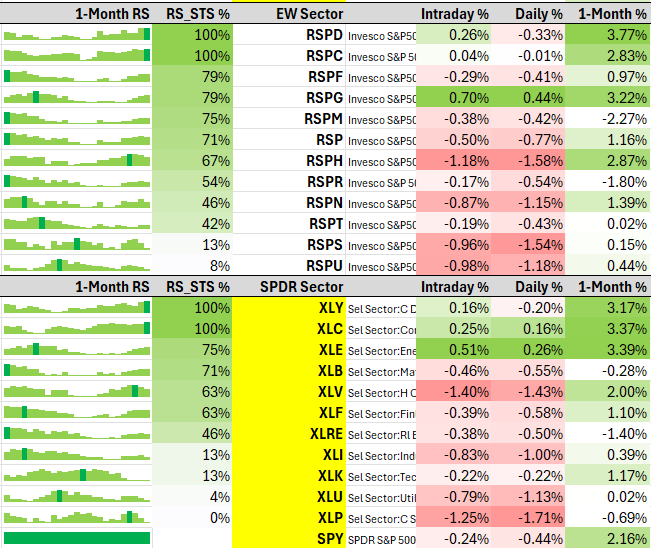
2. Sector RS % Sorted, Equal Weight vs Cap Weight
I strongly recommend reviewing the technical charts of $XLP, $XLU, $RSPS, and $RSPU amid this month-long selloff
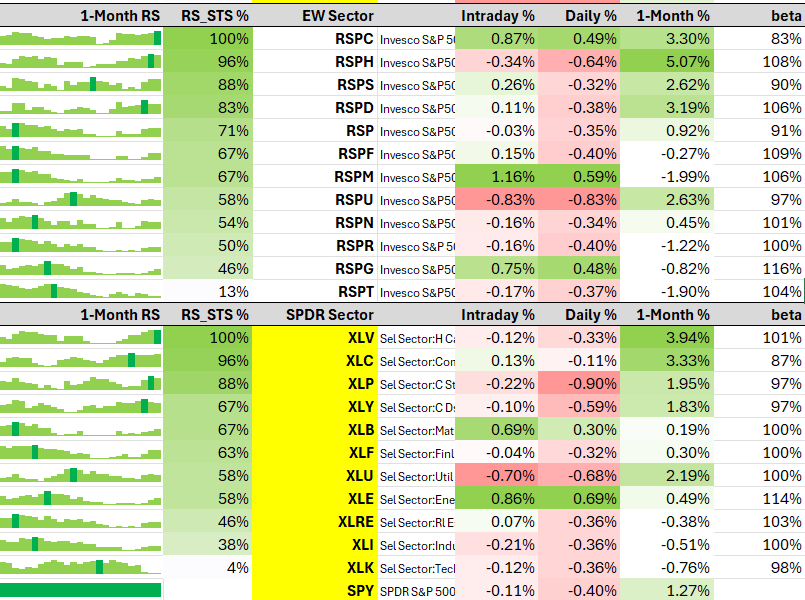
Consumer Staples $XLP & $RSPS are the only sectors to eke out gains among the 11 sectors in both equal-weighted and cap-weighted formats. At RS % level, Utilities, Consumer Staples, Industrials, and Real Estate is outperforming the market index at both $SPY, $RSP and $QQQE level.
3. Top 15 Industry Group (1-Month RS% Sorted), Equal Weight vs Cap Weight
$KC - A Breakdown of My Trade on $KC's +180% Move in a Month (Scans, Watchlist Management, Entry Day Insights, and Systematic Risk Management for Holding)
Rather than replying to individual DMs about my $KC position (ironically, my earlier post was about $FBTC), I decided it’s better to share this as part of the free educational content for everyone to benefit from.
Here are a few key points about the share structure of $KC before the breakout, so you can adjust your screening parameters if needed. This is the type of stock profile that typically shows up in the 'Top 100 Performance% Stocks' annually. It's also why I tend to focus on small to mid-cap stocks most of the time.
1. 1st move back above 200-MA after 1 year, +80% with RS during the 2 weeks.
$KC will initially show up on your '1-Month Strongest Move' screener. I move the entire list (which includes $KC) to my watchlist, awaiting a higher low swing to confirm a character change.
2. Higher Low may be in place at this point with price contraction within a symmetrical triangle. I abolutely pay more attention to stocks when price contract along with ALL moving averages contracts together. (10, 20, 50, 100, 150, 200 DMA)
$KC remains in watchlist, but will begin to keep appearing in my 'Screener within Watchlist' based on technical price compression.
3. Entry day on 5/11; here are some qualification
i) it broke out of a 2 week technical triangle pattern and consolidated range
ii) it broke out with high RVOL (RVOL was 40% in 10mins of open)
iii) LoD was only 40% (i skip trade beyond 60%. I want high possibility of position ending the day with unrealized profit, not near entry price)
Entry day is T. 3 stop set based on 33% stop level from entry to LoD. I do not consolidate and adjust my stops to breakeven (avg price) until T+3 days
T+3 = 33% size down (immediate partial profit taking or shaving risk down on trade that did not follow through but still hovering above avg entry as I have tight stops (since I only do execution when price action presents entry to LoD below 60%). All stops are consolidated to breakeven level on 1 full singular size.
Read more here on my detailed approach to risk management within a singular trade: x.com/jfsrevg/status…
4. Day 4 onwards is all mental stop on 10-MA. I do not mess with the trade if it doesn't close below 10-MA.
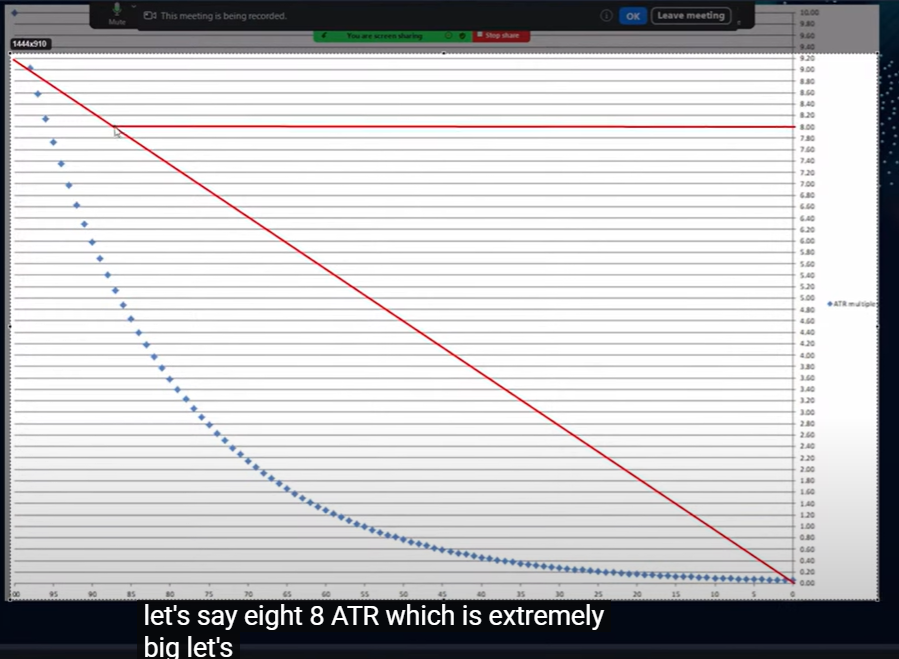
5. This trade did not close below 10-MA at all even at 13 x ATR% from 50-MA currently (highest ever). No reason to sell everything, but you have every reason to sell some pieces into strength at extension beyond 10 x ATR% beyond 50-MA.
To be fair, nobody will know the outcome on the day their trade execution; but what I strongly advise is to adhere to the principle of law of large number and you need to have this few things right;
i) make sure your screener gets u the setup before they MOVE, not after (i do not believe in high volume scan, you have already missed the most optimal entry day and the risk/reward is skewed after it. Try volume based high RVOL 'at time' scan instead during live market at minimum. High volume scan works best only as post continuation base setup, and the perfect entry spot often is a few weeks after that result appear)
ii) have a entry rule that stack the odds of position ending the day with unrealized profit. LoD 60% rule, high RVOL etc are my 'secret'
iii) ensure you have non-discretionary profit taking/stop loss rule. you cannot second guess the market, and u need to keep your emotion in check. you won't be able to hold a big runner if you like to second guess 'top' and 'bottom' in the market. the trades that can move needle in your annual performance % are trades that you never expect to do what they are doing. they make moves against basic human instinct.
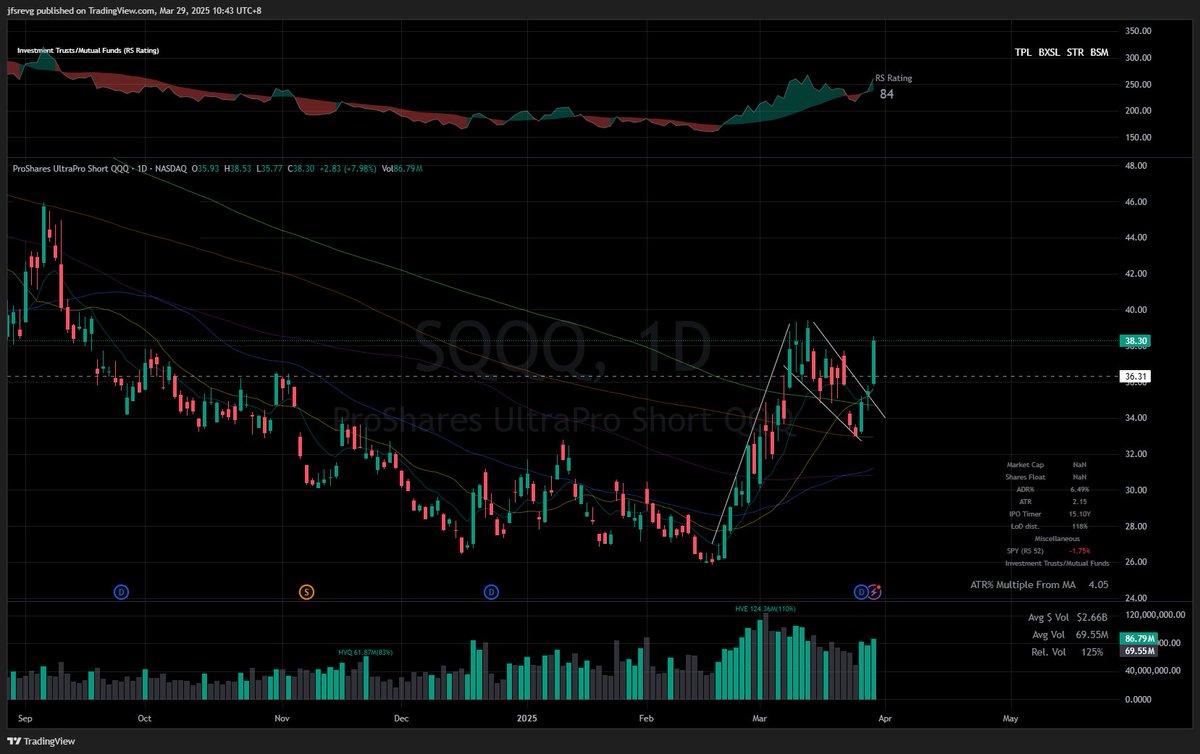
iv) you need to know when to go 'heavy' vs 'light' in terms of trade frequency and activity. $KC trade was taken right on the day market bounce off it's rising 50-MA, before subsequent market gap up to reclaim 10 & 20-MA. Market index chart eg. $SPY $RSP $QQQ are great to cushion you when to layer your risk or release the pedal. I will never take on risk when $SPY is 4 x ATR% from 50-MA when it historically pullback from 5 x ATR% from 50-MA. I am pretty certain $KC sort of move will never happen in any stock at this juncture of the market. You need to stack every single possible odds to let the trade work in your favor, and the current market extension now is a headwind more than a tailwind.
v) repetition & refine; do this 100 times, go through your trade data and refine. do it another 100 times again, go through your trade data and refine. in a year, you will be able to refine up to 4 times at least. you only can get better if you refine your trading based on your trade journal. you can't escape this part of the work, please.
I hope this is helpful, it's just some basic principle, math and plenty of repetition in trading for me.
If you find this type of content valuable, do retweet ♾ so I know what sort of things to share in this space during my free time.
@stonkypits this will be helpful for you
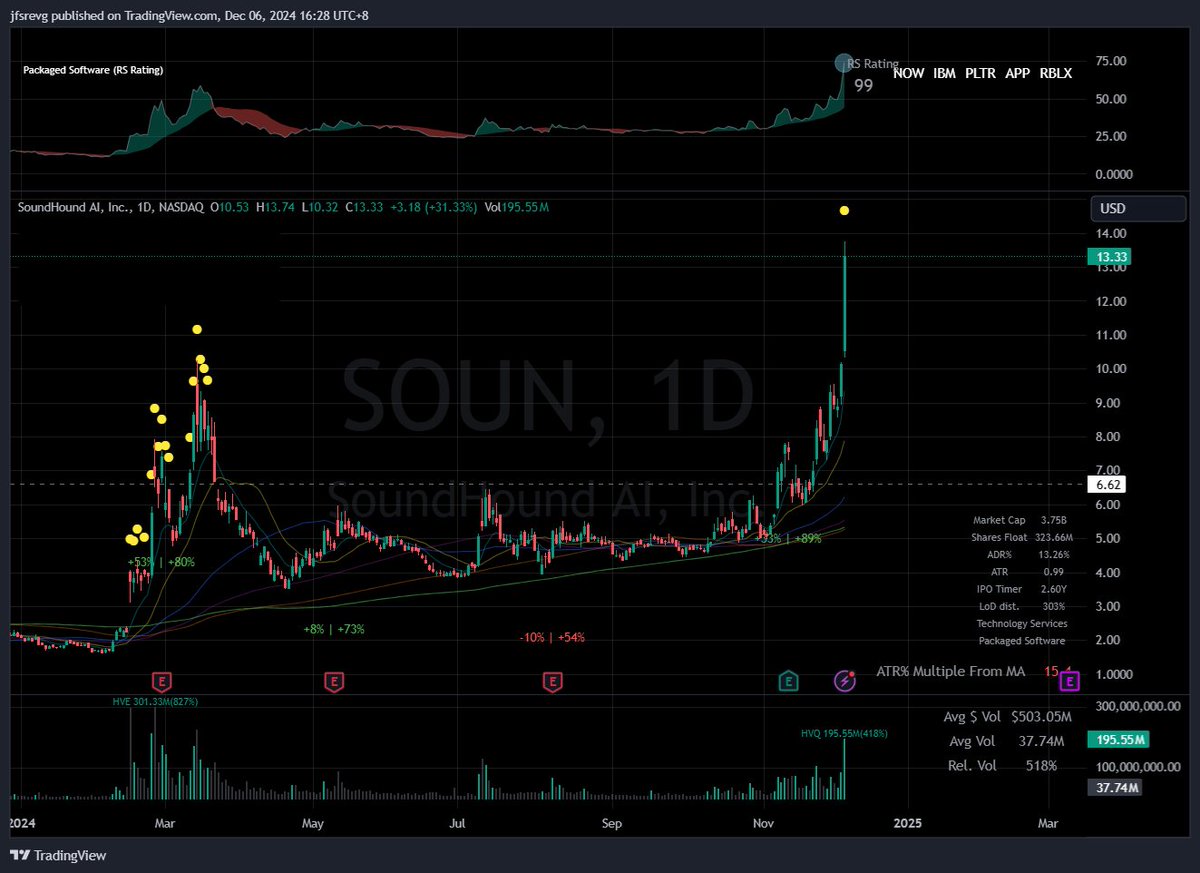
$SOUN , same type of share structure. I taken too many new positions on 21/11 to trade this. such a bad miss.
PS: I did not add outstanding shares float filter as requested by some last week. A 150M cut off will give condense to 17 result (recommended)
Strongest Segments - If you notice the development of 1-month RS on histogram basis, @dryan310 is certainly spot on with his call for mid cap level strength on 21/11 (that's 6 bar from last candle)👍
@dryan310 Strongest Cap Weighted Sector vs Equal Weight Sector
#1 $RSPD $XLY - Consumer discretionary
#2 $RSPF $XLF - Financials
#3 $RSPC $XLI - Equal Weight Communication , Cap Weight Industrial
#4 $RSPN $XLC - Equal Weight Industrial, Cap Weight Communication
Systemizing profit taking for me, with some nuances highlighted;
1. Entry Day = Day 0, 3 stops at 33% level to final stop (usually LoD). 33% net size at each level.
2. If profit to risk exceeds 2x in day 0-2, i will shave 33% off. all 3 stops level will be maintained, have size adjusted to the net balance qty. I have highlighted several post on managing risk with 3 segregate stops to reduce your 1R loss even 0.6 to 0.8R. 1R loss is not 1R, more often than not it is 1.03 to 1.3R with slippage, spread, borrwing etc depending on liquidity of the securities on average period, and at time of explosive move u saw it is already making.
3. Day 3 = 33% size down (immediate partial profit taking or shaving risk down on trade that did not follow through but still hovering above avg entry as I have tight stops (since I only do execution when price action presents entry to LoD below 60%). All stops are consolidated to breakeven level on 1 full singular size.
4. Day 4 onwards is all mental stop on 10-MA. I do not mess with the trade if it doesn't close below 10-MA.
eg. If close below 10-MA on Day 8, stop remains at breakeven level on Day 9 and I will let market trade for a opening range of 5 minutes and adjust my breakeven stop to the low of the opening range (ORL) and let it the market take it out.
If stop not taken out by EOD of Day 9, during pre-market routine i will adjust back to breakeven, and reset new ORL for Day 10. I repeat this process until it get taken out. The rationale is to hold onto your winning trade as long as possible with minimal sacrifice or unrealize profit. Study my $XLU entry on 9th July. I'm still holding, and even added along the way up today (86 calendar days and running).
5. Some nuances to consider;
i) if I were to take a catalyst gap trade eg. 1/10 (Day 0) $UNFI +100% surprise beat in EPS and intraday hit 10 x ATR% extension to 50-MA. When $UNFI hit 2x profit-risk in full size within 25 mins of the trade, I take 33% size off. It continue to follow through and hit 10 x ATR% extension from 50-MA. It is extremely unlikely for me to even be aware of this because I usually shut off after 3 hours from open and let my stops take care of my open heat risk. I will let Day 1 open and size down further 33% of net size as partial profit taking. When a trade ran up exceeding 4x profit to risk before my Day 4 breakeven, i will definitely consolidate all risk to a singular stop at breakeven. I am taking the risk of losing the remaining unrealized profit but it definitely don't make sense to visit losing range (below entry) by maintaining stop at 33%/66% and LoD stop at this parabolic point.
ii) if i were to hold a swing trade beyond day 4 (all stops already consolidated at breakeven with partial profit taking already taken place), and trade continue to trend much faster than 50-MA to give me a 8-10x ATR% extension from 50-MA, this is a partial profit taking alert for me to sell on strength. eg. size down 33% of net size and readjust breakeven stop quantity accordingly. stop is always at breakeven with mental stop at 10-MA.
iii) if Day 0 entry executed, and hit my first 33% level stop or even slice through to 66% level stop (2 stops trigger) before Day 4, i will always adjust a horizontal price alert to previous day high (the stop day), and if it trigger, i will add size inverse pyramid method (eg. 10,000 shares in, 6,666 shares stopped out and nett 3,334 shares. I will add 50% of 3,334 size (1,667 size) bringing me back to 50% net size instead of 33% net size). By doing so, if trade turn south to LoD stop on the singular day, u will not be hit risk exceeding 1R even with attempt to re-scale back up.
iv) In holding a trade beyond Day 4 (with consolidated stop at breakeven at nett size), if there were to be a sideway price consolidation setup below 4x ATR% from 50-MA, i will inverse pyramid add 50% size of my nett size. @Qullamaggie treat it as a separate new setup but i prefer managing the same ticker as a single trade. By adding smaller size up this way, your avg price to the trade will not be severely disrupted and will bound to be below your 10-MA mental stop. You can continue to trail the trade like it was but with more potential profit trajectory to the trade.
v) gap down open occasion below 10-MA, the routine i take is the same as 4. on ORL.
The way I manage profit sizing and adjust stops in a sequential manner is aimed at reducing monthly drawdown % and achieving a smoother equity curve on a MoM basis.
As your equity grows (especially when it surpasses your absolute dollar risk tolerance relative to your monthly expenses), seeing unrealized profit drop from, say, +$500,000 to +$280,000 in a single session can be hard to handle, even if you're following textbook rules. I believe not many can emotionally withstand holding 8-10 full-sized trades with 80% portfolio utilization, especially when trading with a bankroll that significantly impacts their quality of life and that of their dependents.