

Initially, I thought: "Hey that's pretty bad." but the more I look into it and thought about it on my way home (on the MTR of course), I start to see the method in the madness. A 🧵summarizing my thoughts. Let me know if I'm on the right track or on the wrong train.
https://twitter.com/aarnavg17/status/1592067843671347201
A backgrounder: My friend RT’ed here observed (correctly) that an MTR station named Yau Ma Tei (YMT) has only one escalator evacuating the lowest level of the station that serves the Kwun Tong Line (KTL) that empties into the middle level serving the Tsuen Wan Line (TWL)... 
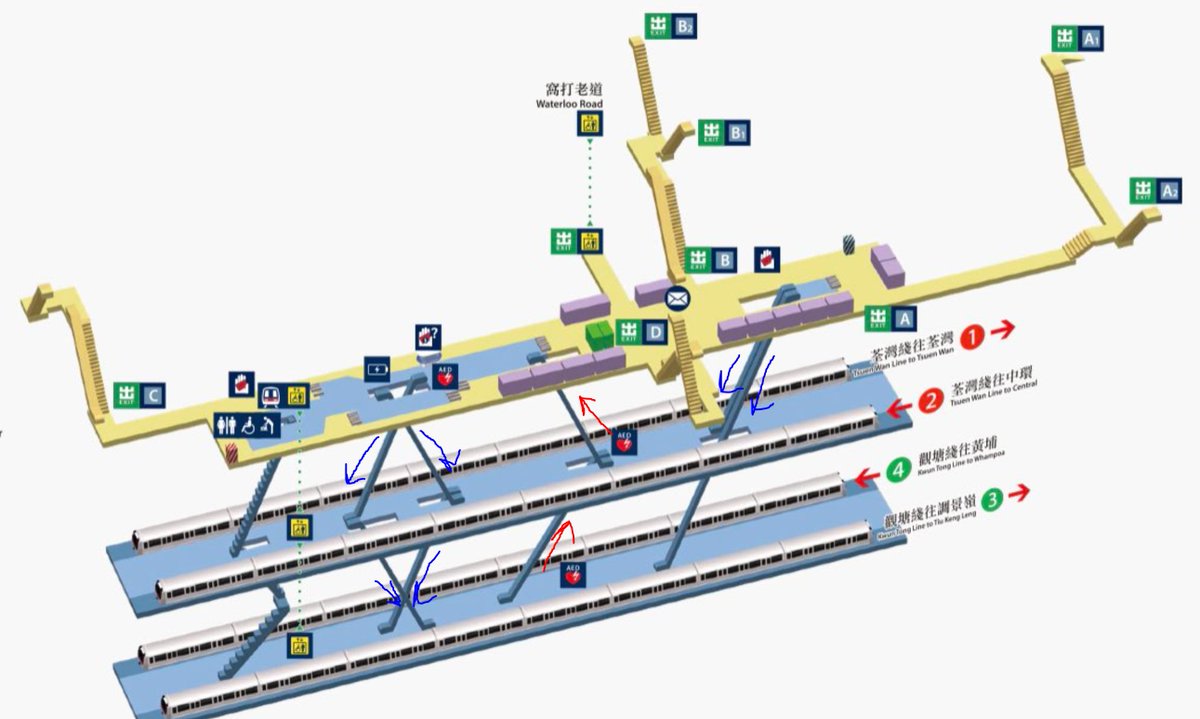
...and both TWL and KTL passengers leaving YMT as well as passengers transferring from NB TWL to SB KTL are forced to use that one set of escalators. While in the current YMT station config the other two sets of escalators serving both the TWL KTL are set to move passengers ...
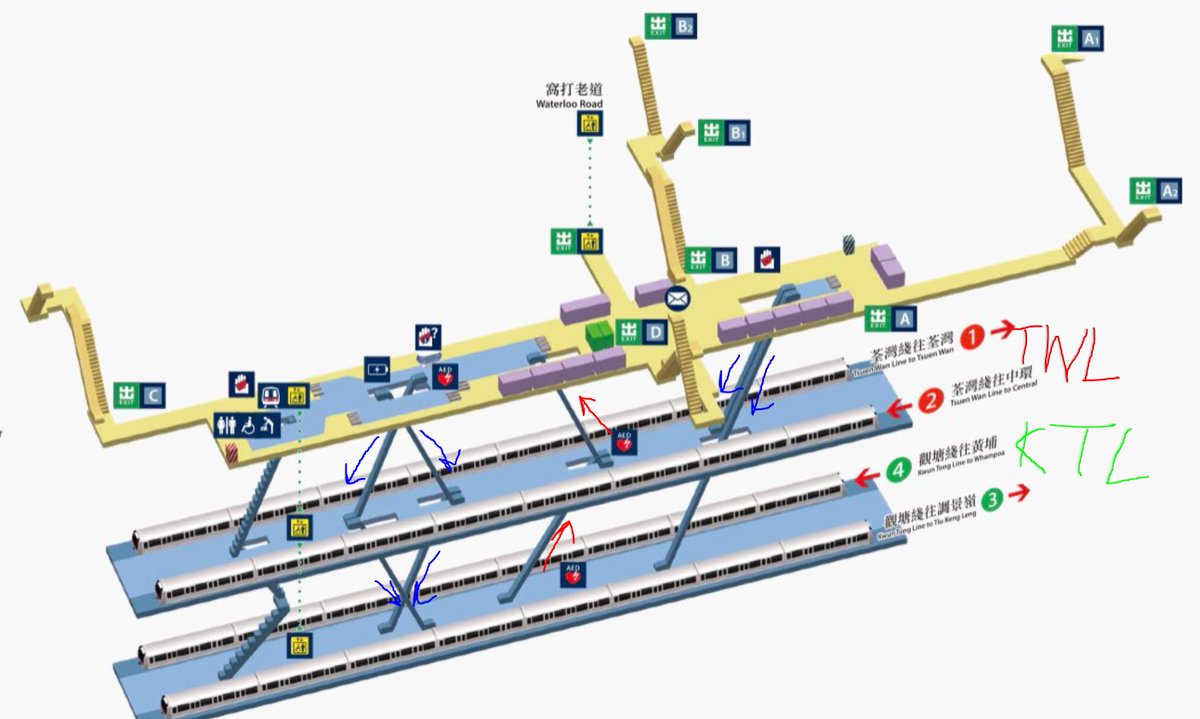
...down into the lower level. This led to some congestion at the landings of the up escalators and stairs. (see their post)...
https://twitter.com/aarnavg17/status/1592067958561726464?s=20&t=f8v2pH3Gmoh_XWiUOvVFtw
....I believe I was pinged in his thread because of my tweet on some interesting escalator width optimizations I observed during a trip to South Korea and Japan....
https://twitter.com/JRUrbaneNetwork/status/1580542065087508480?s=20&t=f8v2pH3Gmoh_XWiUOvVFtw
....However, as many people know, HK’s railways are a bit of a different beast compared to a light metro serving a city half to a quarter the density and/or size....
....But my friend was correct in his observations and got me thinking: Why is so much escalator capacity being devoted to getting passengers from the TWL to the KTL at YMT when there is some congestion to get out of the station or transfer in the opposite direction?....
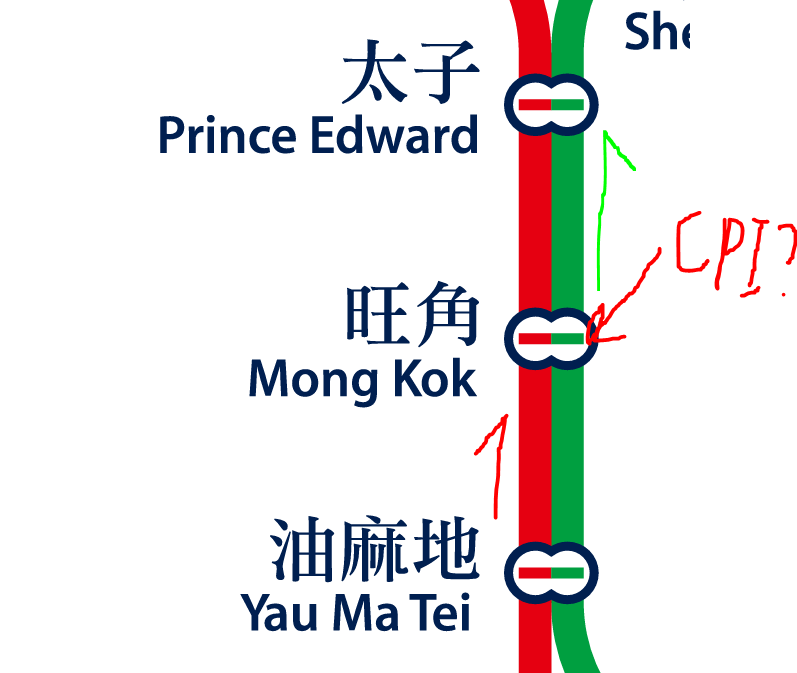
....Especially, if there is a perfectly good cross-platform interchange (CPI) pair north of YMT? Especially with adjacent MK being the NB same-direction interchange?...


....I believe this is a classic case of what in Transport Engineering we call User Equilibrium (UE) vs System Optimal (SO). You can quickly see this presentation explaining it roughly. sboyles.github.io/teaching/ce392…
or just sit tight and scroll down VVVV....
or just sit tight and scroll down VVVV....
....User Equilibrium (UE) is a user-driven traffic state in which each user chooses the most convenient path selfishly. At the end state, of all users sharing the same origin and destination will experience the same cost (which usually is travel time), repeat for each OD pair....
....System Optimal (SO) is a system-driven traffic state that a given criterion function (cost) at an aggregate network level is minimized. (again cost here is usually travel time)....
....There is a lot of math behind this to study but I always see it as the tension between “tragedy of the commons” and “majoritarianism” but like with lots math, economics transport engineering, nerds with PowerPoints, transport models and excel spreadsheets....
....Basically, you as a transit user will always find ways to shorten your commute time while maximizing your comfort and generally not care about other people (especially if you can't see them) strive for UE....
....while a government and/or transit operator generally tries (keyword "generally tries") to maximize overall benefit at the lowest cost and as such strives for SO. These two things are in direct conflict with eachother....
UE will always end up with everyone in the network overall wasting more time/experience more congestion in total.
SO will save time/reduce congestion for everyone at the expense of a few people who will experience more delay and congestion BUT also the net total delay and congestion of the whole network are minimized significantly compared to UE.
Again, users always want the travel time of UE while a network operator strives for aggragate benefit of SO. So how does this relate to our friend’s observation with the MTR at YMT? Well, we need to go a bit deeper.
So as noted before, ppl making the critical (highest volume) PM NB transfer between the TWL and KTL can do a CPI at Mong Kok (MK) one station north. However, what this assumes is MK is not a constrained and congested station on the network.
For those who don’t live in HK, MK is one of the most heavily used stations in the MTR. Handling half of the transfer traffic between the TWL and KTL (both handle close to 1 million passengers each day) along with Prince Edward (PE) as a paired CPI. Sauce: mtr.hk365day.com/Railway/Specia…
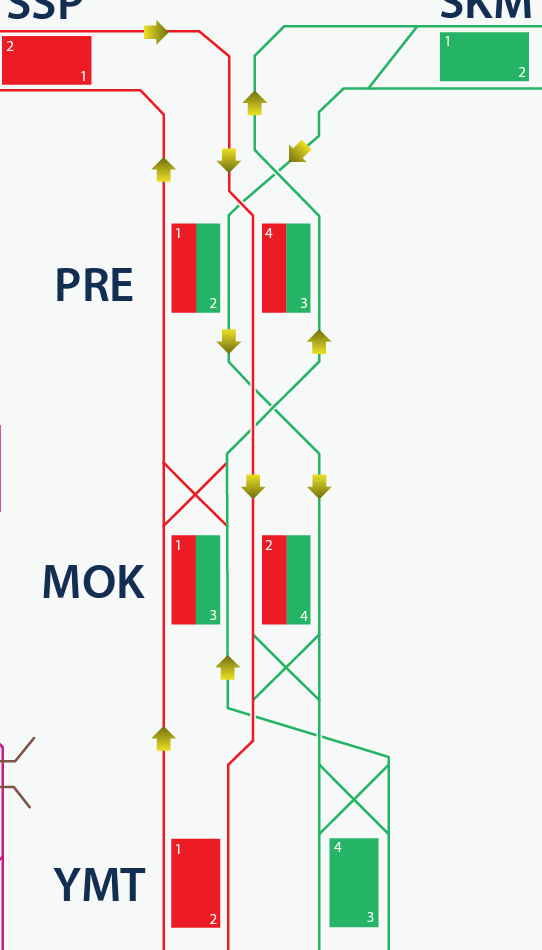
@RmTransit has an excellent video on this.
However, another wrinkle is MK, unlike PE and YMT, also has abnormally high station entrances and exit volumes even for HK as it serves the bustling Mong Kok commercial district, one of the most intensely urbanized areas in the world.
So, the station can be quite congested with me observing quite long dwells compared to adjacent stations (PE and YMT) as crowded trains and congested platforms lead to doors needing a few tries to be secured during rush hour.
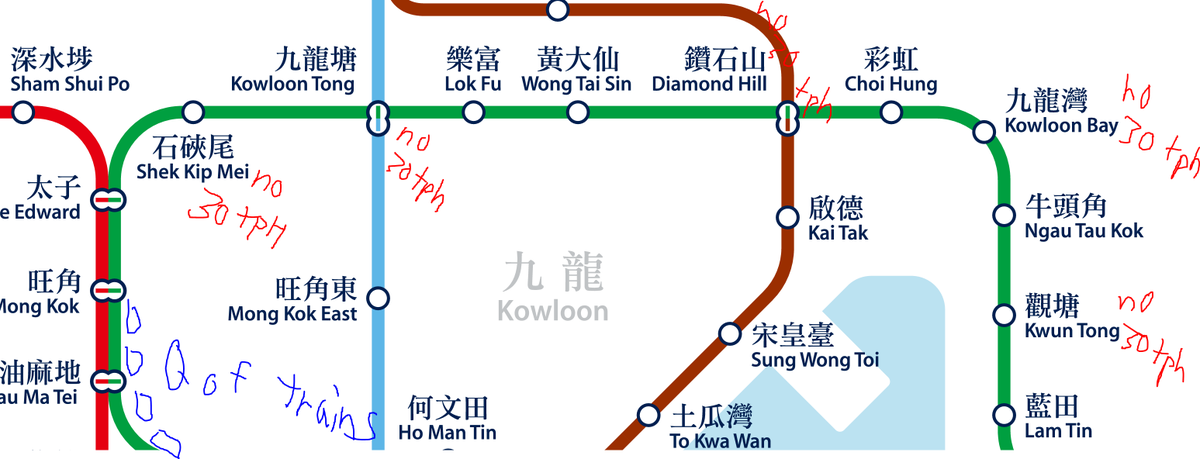
This leads to high dwells and can destroy your Trains per Hour (TpH) through a section. MTR runs a pretty tight ship with both the TWL and KTL operating exactly 30 TpH during rush hour which can get pretty tight for a system using massive 190m long trains.
To run an even service on a line the dwell times for each station have to be consistent for each train at each station. This does not happen during congested conditions...
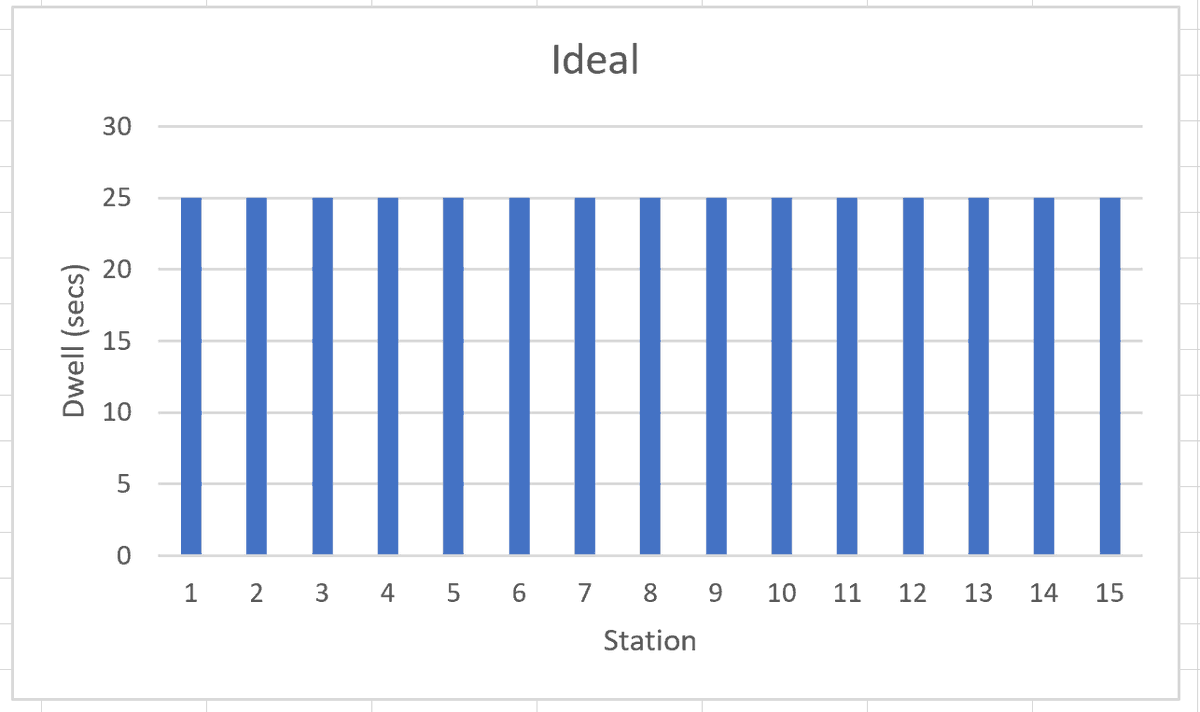
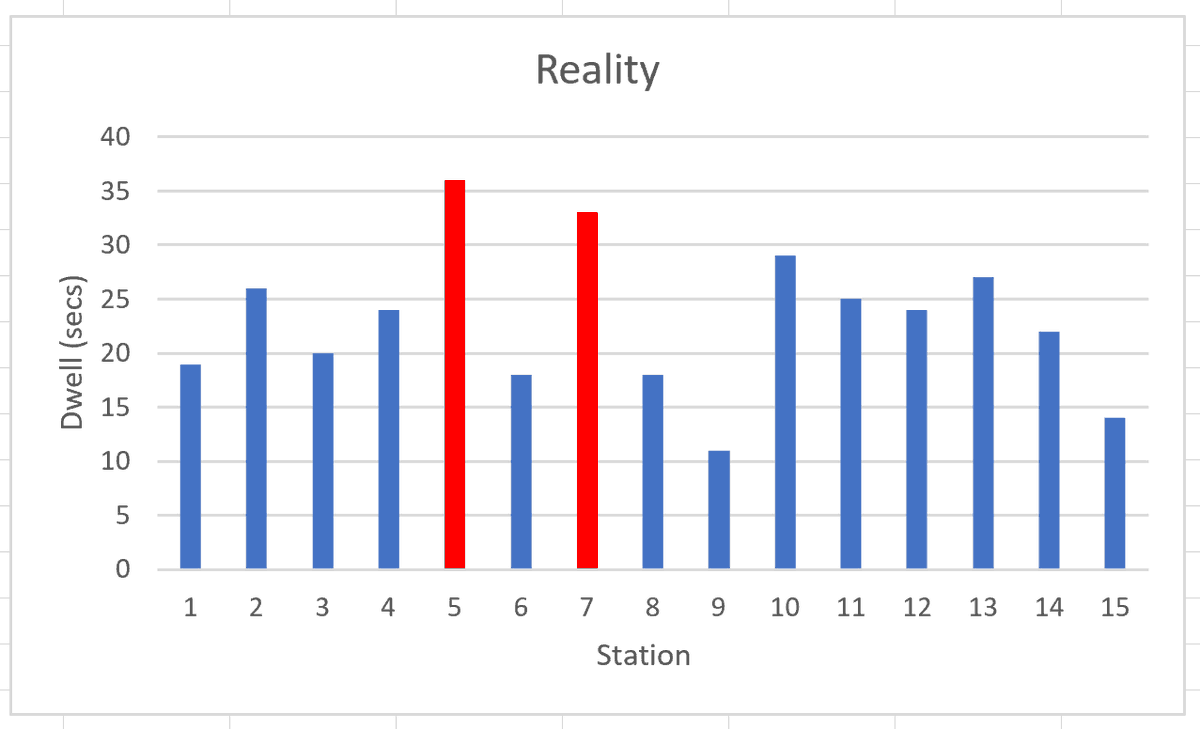
So if you are the MTR and you have a particular station that is venerable to congestion creating high and variable dwells what do you do? You put all your resources to improve capacity and/or divert traffic away from that station.
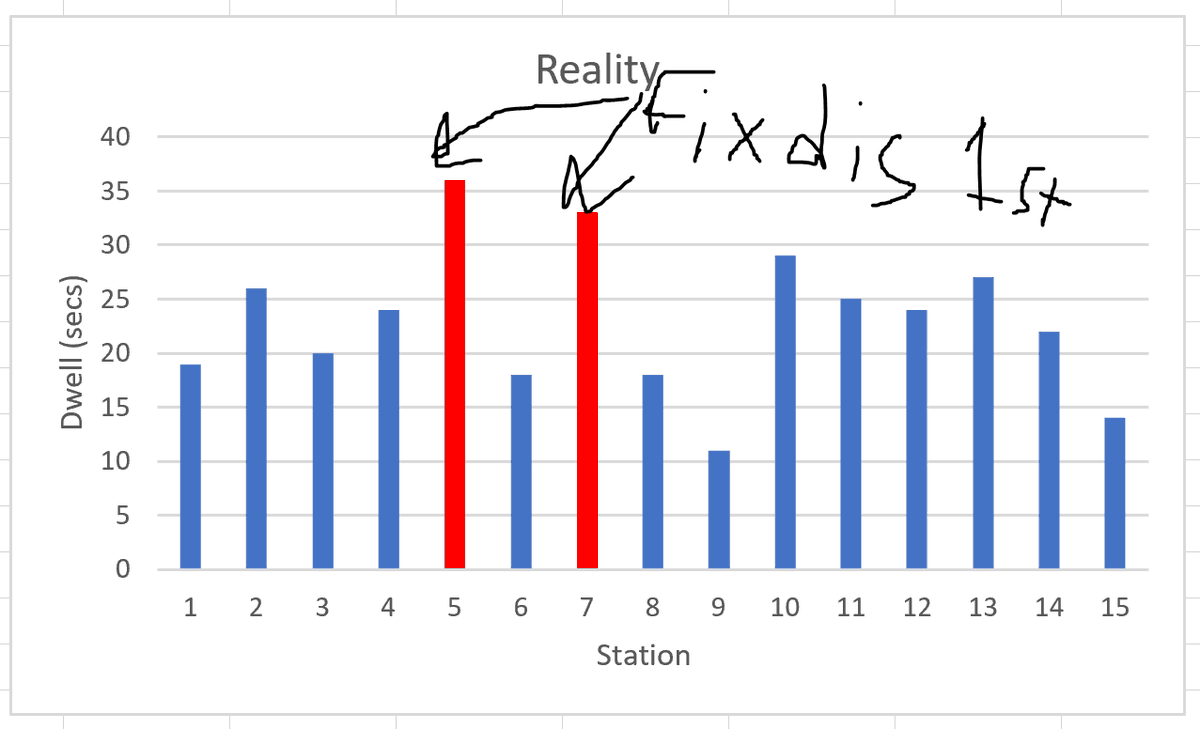
But Mong Kok is the highest capacity design already, being a CPI, so there is nothing really you can do to increase capacity (short of retrofitting Spanish solution side platforms for people not transferring).

Therefore, MTR should encourage people to use the spare transfer station capacity at YMT instead of which NB KTL trains are half full coming in.

But YMT is not a CPI people have to use the more time-consuming stairs/escalator also there are only 3 sets of escalators. This is where UE and SO come back in.
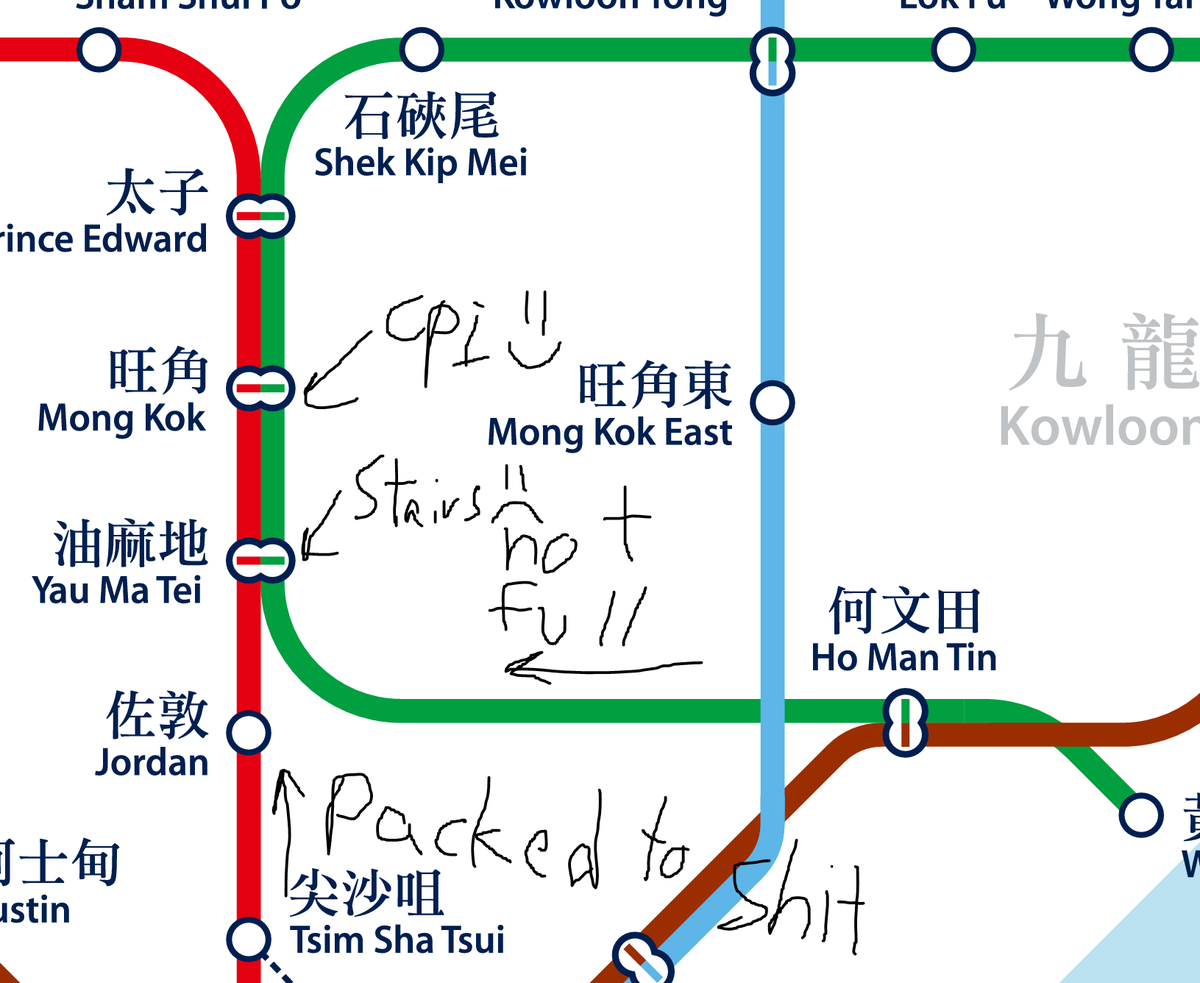
UE will dictate that if MTR does nothing everyone will selfishly go to MK for the easy CPI transfer (hoping it will not be crowded) some may be smarter and use YMT to get a quick seat.
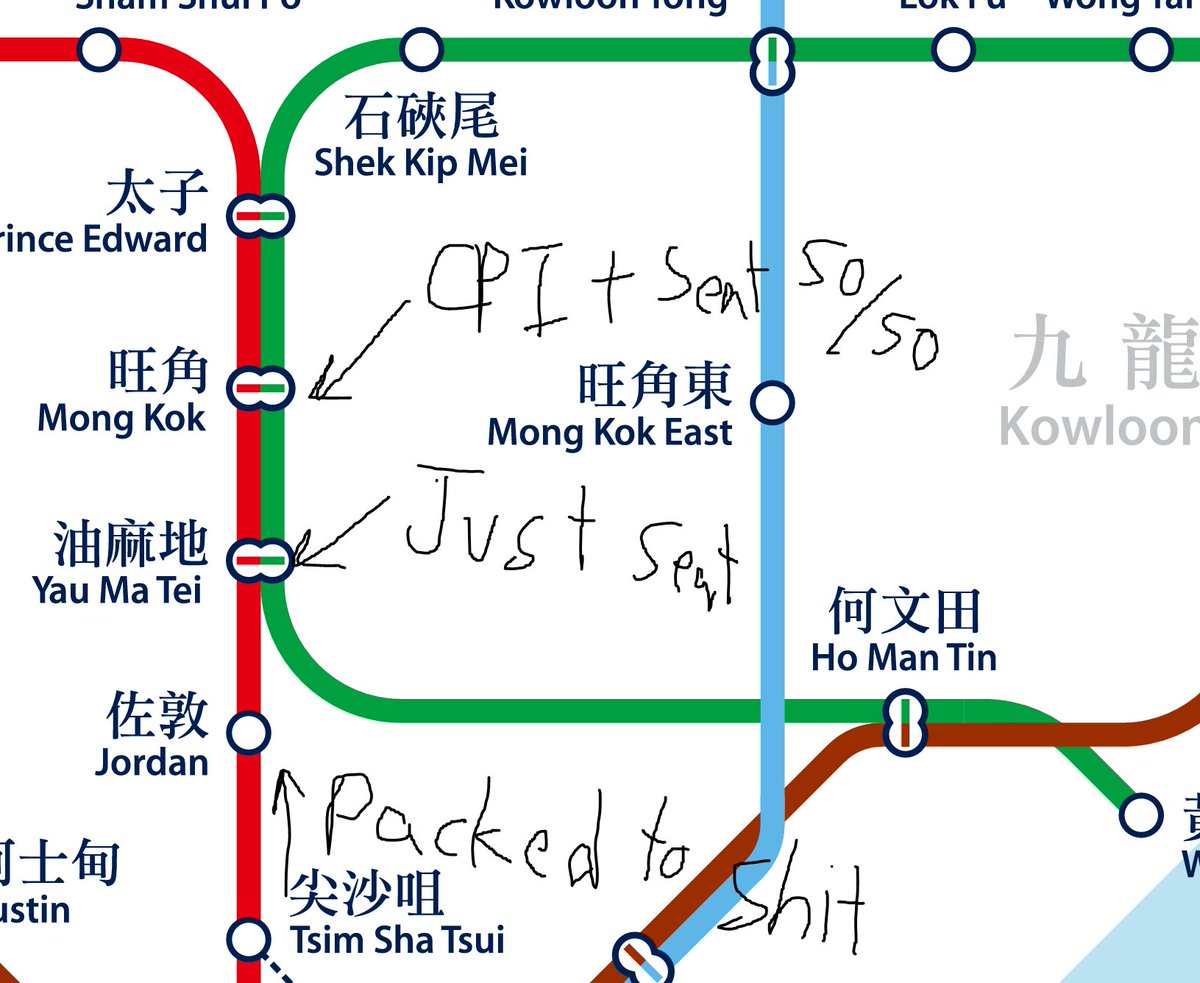
But it might not be worth it at YMT bc if everyone thinks they have a shot at a seat and the quick CPI at MK, they will all go for MK (remember selfish) as typically a KTL train does have a few empty seats when arriving at MK. People will take their chances. See matrix.
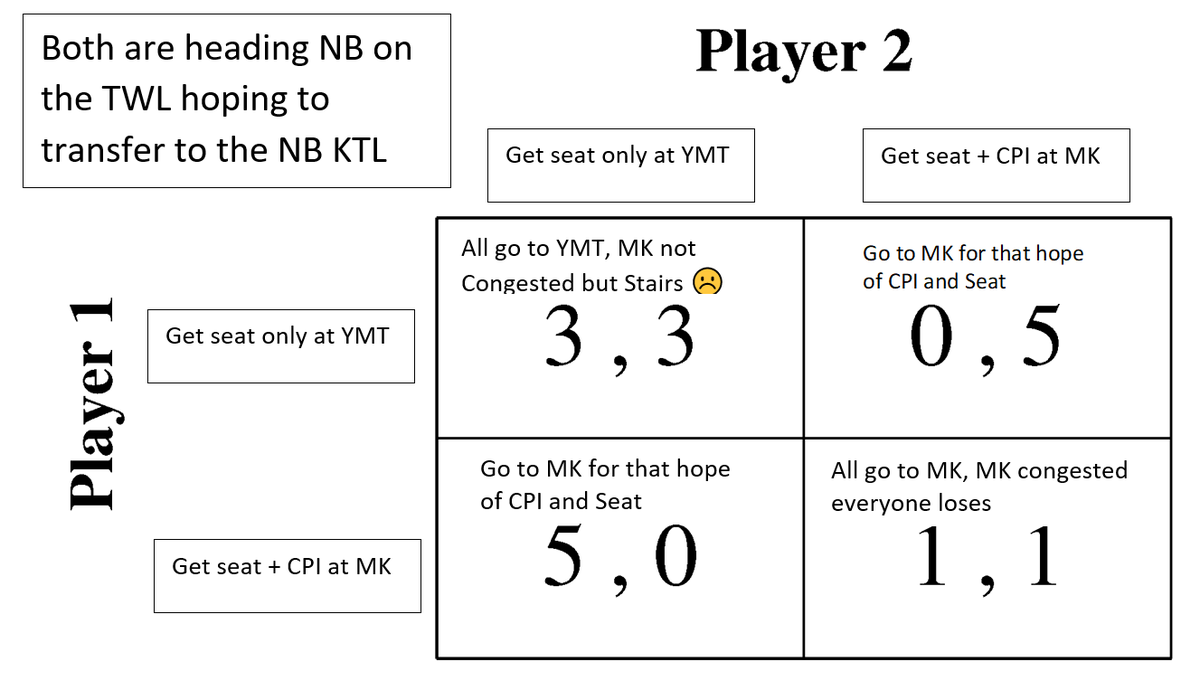
In the game matrix 3 points are getting a seat and using the CPI is 2 points everyone wants 5 points for themselves at the expense of everyone else who gets 0. The result: everyone goes to MK and loses. This is called UE.
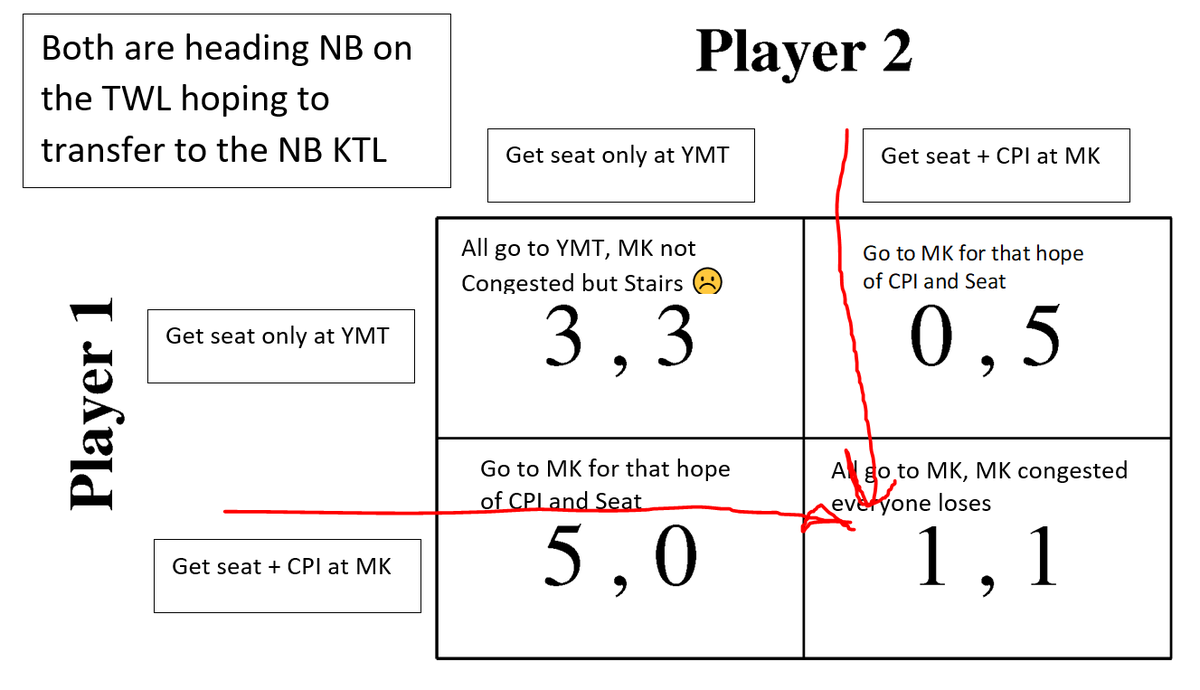
As a result in UE, MK gets very congested and it may take 4-5 repeat tries to close and secure the train doors leading to a backlog of trains NB at MK and a drop in TpH.
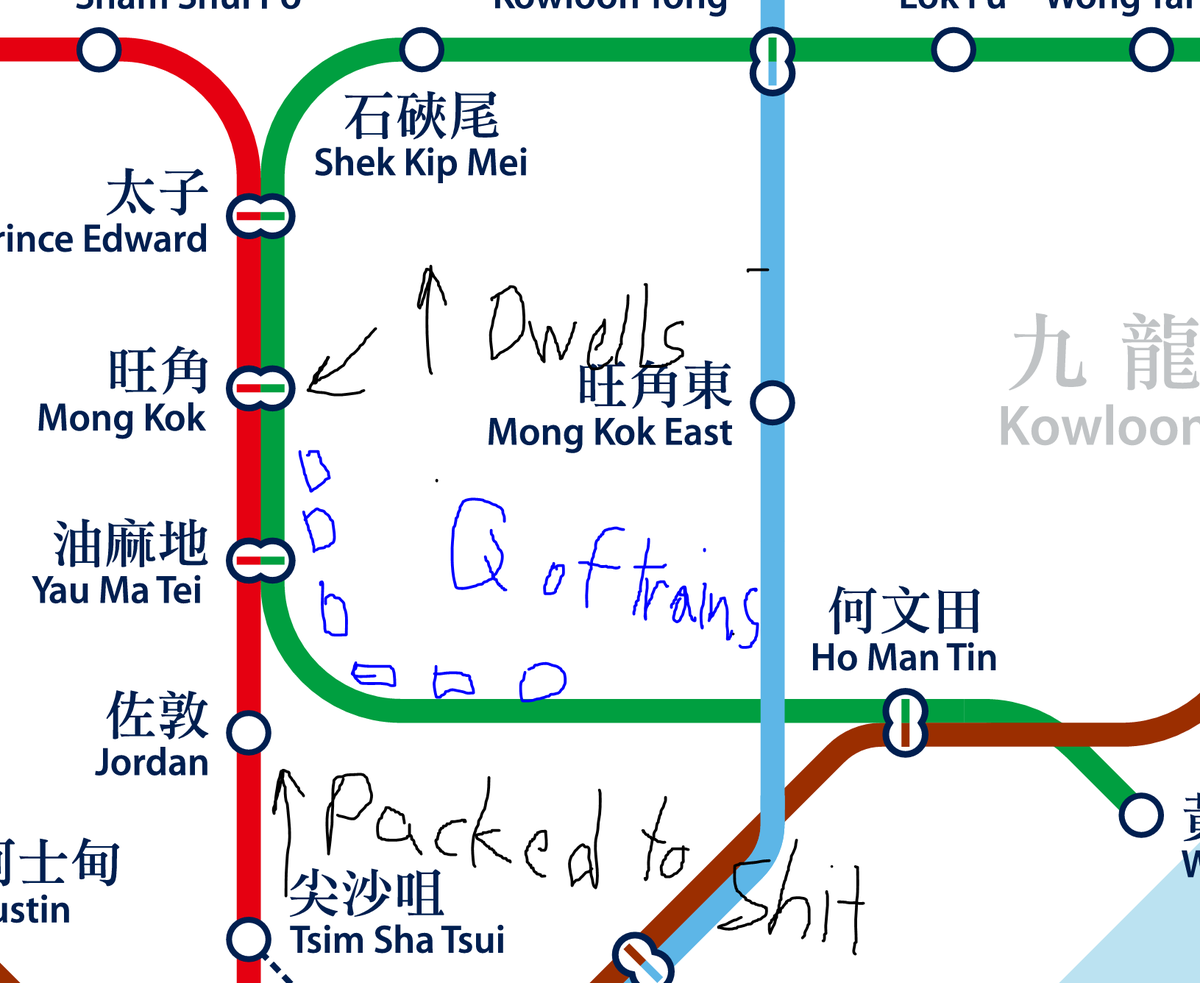
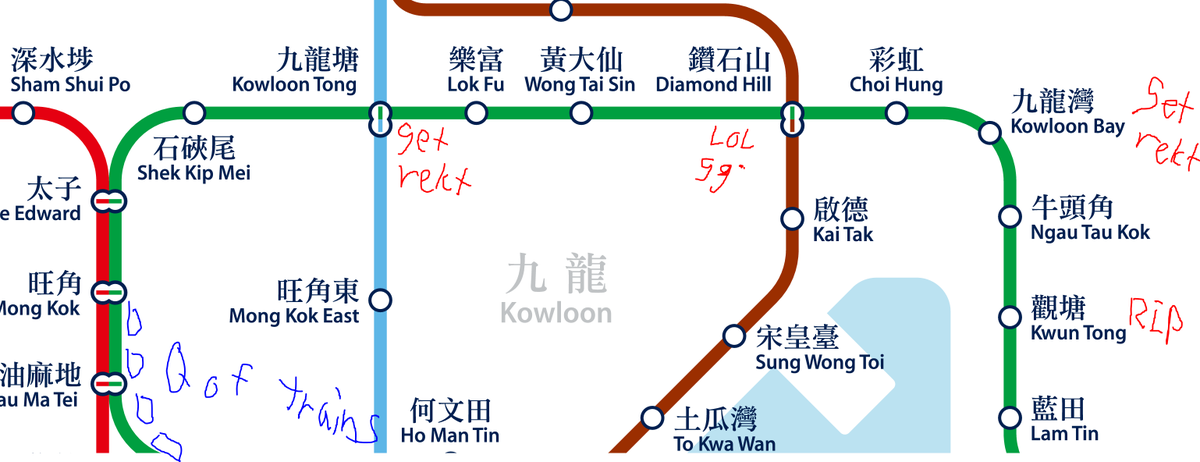
When each MTR train can carry over 3,000 people losing 2 per hour could lead to more station congestion and delays for people down the line (Kowloon Tong and Kowloon Bay anyone?) more L+ratio's all around.
So what does MTR need to do? Force SO by making it attractive to transfer at YMT for some people instead of MK. That means an escalator transfer at YMT needs to compete with a CPI at MK.
MTR most likely found out the reward of getting a free seat at YMT ahead of the crowds at MK is not shifting enough passengers (again UE many people may stay on an NB TWL train for the hope of the easy CPI AND snatch a free seat at MK).
MTR also probs realized that when a lot of people tried to transfer at YMT to avoid MK... but escalator there congestion can and will push them back to MK. Being that YMT has only 3 escalator banks connecting the TWL and KTL platfroms....
MTR said: OK YMT is not a CPI like MK but I gave you 2 out of 3 banks so at least you will not be crowded in MK. As such maybe 20-30% of NB transfer traffic peel away from MK, dwells are controlled at MK and the TWL and KTL run reliably at 30TpH.
But what of my friend who needs to leave YMT station or do a NB to SB transfer? Too bad you might get a bit of congestion trying to leave the station on the remaining escalator. Which when I looked at the situation today at PM rush didn’t seem too bad.
https://twitter.com/JRUrbaneNetwork/status/1592110294683504640?s=20&t=f8v2pH3Gmoh_XWiUOvVFtw
and a significant volume of ppl seems to be diverting to transfer at the more inconvenient YMT.
https://twitter.com/JRUrbaneNetwork/status/1592111618791735297?s=20&t=f8v2pH3Gmoh_XWiUOvVFtw
In fact, adjusting the escalator in their favor (2 leaving YMT station) as they suggested may not actually help them. As the increase in dwells at MK might create queue of NB KTL trains blocking YMT so you actually might waste more time sitting on a train slowly moving into YMT.

So as I mentioned this is done by the operator (MTR) to achieve SO, the needs of many trumps the few. Unless it's taking like 5+ mins more to leave the station MTR is doing the right thing.
https://twitter.com/JRUrbaneNetwork/status/1592119851665199104?s=20&t=f8v2pH3Gmoh_XWiUOvVFtw
TL;DR: Feeling like you are getting shafted in transit? Sometimes it be like that, take one for the team.
That being said please follow and check out @aarnavg17 he has some good work over there and I know his observation on YMT was not out of malice. Check out his dream 2050 Delhi Metro Map.
• • •
Missing some Tweet in this thread? You can try to
force a refresh




