
How could COVID be involved in the pediatric health crisis resulting from a surge in RSV and flu in various places (Canada, USA, Europe)? There are at least three ways. 🧵
First, let me get the "immunity debt" idea out of the way, so I can focus on the alternative (or, more likely, additional) explanations. I have already done some threads on this subject.
https://twitter.com/TRyanGregory/status/1592688153949016064?s=20&t=n85G3PPXC904IwperdUbpA
In short, the current patterns of infection -- when, how much, and where they are happening, and the number of severe cases -- does not seem to fit a simplistic "immunity debt" explanation. So, what else could be going on this year?
If (and we need more data here) it is NOT simply a matter of way more cases this year with the same percentage of them being very serious, then it would mean that either the severity of infections has increased for many patients. How could that be?
In simple terms, this would suggest that either the virus has changed, and/or we have changed, and/or there is some additional factor increasing the relative number of severe cases. So, what might be different this year? And how could COVID be implicated?
1. Co-infection.
COVID, RSV, and flu are all circulating right now. Being infected with more than one of them at the same time makes things worse.
COVID, RSV, and flu are all circulating right now. Being infected with more than one of them at the same time makes things worse.
Here are some papers about co-infection with COVID making RSV and flu infections more severe:
thelancet.com/journals/lance…
pubmed.ncbi.nlm.nih.gov/36112521/
ncbi.nlm.nih.gov/pmc/articles/P…
onlinelibrary.wiley.com/doi/10.1002/pp…
thelancet.com/journals/lance…
pubmed.ncbi.nlm.nih.gov/36112521/
ncbi.nlm.nih.gov/pmc/articles/P…
onlinelibrary.wiley.com/doi/10.1002/pp…
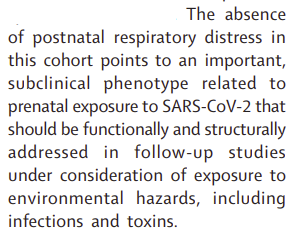
This doesn't cause respiratory distress by itself at birth, but it could become relevant when infected with respiratory viruses. 
3. Immunity theft, in which COVID infection damages the ability of the immune system to fight off other infections.
How could this happen?
How could this happen?
One mechanism is by COVID infection affecting dendritic cells.
journals.plos.org/plospathogens/…
frontiersin.org/articles/10.33…
Those cells are important in fighting RSV infections.
mdpi.com/1999-4915/12/1…
journals.plos.org/plospathogens/…
frontiersin.org/articles/10.33…
Those cells are important in fighting RSV infections.
mdpi.com/1999-4915/12/1…
Some patients with long COVID show dysfunction in the immune system for at least 8 months post-infection even if the acute case was mild.
nature.com/articles/s4159…
nature.com/articles/s4159…
There are other ways that COVID infection can affect immune function, including exhaustion of T cells. This article summarizes these and other ideas that have been discussed by @fitterhappier very well:
thetyee.ca/Analysis/2022/…
thetyee.ca/Analysis/2022/…
So, to summarize, there are three major ways that COVID could very plausibly be making this season much worse:
1. Co-infection with COVID and RSV or flu.
2. Infection during pregnancy affecting fetal lung development.
3. Immunity theft (several mechanisms).
1. Co-infection with COVID and RSV or flu.
2. Infection during pregnancy affecting fetal lung development.
3. Immunity theft (several mechanisms).
A reduction in population level immunity and thus more susceptible hosts is obviously a factor (though, again, there was lots of RSV last year in many places). But it matters a great deal whether there are other factors.
A very large fraction of people, including children, were infected with Omicron variants over the past year. So, this would be the first season of RSV and flu in which this would be a major factor in most places. The season is starting early and many hospitals are overwhelmed.
It's worth noting that Sweden, which never had lockdowns, had a bad RSV surge last year.
From Nov 2021:
thelocal.se/20211105/rsv-w…
From Nov 2021:
thelocal.se/20211105/rsv-w…
If COVID has made the severity of RSV and flu infections worse, then we need to mitigate the spread of these viruses now to protect children who are more vulnerable. We do not need to let them get infected to pay an immunity debt.
It is also important to consider what this would mean as more and more people get infected (or reinfected) with COVID. What about future seasons? Other viruses? Bacterial and fungal infections?
What we need is data, not assumptions.
What we need is data, not assumptions.
One quick clarification. The claim is not that *all* RSV and flu infections are more severe. It's that more of the infections that occur will be severe because in *some* kids COVID has these effects. I don't want people misconstruing the claims made.
Another possible factor besides "immunity debt" or COVID is that the RSV or flu viruses in circulation this year are different and more virulent and/or transmissible. Here's a recent study on RSV variants that result in longer infection, for example.
academic.oup.com/jid/advance-ar…
academic.oup.com/jid/advance-ar…
• • •
Missing some Tweet in this thread? You can try to
force a refresh






