Gerrit Bruhaug Profile picture
Dec 2, 2022 17 tweets 6 min read Read on X
So when talking about recycling spent nuclear fuel (i.e. "waste"), we often like to focus on turning it back into more nuclear since that is an amazing trick! But there are also lots of useful isotopes to recover and if we recycle at scale it could really change things! 🧵 1/17
When atoms fissions, we get a broad range of isotopes with most of them massing either ~95 or ~137 amu, but there is a broad distribution and the exact make-up depends on isotope and neutron energy. 2/17 hyperphysics.phy-astr.gsu.edu/hbase/NucEne/f…
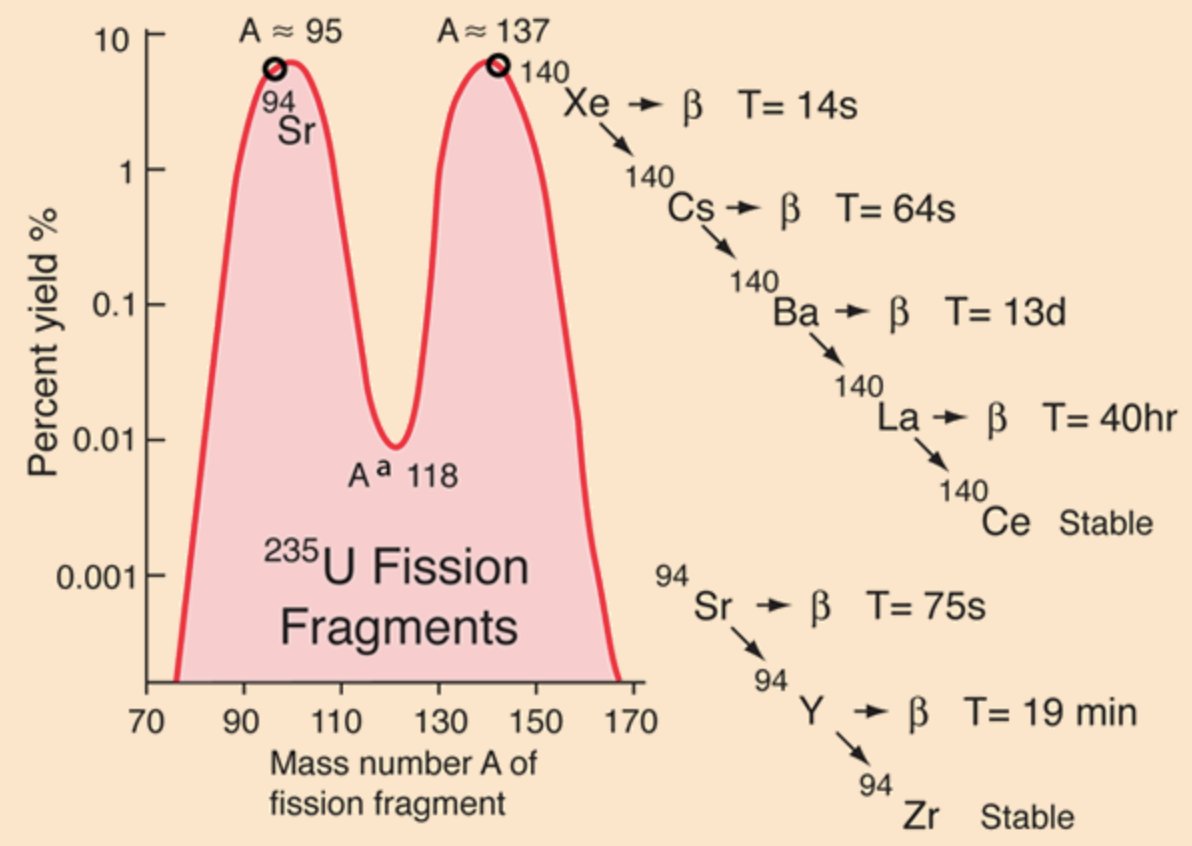
The first obvious isotopes to recover are the ones we already do at research reactors, medical isotopes! Mo-99 is the most common fission fragment recovered, and it is used as a source of Tc-99m for medical diagnostics. I personally have even had some! 3/17
~6% of fissions make Mo-99, but it has a ~66 hr half-life so recovery is hard to do. Wide scale reprocessing would increase total supply, but the amount would vary. Other, longer lived isotopes will be available in larger amounts though! 4/17
Cs-137 also is made ~6% of the time and has a ~30 yr half-life. As a powerful gamma and beta emitter it has a number of uses in medicine and industry. Similar story for Sr-90, which has even been used as a much cheaper isotope for RTGs! Imagine low(er) cost space probes! 5/17
There also may be industrial applications for lower activity radionuclides like Tc-99 and Zr-93. Tc-99 doped steel is much more corrosion resistant and could be used in nuclear applications without any radiation concerns. 6/17
The Zr-93 generated as well as the leftover activated Zr clad from spent fuel could also be remade into slightly radioactive fresh clad for the recycled nuclear fuel. The industrial processing would be slightly more complex, but it would lower our waste burden. 7/17
But there are also stable isotopes to be recovered, and valuable ones at that! We can recover platinum group elements as well as some noble gases from fission products. Some may need some isotope separation, but others come out effectively ready to use! 8/17
Ruthenium is a very rare metal of which several isotopes are made during fission. The longest lived radioactive isotope is ~100 days, so after a couple years of "cooling" you would get pure, stable Ru for sale! Since it costs ~$475/oz that could be nice! 9/17
Rhodium is similar to Ru, but only has two isotopes and would be non-radioactive after ~10 days! It currently costs >$13000/oz so even tiny amounts are worth extracting! 10/17
Palladium is something many of us may be wearing, but it is a bit harder to justify extracting from fission. Although the yields are good (>0.1%) one of the 6 isotopes has a 6.5E6 yr half-life... Perhaps with good isotope enrichment we can make this make sense! 11/17
We also can extract good old fashioned silver while doing this, and all of it will be stable after just a couple weeks! This would only make sense when extracting the other platinoids though. Yttrium (not a platinoid, but a valuable rare earth) can also be extracted stable. 12/17
Indium can also be extracted, although it is technically radioactive. In-115 is one of the two "stable" isotopes found in natural indium though, and has a half-life longer than the age of the universe. Indium is some very valuable stuff, so I would think hard about this! 13/17
The final thing worth considering would be xenon and krypton. Xe will come out essentially stable, with one isotope technically being radioactive, but so long as to not matter. Kr will need some significant cooling (decades) or we could enrich it. Both are very expensive! 14/17
The various amounts of material recoverable will depend on burn-up, but recovery of some of these stable isotopes has been considered! A group from Russia looked into this and generated the following chart. 15/17
The total production just from current SNF is something worth considering. A future with more nuclear power would make this process even more exciting! We could potentially upend the platinoid and noble gas markets with enough reprocessing as well as lower the total cost. 16/17

• • •

Missing some Tweet in this thread? You can try to force a refresh

 

Keep Current with Gerrit Bruhaug

Gerrit Bruhaug Profile picture

Stay in touch and get notified when new unrolls are available from this author!

Read all threads

This Thread may be Removed Anytime!

PDF

Twitter may remove this content at anytime! Save it as PDF for later use!

Try unrolling a thread yourself!

how to unroll video
  1. Follow @ThreadReaderApp to mention us!

  2. From a Twitter thread mention us with a keyword "unroll"
@threadreaderapp unroll

Practice here first or read more on our help page!

More from @GBruhaug

May 17
So in when talking about nuclear power in the long term, seawater extraction often comes up. A slightly less often discussed aspect is the Energy Return On Energy Invested (EROI) of this process. This tell us if the whole thing is even worth thinking about. 1/6 Image
There are a wide variety of claims, but this DOE report seems like the best researched and most balanced. It's a bit behind on the tech, but still the numbers are painful. We lose ~10X for LWRs! 2/6 www-pub.iaea.org/iaeameetings/c…Image
It's interesting to consider how other fuel cycles handle this though. We can see that different reactor technologies and even going for limited recycling, like France does, doesn't really help! The only two options seem to be the full breed/burn or... the humble CANDU! 3/6 Image
Image
Read 6 tweets
Jan 25
The UK making a major blunder here. Not only do they not have anywhere to bury this stuff, but it's a MASSIVE waste of already extracted plutonium! The reprocessing was already done! For some perspective this is ~3100 TWh of energy already usable. world-nuclear-news.org/articles/uk-op…
That assumes just burning the Pu though. If you instead make MOx and use it in an LWR like France does, the UK could get ~842 TWh of electricity! That is 2.66 years of total UK power, about 20 years of their nuclear fleet, or ~60 years of their French imports.
So at worst, give it to France! The UK could also use this fuel for some of the advanced reactors that everyone is interested in. Pu/U mix could substitute for HALEU and be a big help for folks interested in reactors that need that kind of fuel.
Read 6 tweets
Oct 5, 2024
So nuclear uprates are in vogue again due to increased demand and gov incentives. An interesting historic thing to note is that BWRs historically have received HUGE uprates with the US fleet running at ~121.5% of installed capacity! 1/6 gevernova.com/nuclear/servic…
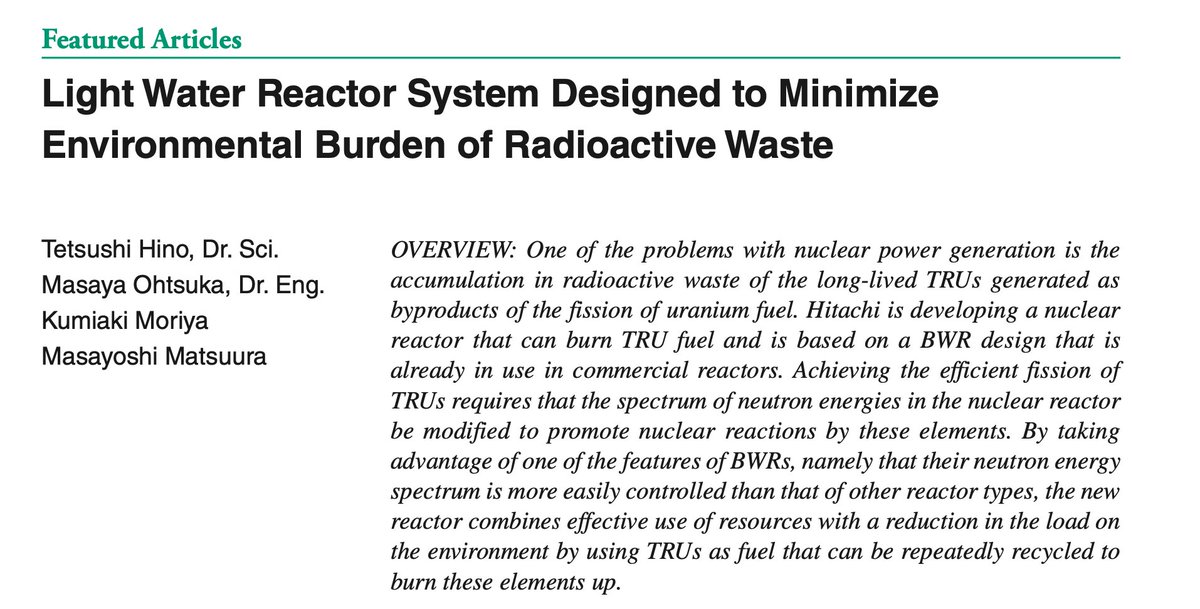
I was looking around for what else could be done and found (again) this cool document about the Resource renewable BWR (RBWR) concept from Hitachi. The idea is that we could substantially alter the cores of current BWRs and make them net waste burners! 2/ hitachihyoron.com/rev/pdf/2014/r…Image
The concept relies on loading two zones of the fuel with transuranic elements (TRUs) and then putting the fuel rods closer together. The neutron spectra is hardened in these regions, thus allowing for burning of the these troublesome TRUs. 2/6 Image
Read 7 tweets
Aug 23, 2024
Ok last time I posted a thread about making antimatter, now let's talk about using it in a rocket! Antimatter rocket concepts cover the full gamut in performance from launchers off Earth to interstellar speed machines and everything in between! 1/22 Image
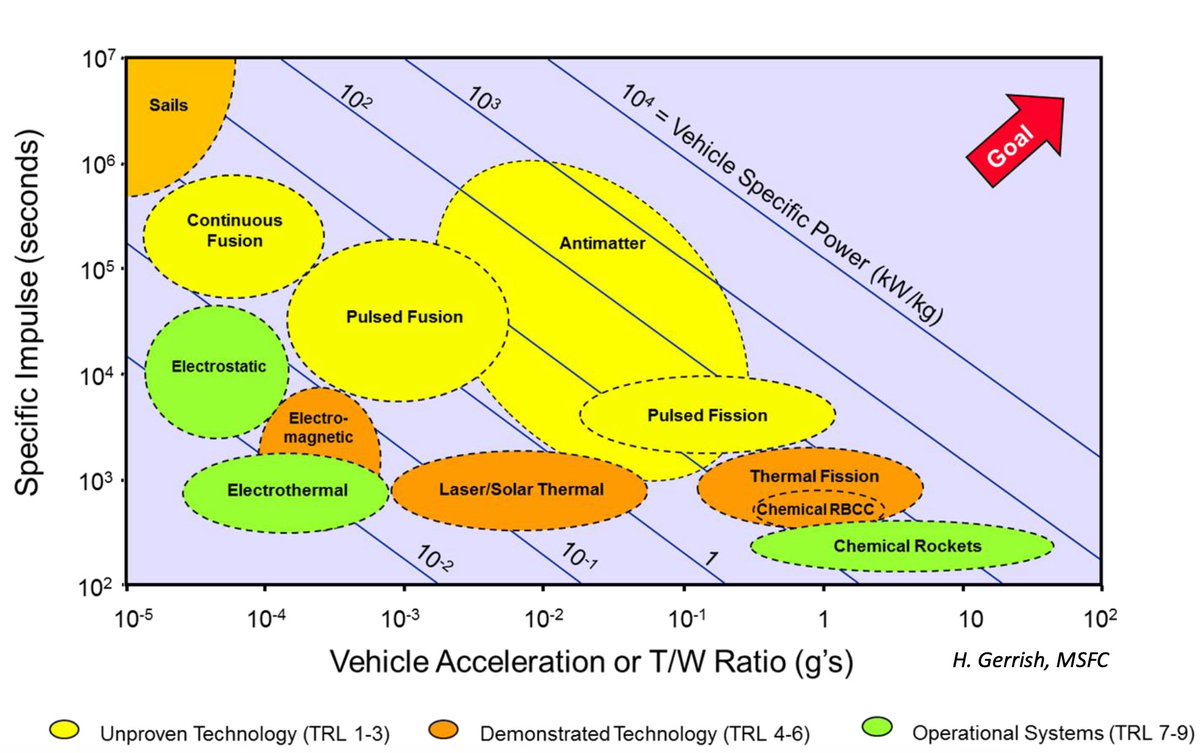
We should first talk about why antimatter? The interest is in the extreme energy density, which then could allow for rockets with very, very high specific impulse. This is like the gas mileage for a rocket and means that we don't need much antimatter to go very fast! 2/22 Image
Antimatter should also allow for reasonably high thrust to weight ratios (TWR), which means the rocket can accelerate up to speed on a reasonable time scale. Once again it comes back to that awesome energy density of ~9E10 MJ/kg, about 1000X fission and 300X fusion! 3/22 Image
Read 22 tweets
Aug 10, 2024
So one fun thing sci-fi fans like to talk about a lot is antimatter (specifically antiprotons) production for starships. The fun part is that we already make antimatter right now! But to get enough antimatter for any uses, we need to do a LOT better. 1/17 Image
The standing record for antiproton production is from @Fermilab during the Tevatrons final years. They hit ~2 nanograms/yr using a spinning iconel target getting bombarded with a 120 GeV proton beam! The target did not live long.... 2/17 Image
@CERN uses a similar approach now, but they are not as incentivized for high production rates since their collider doesn't use antiprotons like the Tevatron did. However, they have really been pushing the science of antimatter storage forward! 3/17 Image
Read 17 tweets
Jun 1, 2023
Since I have seen this article make the rounds a couple times now, I wanted to address how silly the arguments against this HEU fueled test reactor are. Here is a little thread about HEU fueled reactors and why these complaints are BS!🧵 1/11
reuters.com/world/us/us-ur…
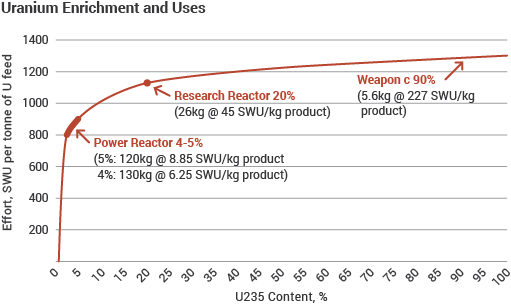
So first of all, what is HEU? Highly Enriched Uranium (HEU) is any uranium with more than 20% U-235, which is the naturally occurring fissile isotope. Natural uranium is 0.7% and typical reactor fuel is 3-5%, but some very small reactors use higher enrichment. 2/11 Image
Above 20% enrichment it is legally classified as HEU. We can quibble about the exact number, but the reasoning is that at this point it is much easier to further enrich the fuel to get to "bomb grade", which is ~90%. So everything from 20% to 99.9% U-235 is treated equally. 3/11 Image
Read 11 tweets

Did Thread Reader help you today?

Support us! We are indie developers!


This site is made by just two indie developers on a laptop doing marketing, support and development! Read more about the story.

Become a Premium Member ($3/month or $30/year) and get exclusive features!

Become Premium

Don't want to be a Premium member but still want to support us?

Make a small donation by buying us coffee ($5) or help with server cost ($10)

Donate via Paypal

Or Donate anonymously using crypto!

Ethereum

0xfe58350B80634f60Fa6Dc149a72b4DFbc17D341E copy

Bitcoin

3ATGMxNzCUFzxpMCHL5sWSt4DVtS8UqXpi copy

Thank you for your support!

Follow Us!

:(