Daniel Profile picture
Dec 9, 2022 8 tweets 3 min read Read on X
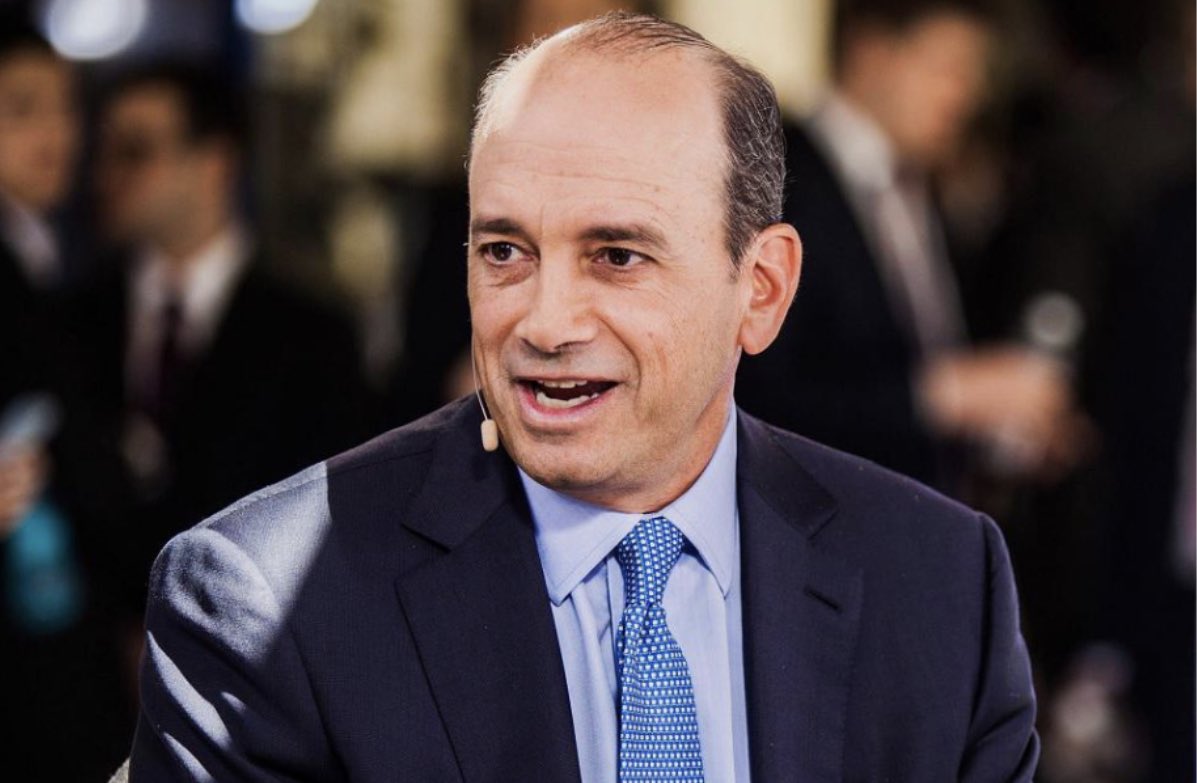
Joel Greenblatt compounded at 49% (!) from 1985 to 2005.

And the best thing, he taught a Columbia Class on how to do it.

Here are 7 Investing Gems from his Columbia Classnotes👇🏼
1. Don‘t do Portfolio Management

If you think like a portfolio manager, you cannot simultaneously behave like an owner.

But portfolio managers research stocks. Owners research businesses.

And that’s what we try to do. Research and buy businesses.

2. Management vs. Incentives

For 90% of investors, getting a genuine and honest picture of the management is impossible.

Instead, look at the incentive structure for the management.

Are they incentivized to add value to the company?

If so, they will. If not, they won’t…

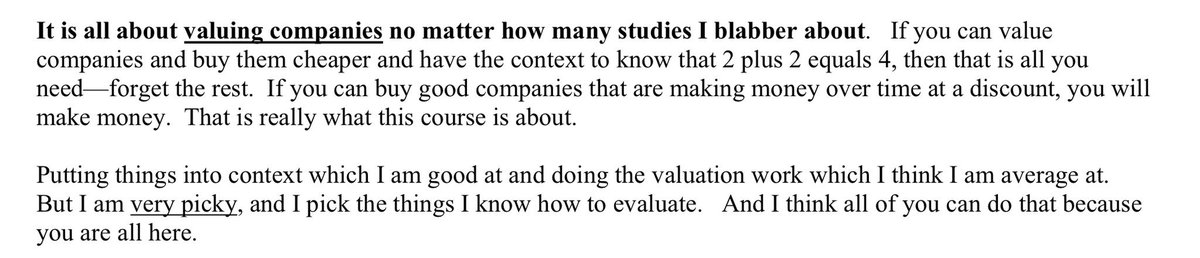
3. All about Valuation

In the end, it’s all about valuation.

Do good valuation work, and you’ll make good investments.

There’s lots of noise in finance and investing.

But that’s not what causes superior returns.

Find the context/story others cannot see, and you’ll do good.
4. Leverage & Patience

If you own a concentrated portfolio, leverage is far more dangerous.

It’ll wipe you out in downturns that ALWAYS occur sooner or later.

Have patience and trust in your decisions, and there’s no need for leverage.

5. What’s your limit?

Most investors fail to see their boundaries.

There are so many names and “opportunities” thrown at you that it’s tempting to fall for them.

But what companies do you actually understand?

For most of us, that will be a very limited amount.

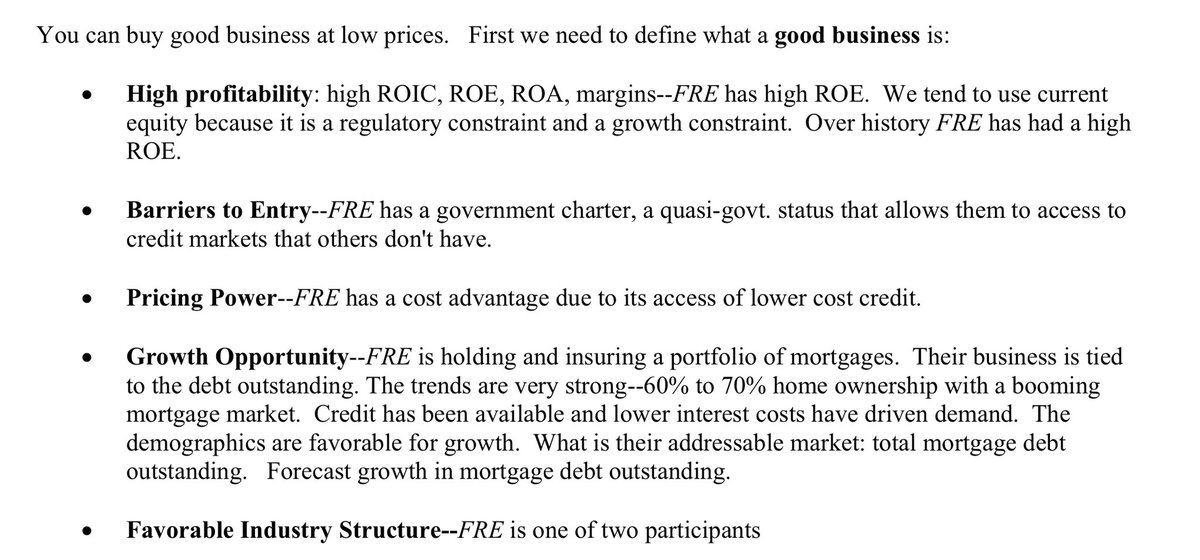
6. What’s a good Business

It’s always: “Buy a good business at a fair price.”

But what is a good business?

This is Greenblatt’s criteria:
You can get the PDF of all Class Notes on my Substack Research Page (link below).

Before you go there, please Like and Retweet this Thread.

Thanks a lot.

Ohh and for more daily Tweets on Investing, follow me @MnkeDaniel 😁

Class Notes PDF:
danielmnke.substack.com/p/resources

• • •

Missing some Tweet in this thread? You can try to force a refresh

 

Keep Current with Daniel

Daniel Profile picture

Stay in touch and get notified when new unrolls are available from this author!

Read all threads

This Thread may be Removed Anytime!

PDF

Twitter may remove this content at anytime! Save it as PDF for later use!

Try unrolling a thread yourself!

how to unroll video
  1. Follow @ThreadReaderApp to mention us!

  2. From a Twitter thread mention us with a keyword "unroll"
@threadreaderapp unroll

Practice here first or read more on our help page!

More from @MnkeDaniel

Jun 29
Bill Ackman made Uber his biggest bet because he knows the market still doesn't fully understand it.

He thinks Uber will be the biggest beneficiary of Autonomous vehicles.

Here's why Ackman bet billions on Uber 👇 Image
1. From Cash Burner to Compounder

Uber used to be the prime example of a loss-making company.

It couldn't scale its operations without hiring more drivers as well.

In other words, there were no obvious economies of scale.

However, Uber managed to turn around its business anyway.Image
In 2023, Uber posted its first full year of profits.

Why? Uber is now the undisputed market leader.

No more discounts to fight off competitors (like Lyft) and more normalized rates.

Additionally, Uber can utilize past losses to obtain tax benefits. Image
Read 12 tweets
May 14
The Most Important Thing by Howard Marks is a must-read Investing Book.

It explains everything that is important in investing!

Here are All 15 Points of the Book explained (bookmark for later): Image
1. Second-Level Thinking

To achieve better returns than others, your thinking has to be better.

Superior thinking is about being different and right.

Second-Level Thinking is about considering second-level consequences.

What happens after the immediate consequence? Image
2. Understanding Market Efficiency

The efficient market hypothesis states that people are risk averse, and thus, more risk = higher reward.

But if that's true, "riskier" wouldn't be risky.

Instead, markets are efficient to a degree. Some more, others less. Image
Read 17 tweets
Apr 27
Anthony Bolton is the former Fund Manager of the Fidelity Special Situations Fund.

He achieved an average 19.5% return over 28 years.

He's also called "The Father of Contrarian Investing."

Here's him explaining how he pulled it off👇 Image
1. "Popularity is risk. Unpopularity is opportunity."

Stock prices move based on supply and demand.

Thus, the more people want to own a stock, for whatever reason, the more expensive it gets.

Conversely, focusing on what stocks nobody wants to own can lead to very cheap prices.
2. "The best opportunities were the uncomfortable ones."

Markets are more rational than value investors want to give them credit for.

The best opportunities exist in uncertain times.

If you wait for the dust to settle, you won't be faster than the market and returns shrink.
Read 8 tweets
Apr 12
Charlie Munger wasn’t just one of the greatest investors of all time — he was also one of the wisest thinkers.

Many years ago, he gave a legendary speech at USC.

Here are 6 timeless lessons from it — for building a successful life 👇 Image
1. "To get what you want, deserve it."

We all chase shortcuts when possible, but this is not a sustainable way to succeed.

If you deliver value, you will get value back.

If you deliver to others what you want, you will get that as well (by and large).
2. "To be successful, be a learning machine!"

You don't need to be the smartest person to be most successful.

But you need to be smarter when you go to bed than when you got up.

Keep learning. Every day. Every month. Every year.
Read 8 tweets
Mar 24
You have probably never heard of Bruce Greenwald.

But he teaches Value Investing, where Buffett once studied it himself.

He taught some of today's famous Billionaire Investors like Li Lu.

Here's what he teaches his students at Columbia: Image
1. Winner vs. Loser

Every trade has a winner and a loser.

Every stock you buy is sold by someone else.

You buy it because you believe you'll make a profit; he sells because he believes the opposite.

With every trade, ask yourself: "Why am I on the right side of the trade?"
2. How to pick the Right Side

You want to buy from emotional or uninformed sellers.

Here's where you find them:

- In non-glamorous, unloved stocks/industries
- In small and micro caps (no institutions)
- In a market selloff (panic)
Read 7 tweets
Mar 5
This is David Tepper.

He is worth over $20 billion and is the Founder and CEO of the Appaloosa Hedge Fund.

He has had tremendous returns of 20%+ annually for decades and is famous for delivering 120% returns in 2008.

Here are his Top 7 Investing Rules: Image
1. Stay Flexible in Your Strategy

One of Tepper’s strengths is his flexibility.

He adjusts his strategy based on changing market conditions.

Whether it's stocks, bonds, or distressed assets, he remains adaptable and is not married to one type of investment. Image
2. Focus on Risk-Reward Ratios

Tepper is known for weighing the risk-reward ratio meticulously.

He invests in opportunities where the potential upside significantly outweighs the downside, even if the situation initially looks bad. Image
Read 9 tweets

Did Thread Reader help you today?

Support us! We are indie developers!


This site is made by just two indie developers on a laptop doing marketing, support and development! Read more about the story.

Become a Premium Member ($3/month or $30/year) and get exclusive features!

Become Premium

Don't want to be a Premium member but still want to support us?

Make a small donation by buying us coffee ($5) or help with server cost ($10)

Donate via Paypal

Or Donate anonymously using crypto!

Ethereum

0xfe58350B80634f60Fa6Dc149a72b4DFbc17D341E copy

Bitcoin

3ATGMxNzCUFzxpMCHL5sWSt4DVtS8UqXpi copy

Thank you for your support!

Follow Us!

:(



