

1/ The Sunday River ski resort near Newry, Maine is a sprawling 870-acre complex of 135 trails spread over eight mountain peaks. Known for its consistent, high-quality snow conditions, the resort is a popular destination for skiers of all skill levels. 

2/ Like much of sparsely populated Maine, Sunday River is characterized by stunning landscapes of unblemished natural beauty. In the summer months, tourists can enjoy a round of golf, partake in a day hike, learn archery, or plan a float trip down the nearby Androscoggin River.
3/ Less than 10 miles northeast of the resort, geological enthusiasts Mary and Gary Freeman recently made a truly remarkable discovery. Just north of Plumbago Mountain in Newry, the couple discovered one of the richest known hard rock lithium deposit in the world.

4/ You would be excused for thinking this incredible find would excite Maine’s environmentalists who believe electric vehicles (EVs) to be a cornerstone of the strategy to wean ourselves off fossil fuels.
5/ Governments around the world have been mandating a shift away from internal combustion engines that burn fossil fuels and toward electric vehicles that rely on rechargeable lithium-ion batteries. This has triggered a huge growth in demand for battery-grade lithium materials.
6/ In a little more than a year, the price of lithium hydroxide risen more than fivefold, making the deposit discovered by the Freemans even more valuable than when they first went public with their findings.
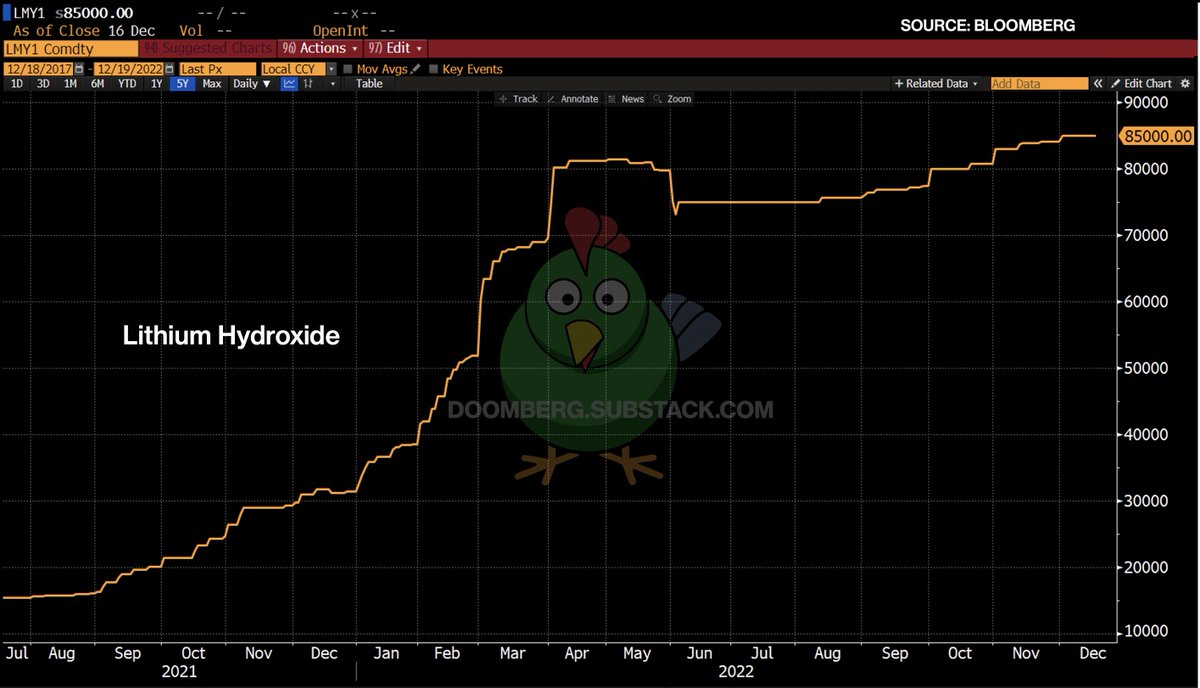
7/ The world would need a massive increase in the supply of lithium to make a meaningful dent in oil demand and meet aggressive CO2 emission commitments. This requires putting discovered deposits, like the one on the Freeman’s property, on the fast-track into production.
8/ Unfortunately for the Freemans and EV enthusiasts the world over, it is a safe bet that no commercially relevant amount of lithium will ever be produced from this remarkable discovery. Maine effectively prohibits the permitting of new mines within its borders.
9/ In 2017, the state legislature put a grinding halt to most new resource development projects. Environmental advocacy groups like Natural Resources Council of Maine (NRCM) – key backers of the new legislation – were quick to celebrate the news.
10/ LD 820, “An Act To Protect Maine’s Clean Water and Taxpayers from Mining Pollution,” bans open pit mines, large wastewater impoundments, and mining on public lands. It also includes a host of other limits and requirements that have driven new mining activity to zero.
11/ If one uses the handy search bar on the NRCM website and queries the word “electric,” a plethora of articles supporting the adoption and proliferation of electric vehicles is quickly returned. See for yourself here: nrcm.org/?s=electric
12/ Forget wanting to have their cake and eat it too, the NRMC wants to manifest cakes that don’t even need to be baked and for which the ingredients immaculately appear. They want to mandate EV adoption yet steadfastly oppose all the real work needed to make that happen.
13/ The citizens of Maine and their elected representatives would like all the benefits the mining sector brings to modern life while taking no part in the reality of acquiring energy resources or critical-to-the-economy minerals.

14/ Of course, the supply of magic cake eventually runs out. It is an objective fact that we aren’t mining enough lithium, copper, nickel, or cobalt to achieve anywhere near the level of EV adoption environmentalists claim is required.
15/ Nor are we building enough electricity generation and transmission capacity to accommodate the massive increase in power demand such a transition would create.
16/ The same environmentalists who cheered the passage of the Inflation Reduction Act will ensure nothing meaningful ever comes of the hundreds of billions of taxpayer dollars being “invested” in the name of climate change.
17/ Grifters will continue to gorge themselves on all the pastry they can eat – the money earmarked in the bill will most certainly be fully spent – and the public will be left with nothing more than debt that won’t ever be repaid and a new pulse of inflation.
18/ That which can’t go on forever usually doesn’t. One way or another, we’ll either get serious about what needs to be done or suffer the consequences of our naïve delusions. Unfortunately, we seem dead set on choosing the second option. <fin>
• • •
Missing some Tweet in this thread? You can try to
force a refresh






