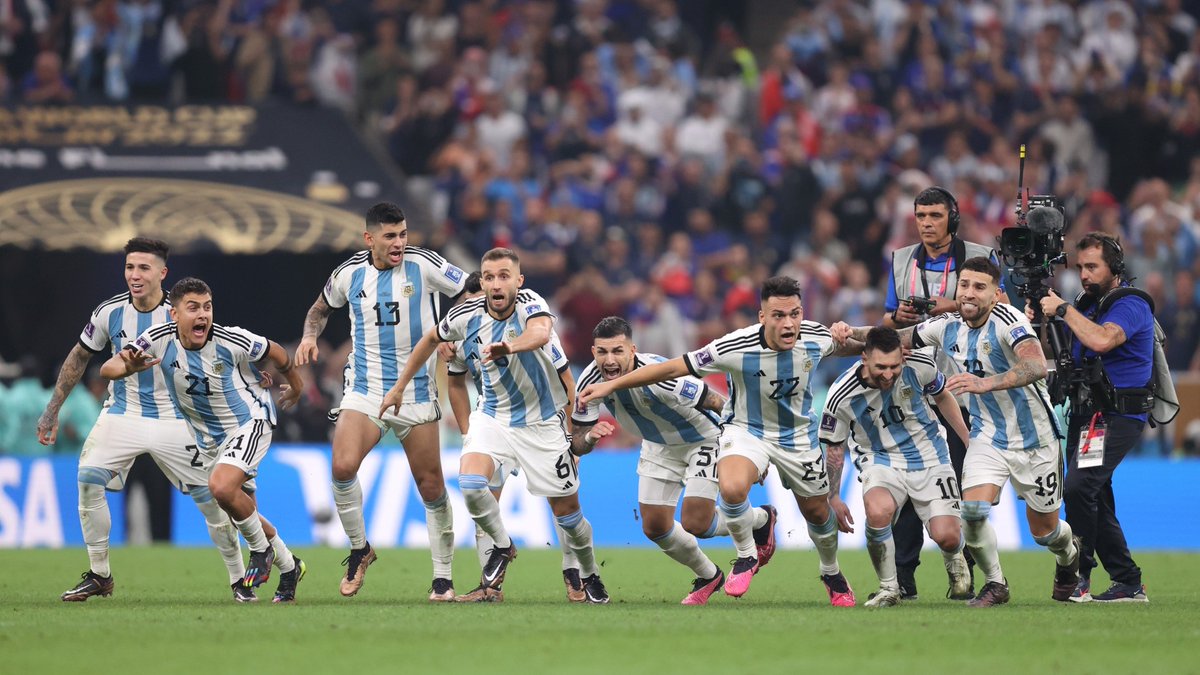
Tonight Argentina didn't just win against France. Nationalism triumphed against Globalism, Belief in God against secularism. Every Argentinian player possessed by a desire to bring joy to their People, to make history for their country, to bring Glory to a Nation.
Look at this image of Montiel, moments after he scored the winning penalty for Argentina. You can feel the joy, the gratitude, the emotion of knowing that an entire country and his family are proud of him, for fighting with pride to the very last minute, for bringing them joy.
Now compare that with this image of 19-year-old Mbappe, after scoring in the 2018 final against Croatia and moments after the final whistle. No joy, no emotion, no pride, no love for anyone but himself.

This isn't to say there weren't any French players who wanted it as badly, I'm sure there were. But when your country actively works to replace you, your culture & your religion w/ people who could never feel the same attachment to the nation, it makes me happy to see them lose.
Victoria a los hombre de Dios! 🇦🇷
• • •
Missing some Tweet in this thread? You can try to
force a refresh

Gooners article got me thinking: a lot of people don't search for/find a partner today because they believe marriage is about them, when it's really all about the kids. So obviously, when you find pleasure in porn, you think it could be a good enough substitute for marriage.
On the opposite end of that spectrum are those seeking the perfect relationship. But perfect relationships not only don't exist, but they also wouldn't work bc the day-to-day struggles (arguments over the dishes, paying the bills, etc.) are where you actually find God, i.e., in bearing the cross. Jung talks about how the search for the perfect love is more of a deep-seated longing for the divine.
While I appreciate Wash's critique of cultural stagnation and especially his focus on the role social media plays in it (which he heavily downplays in favor of critiques of liberalism, which then forces him to down a rabbit hole of "shared culture" nostalgia), what he's really trying to get at is the problem of Mass Consumption, i.e. the thing that turns everything into a "lifestyle" (or a "LARP").
However, Walsh can't point to it, because ultimately Daily Wire is very much part of the mass consumption problem. Not only they are part of it, but they are actually the kings of the Right when it comes to it. 🧵
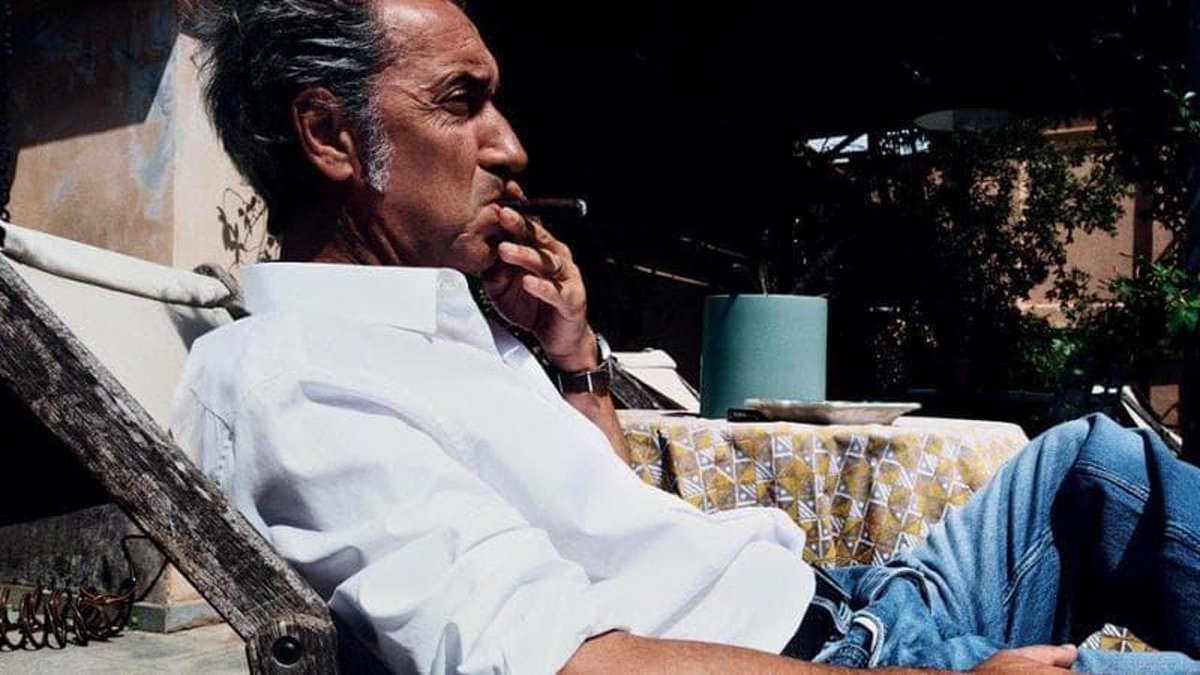
Pop Culture used to be better before the era of social media because High Culture was driving it. Paolo Sorrentino summed this up best when he said: "I don't have Twitter. I'm a serious person."
Sorrentino doesn't just mean "social media sucks"; he means that he's someone who gets his ideas from the great writers, philosophers, poets, etc. He means that he's not trying to "own the Left." He means that he's not attempting to "create a shared culture" (again, "owning the Left"), nor "trying to reach an audience". In a nutshell: he's not trying to turn himself intro a "brand."
Daily Wire, and pretty much all the things Walsh mentions, particularly the influencers he partly blames for the lack of shared culture (which include "thought leaders" like himself, of which he admits, but fails to see the irony in it), ARE brands. They are because they're trying to appeal to the masses, *on social media* (an inherently militarized technology, like all computational technology, i.e. designed for War, hence: division).
This is why Matt can only bring up good examples of pop culture, and can only focus on calling for more good pop culture, but doesn't even mention everything else that drives it: great books, great theater productions, poetry, even groundbreaking philosophy, and so forth.
Conservative/anti-woke liberals, columnists and the likes have this delusion that we can just overthrow status quo by getting everyone to “speak up”. Worst, they put their own efforts in such regards at the same level of "normie" types using their real name on social media. 🧵
As I pointed out before, this mainly because they fail to understand difference between themselves i.e. people engaged in content economy (or “intellectuals”) and the “average” person. There’s a reward structure built into the commentary industry that just isn't there for normies
If someone tries to “cancel” me (editor of publication with connections in industry), unless I say something totally indefensible, it could potentially be best thing that happens to me, professionally speaking. I’d get "bigger", attract more attention to our ideas, and so forth
Interesting that Peterson is defending Fridman on this, though at the same time makes perfect sense. The reason why Lex has been getting so much criticism for the reading list is that it's a pretty good window into what he is/does, and Peterson lately is not much different. 🧵
A lot of people (myself included) have pointed out that this is a pretty basic, generic list of books one's usually expected to read in high school, to which Lex defended himself by saying he's actually re-reading most of them and that they're "profound".
Fair enough. I guess we don't have proof for the former, but let's focus on the latter.
Yes, some of these books are "profound" in many ways. But then why ask people to spend a week on them only? And what is the relationship between them, in that particular order?
This is my great-granduncle, Giordano Bruno Granzarolo. He was one of the 11 pilots who took part in the "mad flight" (il "pazzo volo") over Vienna in a WWI air raid with poet and nationalist Gabriele D'Annunzio in which 400k propaganda leaflets were dropped over the city.
A 🧵
G. B. Granzarolo was born in Verona in 1894, the son of a farmer named Lino and Teresa Zanibello. He enlisted in the army in 1915, quickly rose to the rank of Captain, and eventually joined the Aeronautica Militare (Italian Air Force) two years later, in February 1917.
From the day of its inception, he was part as Lieutenant of the 87ª Squadriglia Aeroplani, also baptized as "La Serenissima", initially composed also of Commander Alberto Masprone and Lieutenants Antonio Locatelli and Aldo Finzi.