
What connects an iconic Indian army battle victory, the famous painter MF Hussain and one of the most iconic slogans ever heard in independent India? Read on to find out (1/10)
Desmond Hayde was born in the UK but grew up in India. Of Anglo-Indian descent, he was educated first at Asansol and then Bangalore. Commissioned from the Indian Military Academy on September 12, 1948, Hayde was placed in the Jat regiment (2/10)
Interestingly, while Hayde spoke Hindi with a thick accent, his Haryanvi was said to be fluent and perfect. It endeared him to the men of his regiment. Their time of glory would arrive in 1965 during the India-Pakistan war (3/10)
In early September, 1965, Lt. Col. Hayde with his 3 Jat regiment was ordered to breach the western bank of the Ichogil canal inside Pakistani territory and occupy the town of Dograi. On the intervening night of 6-7 September, 3 Jat achieved their objective (4/10)
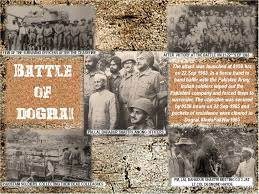
Unfortunately, the regiment had to pull their reins as their supply lines were strafed by PAF fighter jets. The unit was not replenished with ammunition and supplies and was forced to camp inside enemy territory for nearly 2 weeks, awaiting further orders (5/10)
During this delay, the town of Dograi was turned into a fortress by the Pakistani army. The order to attack finally came on September 20. Hayde’s single battalion was faced by a two-battalion strong opposing force, further aided by a tank detachment (6/10)
But the Jat battalion, inspired by their CO, fought ferociously and after 27 hours of relentless battle, took possession of Dograi, at the cost of losing nearly hundred of their own (7/10)
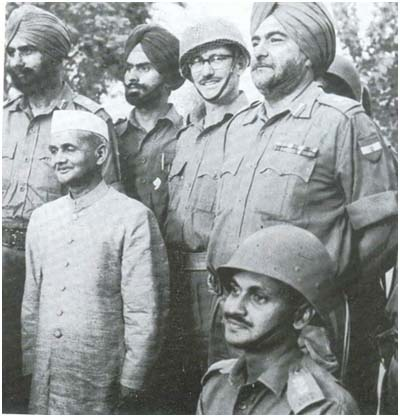
Lt. Col. Hayde’s battle cry “Zinda ya murda, Dograi mein milna hai!” lives on in the history of the Jat regiment. On October 29, PM Lal Bahadur Shastri, while addressing Lt. Col. Hayde’s men uttered his iconic slogan of “JAI JAWAAN JAI KISAAN.” (8/10)
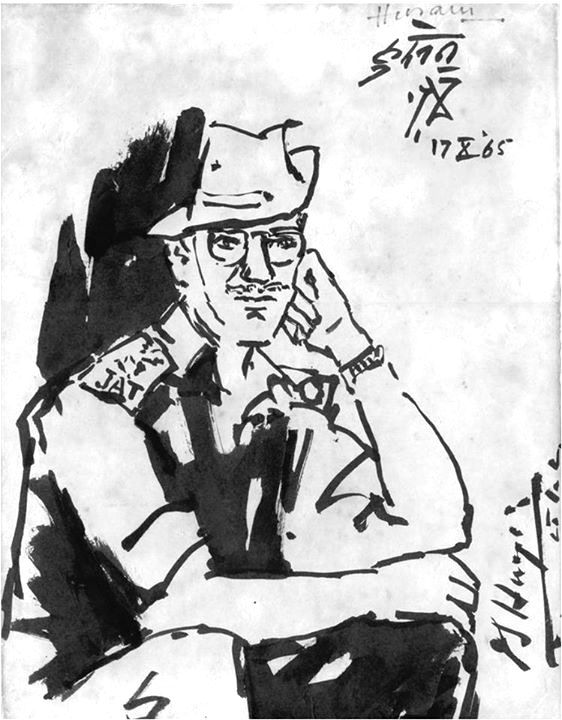
Lt. Col. Hayde is believed to be the only Indian soldier to be painted by painter MF Hussain. Lt. Col. Hayde was awarded a Mahavir Chakra for his gallantry and would eventually retire from the Indian Army as a Brigadier (9/10)
He settled down in Kotdwar, Uttarakhand where a school, built on land donated by Hayde carries his name proudly to this day. Desmond Hayde passed away in 2013 from skin cancer (10/10)
When Burma fell to Imperial Japan in the summer of 1942, it made British Calcutta vulnerable to attacks by the Japanese air force. The city would soon come under intense attacks as feared but a new hero would step up. This is his story - a thread (1/17)
By April, 1942, Japanese fighters had ravaged Ceylon, Kankinada & Vizag. Calcutta was unaffected in April but on the cold night of Dec 20th, 1942, the defenseless city was raided by Japanese fighter jets (2/17)
A massive, gaping hole caused by a Japanese bomb opposite the Great Eastern Hotel served as a brutal reminder to the city’s population of the real & imminent danger. Another raid followed on Christmas Eve (3/17)
In 1951, a determined man returned to Bombay from Europe with a dream of developing Swadeshi products. The 1st of them was a typewriter. A thread on the man - Naval Godrej and creation of India’s first typewriter. @GodrejAndBoyce@amarchitrkatha
Image credit: Godrej Archives 1/10
Naval Pirojsha Godrej (1916–1990), often known as Naoroji, was the youngest son of Pirojsha Burjorji Godrej, an Indian industrialist and the younger brother of Ardeshir Godrej, the man behind the Godrej Group.
Image Credits: Godrej Archives 2/10
When Naval told his father about his desire to create India's first typewriter, Pirojsha cautioned him that the task would be highly challenging and he would accept nothing short of a world-class product such as Remington. 3/10
Calcutta, June 1942. Some players and officials at the East Bengal football ground were shocked to see a thin man, looking almost destitute, walk into the tent. The man was a refugee from Rangoon. What happened next is a stuff of legends. A thread. 1/18
It was the summer of 1942. The world was in the throes of the most devastating war mankind had seen. Slowly, the embers of war had spread to Asia. In February, Rangoon fell to Imperial Japan. 2/18
This watershed event prompted a great exodus of Europeans, Anglo-Indians & Indians from Rangoon back to Indian territory. The British administration only allowed Europeans to be repatriated back on ships and boats. 3/18
When Argentina lifted their first-ever FIFA World Cup in 1978, a remarkable Pakistani born in Bhopal left his indelible mark by helping the Argentines win the prestigious trophy. It is story time and we fly to Buenos Aires. A thread (1/18)
To unearth the personal accounts for this immensely interesting story, we spoke to Ijaz Chaudhry, an eminent sports journalist with roots in both Pakistan and the UK who has written, reported and spoken in several prestigious sports newspapers and on TV/Radio channels (2/18)
1978. Argentina was politically turbulent. Democracy was in tatters, the country was in the grip of a dictatorship. That year, Argentina hosted both the hockey and football World Cups. The hockey event was held in March, and the football extravaganza followed in June (3/18)
On the evening of Dec 3, 1971, Pakistani Air Force fighters attacked Indian airfields sparking off the 1971 Liberation War. Before daybreak, India launched a retaliatory attack. The first blow was by a group of Muktijoddhas – read on to find out more (1/21)
In Mar, 1971, a brutal crackdown across East Pakistan was started by the Yahya Khan administration. One outcome was the formation of the Mukti Bahini – a guerilla fighting force comprising Bengalis from the armed forces, police as well as civilians (2/21)
Initially localized and severely disorganized, the Mukti Bahini gradually took the shape of a more formal fighting force with support from India (3/21)
What are the odds that a little boy from Benares who was left an orphan by the Great Indian Rebellion of 1857 went on to score a goal in the prestigious FA Cup final? Discover the story of William Lindsay, the footballer you may have never heard of. 1/17
1857 was a turbulent year across the British Indian landscape. The Great Indian Rebellion was a result of years of simmering anger and frustration among the people of India, after a long history of exploitation and abuse by the British East India Company. 2/17
Mangal Pandey's rebellious act in Barrackpore sparked a larger revolution in India. Within a few weeks, the Indian uprising had spread to other nearby cities such as Meerut, Agra, Mathura, and Lucknow. But, Cawnpore (now Kanpur) exuded the proverbial calm before the storm. 3/17




