A joint distribution encodes the dependencies between its two marginal distributions (here in the simple case of a density with respect to a product of measures). en.wikipedia.org/wiki/Marginal_…
Fun (...) fact: the figure was generated backwards: from fX and fY, the joint distribution f is computed as the solution of an entropic regularized Optimal Transport (aka Schrodinger's problem).
A much simpler approach (but less pleasing visually) would be to take f(x,y)=fX(x)fY(y) (corresponding to the limit of infinite entropic regularization, ie infinite temperature of the gaz for Schrodinger, or independent random variables for probabilists).
• • •
Missing some Tweet in this thread? You can try to
force a refresh

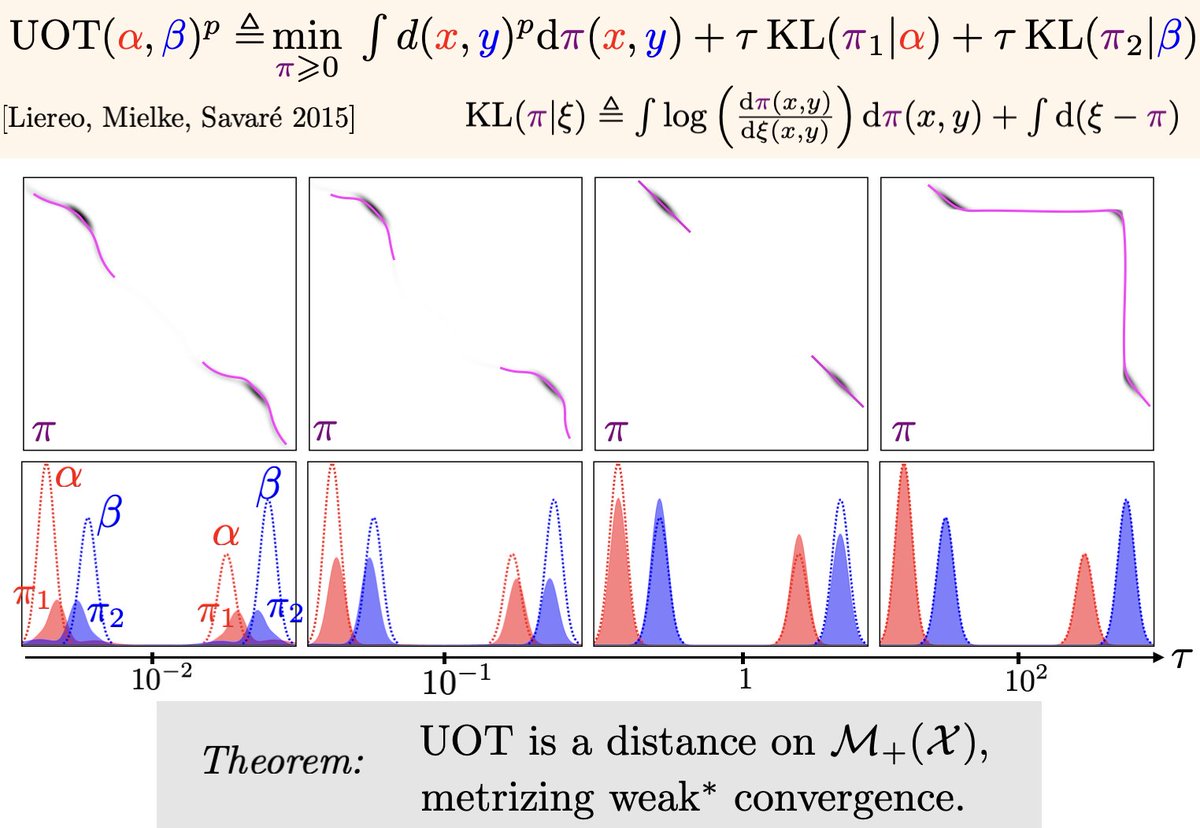
Optimal Transport (OT) imposes the exact conservation of mass, which is often problematic. Unbalanced OT relaxes this constraint and makes OT robust to outliers and noise. 1/7
This idea was introduced by J-D Benamou in a landmark paper, which has since then been very much improved among others by @GSavare. 2/7 esaim-m2an.org/articles/m2an/…
By slightly changing the cost, one can turn this into a geodesic distance on positive measures, which often leads to smoother interpolation than vanilla OT interpolation. 3/7 arxiv.org/abs/1508.07941
Oldies but goldies: L Page, S Brin, The PageRank citation ranking: Bringing order to the web, 1999. Page rank is the leading eigenvector of a stochastic matrix. Can be computed efficiently for sparse graph using power iterations. en.wikipedia.org/wiki/PageRank
What the Perron-Frobenius theorem really is about are convex cones. You can replace the cone of positive vectors by another one, for instance the one of positive semi-definite matrices.