TLDR on the data: the drug has some activity against myelodysplastic syndromes, but also safety baggage.
But I want to talk about something else: the way big ideas in biology often turn into small, very incremental innovations.
This is a common thread in biotech history.
$GERN, in 2000, was a small company with world-changing ambitions. It was one of the companies focused on embryonic stem cells as a treatment. It was also focused on an enzyme called telomerase, which was the longevity fad of its day.
It also had a cult following on Wall Street. A $GERN investor was the first reader to write me hoping that I would get cancer. Guy would have fit in on Twitter.
The drug results today come mostly out of the telomerase work. But they're also a far cry from the fountain of youth hype.
And this isn't just something that's happened once!
I'm reminded of the drugmaker Clinical Data, which was going to pair antidepressants with genetic testing -- what they got was a new antidepressant that got the company bought out for $1.2 billion, but didn't really have a lot of huge advantages.
What happens is that the big idea yields some promise, but less than expected. And then companies hold on, throwing good money after bad, until they finally get some success. This is one reason pharmaceutical innovation is so expensive -- and why we're often disappointed with it.
I don't have a solution. Do we really want to abandon medicines that will eventually work? I don't know.
But biotech often means setting your sights on the stars and hitting the moon.
• • •
Missing some Tweet in this thread? You can try to
force a refresh

Today I'm watching the FDA advisory committee panel regarding expanding the authorization for the Moderna vaccine to children aged 6 years through 17 years.
I'm going to keep my observations in this thread.
We're not live-blogging this one; tomorrow, @HelenBranswell and I will liveblog the panel on vaccines for younger kids.
Voting and discussion, the really important part of the day, won't happen until after 3. Right now they're reading the roster and the conflicts of interest.
Before this starts, I thought it would be useful to toss out my own thoughts on today's discussion. It could be boring! This is an effective vaccine, and the most likely outcome by far is that the panel authorizes it.
I'm watching today's Advisory Committee on Immunization Practices meeting.
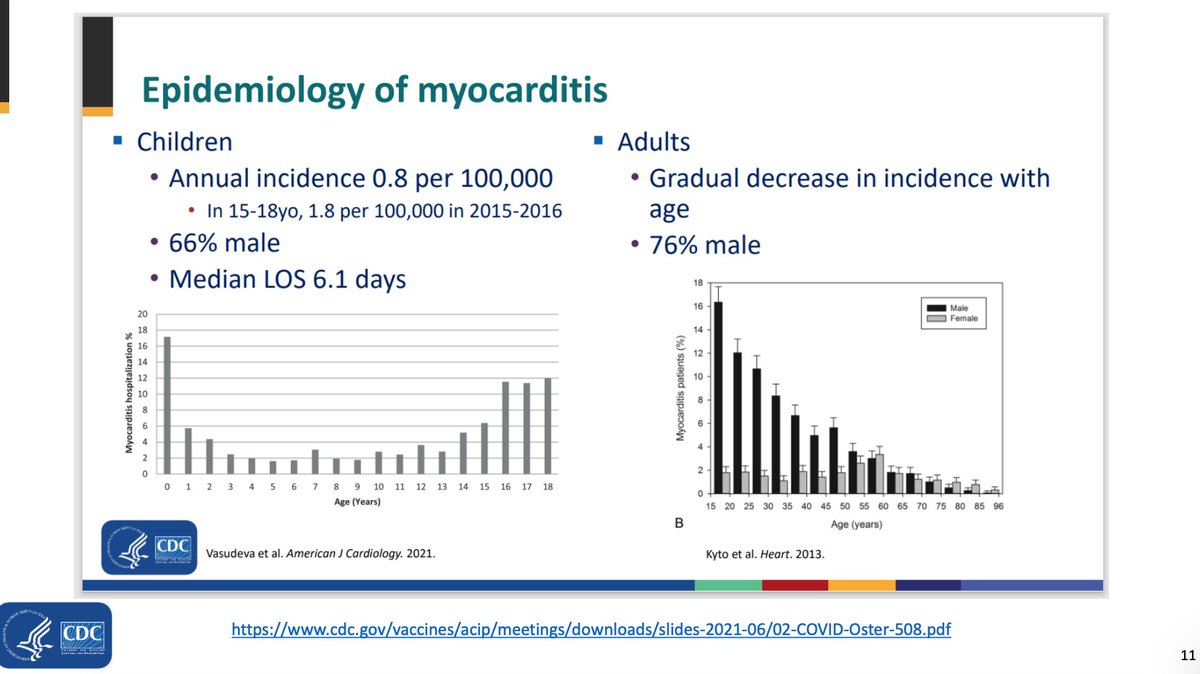
This is a slide that's previously been presented at ACIP, but I think it's very useful for understanding the issue of myocarditis. This is when it occurs without vaccines.
How was my holiday break? Well, a bit panicked. Both my kids, who are adolescents, developed Covid.
Both are fine. My daughter had a fever for two days; my son has seemed asymptomatic. 1/10
It feels like a defeat. We did decide to travel over the break, via train, but avoided high-traffic days and work KN-95s the entire time.
Apparently wasn't enough. Although they could have picked it up at school. Or getting rapid or PCR tests before we traveled. 2/10
We were visiting my parents, so the first sniffle turned into a whirlwind of infection control. Open the windows! Everyone mask up! No one go near the kids' rooms! Rent a car, get out of dodge!
So far, my parents have no symptoms and test negative on antigen. 3/10
I listened in on the $ZY call. Some observations. (Stock is down 68% after hours.
(1) Using synthetic biology to make non-biotech products was always going to be hard. So it's not surprising that it would be difficult to understand how such a product would sell.
(2) Still, the facts here are surprising: a company that just IPO'd predicted it would have a market in the near-term, and that market evaporated.
(3) Basically the only thing this company has going for it is that its chairman, Jay Flatley, is taking over. And that's not a small thing. At $ILMN, Flatley was a legendary CEO who built the company into a giant.
Echoing Jonathan Jackson, Yancy says: "This is a science problem. This is not a political problem."
Jackson responds that we need to rely on infrastructure, not hope. Systemic problems require systemic change.
Highsmith made a point that as a black woman, she worries about getting triple negative cancer and being treated with treatments + algorithms developed with genetic databases that are almost entirely white.
She is, a reminder, a c-level executive at Genentech.
We have a virtual event happening today at 2 that's got me really excited. It's about diversity in clinical trials, and will be moderated by @SciFleur.
The Covid-19 trials may well represent a sea change for recognizing the need to get diverse populations of people into clinical trials. Because, maybe for the first time, companies and investigators had to sacrifice speed for quality.
What do we have to add today?
2/5
What I'm particularly excited about is that we've got speakers who, while all arguing that trial populations need to be diverse, have different experiences.
They each come at the problem from a different angle, and that will likely result in a lively discussion.
3/5