
With all the talk of unity one would think white Christians loved MLK in the 60s. After his assassination, Wheaton College dared to hold a service to honor his life. Some Christians were not happy. 
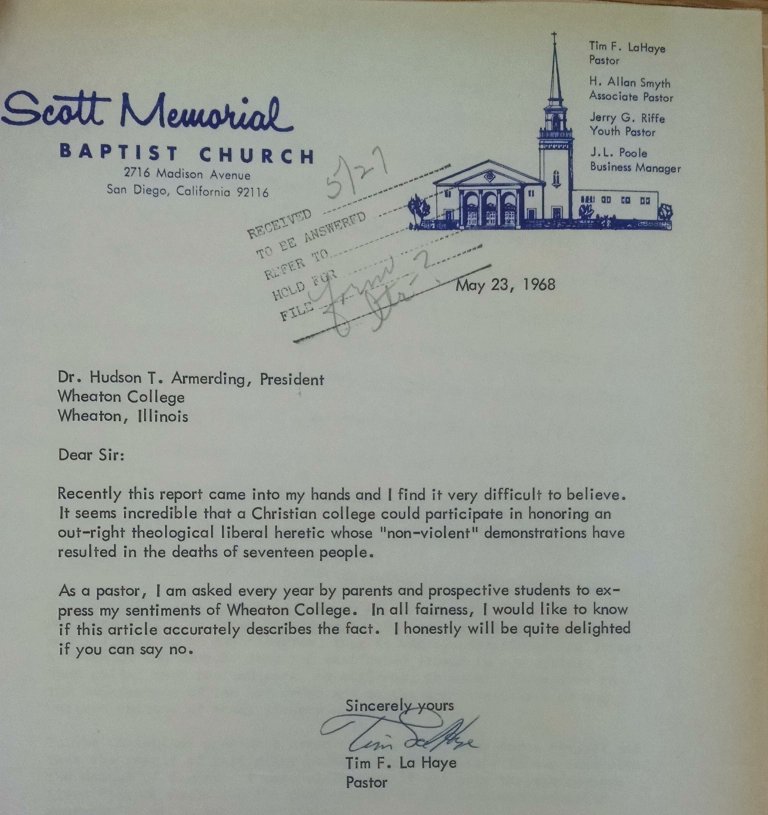
Let's take a look at the tactics used by Tim F. La Haye (Left Behind book series author).
First off, his expression of shock and disbelief. He basically is saying, "This can't be true! How could you do this?"
First off, his expression of shock and disbelief. He basically is saying, "This can't be true! How could you do this?"
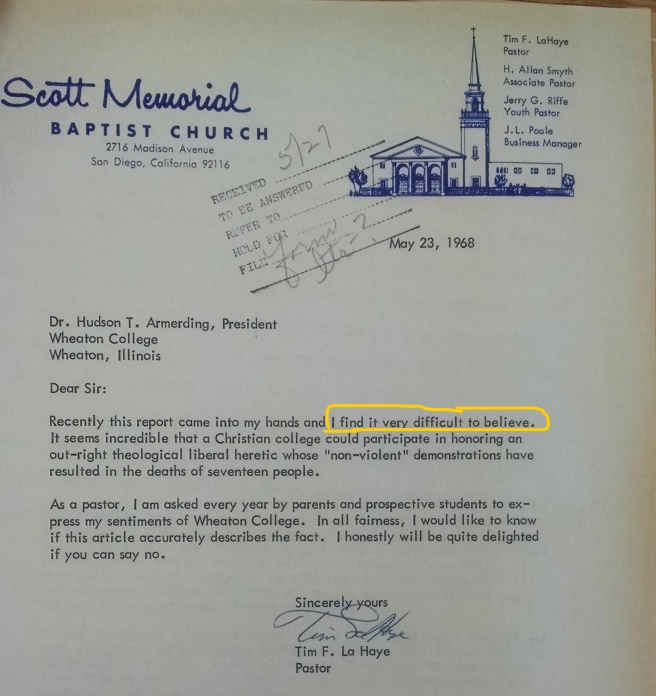
Next up, slandering MLK and labeling him a 'theological liberal heretic.' Unbelievably La Haye then blames MLK for the deaths that resulted from white violence when MLK was literally a victim himself.
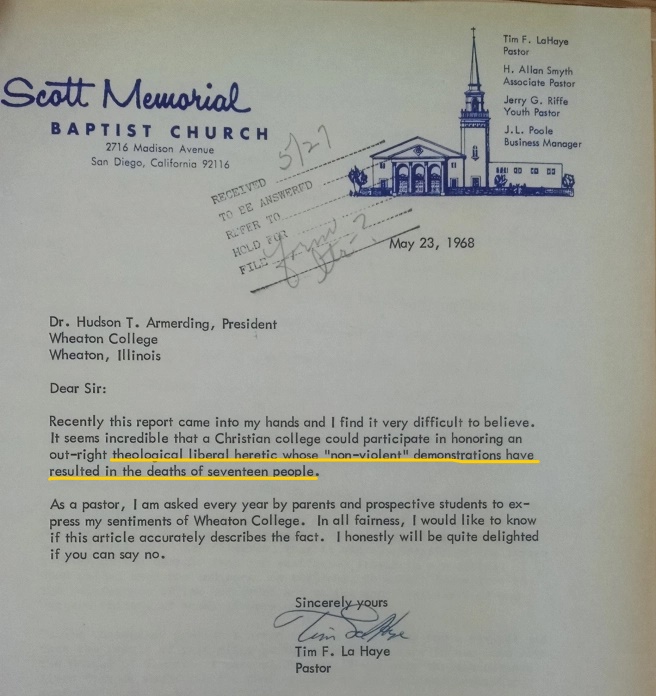
Before the main point of the letter is this appeal to his spiritual authority. Don't neglect to notice this is printed on church stationary. He is speaking as a minister of the gospel, ordained, and consecrated for ministry, representing his church and Jesus Christ.
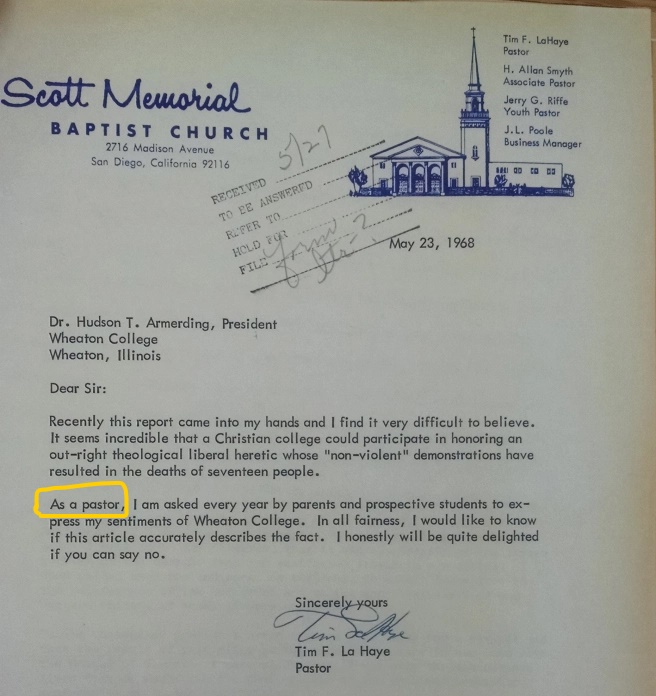
Next is the crux of the letter, the entire reason for writing. Everything else has been set up for this thinly veiled threat: "Don't forget who pays your bills. I will use my influence to dissuade people from enrollment."
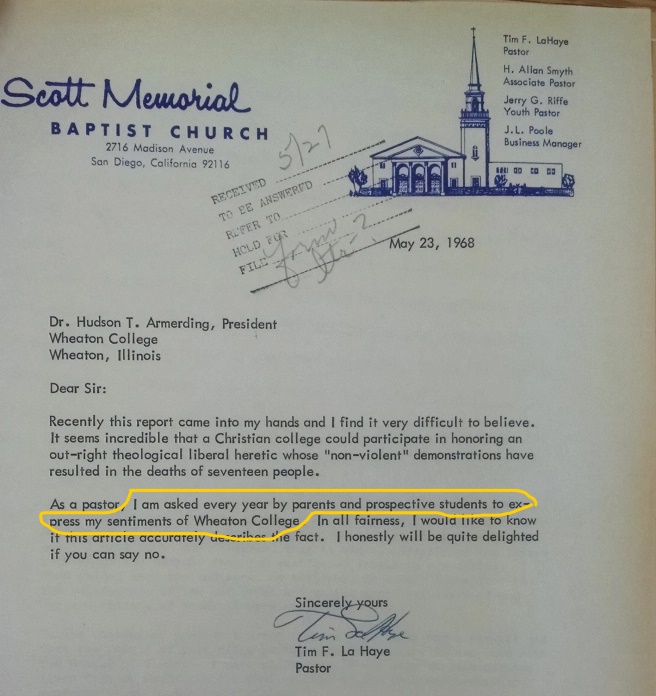
This is a gross misuse of pastoral influence and an attempt at coercive control. He ends the letter by reverting back to his original tone of sincere confused disbelief- feigning that he really just wants clarification and a refutation that the event occurred.
But it's all just a ruse to pad the real point, the threat of a bad reputation. He wants them to know that HE knows what they did and isn't happy about it. It's designed to make them think twice about doing something like that in the future because people are watching.
Lest you think this sort of thing doesn't happen anymore, see this petition from concerned parents "save GCC from CRT" a year after Jemar Tisby spoke on campus. They specifically note the "enormous financial sacrifices" they made to send their kids there.
petitions.net/save_gcc_from_…
petitions.net/save_gcc_from_…
A week after the petition the President put out a statement firmly against the accusations, asking those concerned to consider the purpose of higher education, and denied that CRT was any part of the discussion at the event that concerned them.
The group responded and continued to put up more pressure until finally a specially formed committee released a 23 page mea culpa - stating the decision to have Tisby speak was a 'mistake', but giving no objection to anything was actually said that night.
Tisby notes this, "Yet in the report you reference not a single word or sentence from my 21-minute message. Your silence on the matter leaves the impression that the real issue for you is not how I spoke about racism but that I spoke about it at all."
How will others look at these things 50 years from now? Can we see the historical parallels? La Haye calling MLK a 'liberal heretic' is like today's character assassinations of Christians like @JemarTisby as 'woke liberals.'
A fuller treatment of this event can be found here:
christianitytoday.com/news/2022/apri…
christianitytoday.com/news/2022/apri…
I'm indebted to @jncthehistorian for bringing La Haye's letter to light.
colorblindchristians.com/2017/01/02/doc…
colorblindchristians.com/2017/01/02/doc…
• • •
Missing some Tweet in this thread? You can try to
force a refresh




