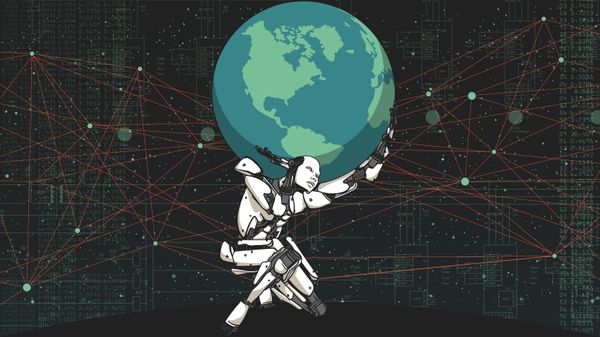
The internet laid the foundations for a digital world brain.
Artificial intelligence will build upon this foundation, and make it a reality.
Here's why.
🧵/1
Artificial intelligence will build upon this foundation, and make it a reality.
Here's why.
🧵/1
Who predicted the internet? H.G. Wells.
Before the internet was even invented, H.G. Wells envisioned a ‘World Encyclopedia’ that would store all human knowledge.
This ‘World Brain’, he thought, would forge an international polity—a new world order.
He was right.
/2
Before the internet was even invented, H.G. Wells envisioned a ‘World Encyclopedia’ that would store all human knowledge.
This ‘World Brain’, he thought, would forge an international polity—a new world order.
He was right.
/2

In his 1962 book, Profiles of the future, Arthur C. Clarke also predicted that this 'world encyclopedia' would be incorporated into an artificially intelligent supercomputer that humans would be able to interact with to solve various world problems.
/3
/3

The internet came into being when the liberal international order was threatened by Russia.
Weeks after the launch of Sputnik, the DARPA agency was created by the Eisenhower administration.
DARPA would lay the foundations for the internet with ARPANET.
/4
Weeks after the launch of Sputnik, the DARPA agency was created by the Eisenhower administration.
DARPA would lay the foundations for the internet with ARPANET.
/4

ARPANET was an offshoot of the US-led counterinsurgency program in Vietnam in the 60's.
Its central purpose was to facilitate that program and enable domestic surveillance efforts undertaken by the US Army and the CIA during the Vietnam war.
/5
Its central purpose was to facilitate that program and enable domestic surveillance efforts undertaken by the US Army and the CIA during the Vietnam war.
https://twitter.com/realhumanschwab/status/1616830136602484737?s=20&t=esw1yXaP-cSp2hJcsRR4dw
/5

DARPA members, like William Godel, were Imagineers of war, specializing in psychological warfare.
Godel was obsessed with tackling communism using advanced science and technology.
Here's an excerpt from Sharon Weinberger's book, incredible stuff:
/6
Godel was obsessed with tackling communism using advanced science and technology.
Here's an excerpt from Sharon Weinberger's book, incredible stuff:
/6


There is much overlap between the history of the internet and the history of the cold war.
Vannevar Bush, who predicted the smartphone and wrote the highly influential "As We May Think" essay—recruited Robert Oppenheimer to run the Manhattan Project that gave us the nuke.
/7
Vannevar Bush, who predicted the smartphone and wrote the highly influential "As We May Think" essay—recruited Robert Oppenheimer to run the Manhattan Project that gave us the nuke.
/7

In the 1990s, the same machines that had served as the defining devices of cold-war technocracy emerged as the symbols of its transformation.
Inspired by the 60s counterculture, hippies like Steve Jobs believed that the personal computer would give "power to the people".
/8
Inspired by the 60s counterculture, hippies like Steve Jobs believed that the personal computer would give "power to the people".
/8


What influenced Job's?
"Taking LSD was a profound experience, one of the most important things in my life...it reinforced my sense of what was important—creating great things instead of making money, putting things back into the stream history & of human consciousness."
/9
"Taking LSD was a profound experience, one of the most important things in my life...it reinforced my sense of what was important—creating great things instead of making money, putting things back into the stream history & of human consciousness."
/9
LSD played a big part in the 60's counter-culture.
It convinced many people that there was a collective consciousness beneath everything.
LSD would influence the view that the internet could create a similar collective consciousness, like a digital world brain.
/10
It convinced many people that there was a collective consciousness beneath everything.
LSD would influence the view that the internet could create a similar collective consciousness, like a digital world brain.
/10

As Michael Pollan writes, "the whole notion of cybernetics, the idea that material reality can be translated into bits of information, may also owe something to the experience of LSD, with its power to collapse matter into spirit."
/11
/11

The film "The Net" documents the close relationship between LSD and Cybernetics
A key 60's figure was stewart Brand, who created the first alternative computer network.
Brand was also a frequent user of LSD with other cyberneticists in the 60's, like John Brockman
/12
A key 60's figure was stewart Brand, who created the first alternative computer network.
Brand was also a frequent user of LSD with other cyberneticists in the 60's, like John Brockman
/12


During the 60's, Stewart Brand belonged to the scene of hippies and artists who lived in houseboats at the edge of Sausalito, California
The author Ken Kesey was a central figure in this scene
Kesey was one of the guinea-pig students in the CIA's MK Ultra LSD experiments
/13
The author Ken Kesey was a central figure in this scene
Kesey was one of the guinea-pig students in the CIA's MK Ultra LSD experiments
/13

Kesey helped create the LSD subculture of the 60's.
He went on tour with musicians and the "Merry Pranksters" theater group.
During these tours, Kesey would conduct so-called Acid tests promoting LSD, to turn consciousness into an 'open system'.
/14
He went on tour with musicians and the "Merry Pranksters" theater group.
During these tours, Kesey would conduct so-called Acid tests promoting LSD, to turn consciousness into an 'open system'.
/14
Stewart Brand said that the main legacy of the 60's was the open-systems approach to everything having to do with computers.
This open-system's approach was the basis for personal computers software and the internet.
Brand's Whole Earth Catalog inspired Steve jobs.
/15
This open-system's approach was the basis for personal computers software and the internet.
Brand's Whole Earth Catalog inspired Steve jobs.
/15
Brand and his cybernticist friends took the side of technology, believing that if tech was democratized, then it would benefit humanity.
Brand mentions the famous anti-tech Unabomber, Ted. K, in the documentary, who took the opposite side of the cyberneticists:
/16
Brand mentions the famous anti-tech Unabomber, Ted. K, in the documentary, who took the opposite side of the cyberneticists:
/16
One of Brand's friends, John Brockman—who also partook in the LSD experiments—founded the Edge foundation.
Brockman has written extensively about cybernetics and artificial intelligence.
When asked about Ted Kazcynski, this is what he had to say:
/17
Brockman has written extensively about cybernetics and artificial intelligence.
When asked about Ted Kazcynski, this is what he had to say:
/17
John Brockman was Jeffery Epstein's "intellectual enabler"
The Edge Foundation famously held billionaire dinners
A BuzzFeed News review of Edge’s IRS filings showed that the nonprofit’s full range of exclusive events would not have been possible without Epstein’s largesse
/18
The Edge Foundation famously held billionaire dinners
A BuzzFeed News review of Edge’s IRS filings showed that the nonprofit’s full range of exclusive events would not have been possible without Epstein’s largesse
/18


Jeffery Epstein, influenced by Brockman's cyberneticist dreams, believed that the human brain and body can and should be artificially enhanced using modern science and technology.
In fact, Epstein wanted to 'seed the human race with his DNA.'
businessinsider.com/jeffrey-epstei…
/19
In fact, Epstein wanted to 'seed the human race with his DNA.'
businessinsider.com/jeffrey-epstei…
/19
Ted Kazcynski was a threat to this elite circle of transhumanists
In 1993, Ted attacked one of Brockman's friends, mailing a bomb to David Gelernter
In 1991, Gelernter had published a book Mirror Worlds, claiming that one day there would be something like the Web
/20
In 1993, Ted attacked one of Brockman's friends, mailing a bomb to David Gelernter
In 1991, Gelernter had published a book Mirror Worlds, claiming that one day there would be something like the Web
/20


In his book, David Livingstone writes:
"Transhumanism, like the New Age movement, is a utopian aspiration derived from the millenarianism which has been the consistent theme of the occult, being derived from the messianic expectations of the Kabbalah."
/21
"Transhumanism, like the New Age movement, is a utopian aspiration derived from the millenarianism which has been the consistent theme of the occult, being derived from the messianic expectations of the Kabbalah."
/21

According to transhumanists: man will create God, the all-seeing eye featuring on the back of the dollar bill, floating above the pyramid of human society, whose omniscience will be derived from mining the accumulated data from recording every facet of human activity
/22
/22


Interestingly...transhumanism, freudian psychology, behaviorism, Kinsey's sex histories, Gramsci’s march through the institutions, the manipulation of the sexual passion as a form of control that was the basis for advertising—can all be traced back to freemasonry.
/23
/23


Adam Weishaupt, founder of the illuminati secret society, laid the foundation for this system of control, borrowing from the jesuits, and the church's method of sacramental confession
Weishaupt created a system of “Seelenspionage” to control minds
How did he do this?
/24
Weishaupt created a system of “Seelenspionage” to control minds
How did he do this?
/24

Weishaupt would 'spy on the soul' by closely analyzing random gestures, expressions, or words that betrayed an adepts true feelings.
Similar to Alfred Kinsey, Weishaupt developed a chart and code to document the psychic histories of members within his secret society.
/25
Similar to Alfred Kinsey, Weishaupt developed a chart and code to document the psychic histories of members within his secret society.
/25

Weishaupt's goal was to create an enlightened man with 'no master'
This was to be achieved by overthrowing thrown and alter, and replacing tradition and revelation with chance nature
The origin of 'moral statistics', or the 'taming of chance' by experts is in this reversal
/27
This was to be achieved by overthrowing thrown and alter, and replacing tradition and revelation with chance nature
The origin of 'moral statistics', or the 'taming of chance' by experts is in this reversal
/27


Today, behavioral modification isn't accomplised through interrogative techniques, like the one's practiced by Weishaupt.
Instead, it's done by computers who condition and nudge our behavior in directions that are favorable to Big Tech giants and the government.
/28
Instead, it's done by computers who condition and nudge our behavior in directions that are favorable to Big Tech giants and the government.
/28

Companies like Google or Facebook deliberately engineer contexts that limit our range of choices, reducing us to rats in a maze.
Algorithms analyze our cognitive functions and—based on that gathered behavioral data—can predict, and even modify, future outcomes.
/29
Algorithms analyze our cognitive functions and—based on that gathered behavioral data—can predict, and even modify, future outcomes.
/29

Behavioral conditioning is similar to Weishaupt's mind control techniques
Both methods seek to understand the subject through analyzing behaviors that escape our conscious awareness
Our Data is used to paint a psychological profile of our unconscious minds.
/30
Both methods seek to understand the subject through analyzing behaviors that escape our conscious awareness
Our Data is used to paint a psychological profile of our unconscious minds.
/30


The goal of the Great Reset is to create digital identities, profiles of the unconscious self.
If they accomplish this, experts and algorithms can shephard our individual choices, creating outcomes which are predictable and certain.
In other words, total social control.
/31
If they accomplish this, experts and algorithms can shephard our individual choices, creating outcomes which are predictable and certain.
In other words, total social control.
/31

Our digital identity will be linked to every click, comment, and share we make on social media; what we buy and sell; how much energy we consume, etc
This information will determine “what products, services, and information we can access.
They want a social credit system.
/32
This information will determine “what products, services, and information we can access.
They want a social credit system.
/32

Social control is intrinsic to all modern technologies (internet, the Cloud, Algorithms, apps, AI bots like Chat GPT, social media services, etc).
Big Digital has always sought to collect and control information, to constrain and frame online behaviors.
/33
Big Digital has always sought to collect and control information, to constrain and frame online behaviors.
/33

As Michael Rectenwald writes, “the Google system of centralized knowledge control resembles nothing as much as it does the centralized Soviet system of production and distribution, only digitalized and privatized."
Where will this system of digital authoritarianism lead?
/34
Where will this system of digital authoritarianism lead?
/34

Just as the nuclear arm's race between Russia and America gave us the internet, the artificial intelligence arm's race between China and the United States will spawn new dystopian technologies.
We will have 'smart cities' — digital panopticons.
No freedom or autonomy.
/35
We will have 'smart cities' — digital panopticons.
No freedom or autonomy.
/35

The purpose of every manufactured crisis (9/11, Plandemic, climate change), and every government-sponsored social movement (BLM, sexual revolution), has been used to get us closer to this point of total social control.
/36
/36



Dissidents who have fought against this system of social control have either been imprisoned, excommunicated, or punished
Aaron Swartz was chased down by the law, whistleblowers like Edward Snowden or Jullian Assange were declared criminals — threats to 'national security'
/37
Aaron Swartz was chased down by the law, whistleblowers like Edward Snowden or Jullian Assange were declared criminals — threats to 'national security'
/37


The fourth industrial revolution is around the corner.
New artificial intelligence technologies are developing everyday, and soon we will have tech that goes under the skin—brain chips like Neuralink.
Man and machine are merging as one.
/38
New artificial intelligence technologies are developing everyday, and soon we will have tech that goes under the skin—brain chips like Neuralink.
Man and machine are merging as one.
https://twitter.com/SmokeAwayyy/status/1617082270501965826?s=20&t=nWuiUyB58y4DMu0Kd18hRg
/38
The transhumanist's dream is to create a God on earth—a 'world brain'.
Similar to many mystical traditions, the global brain idea holds the promise of a much enhanced level of consciousness and a state of deep synergy or union that encompasses humanity as a whole.
/39
Similar to many mystical traditions, the global brain idea holds the promise of a much enhanced level of consciousness and a state of deep synergy or union that encompasses humanity as a whole.
/39
In reality, the transhumanists dream—uploading one's consciousness to a digital world brain—would mean the end of consciousness itself.
Technology will not merge man and machine; we will not take charge of our evolution.
Humanity ends where artificial intelligence begins.
/END
Technology will not merge man and machine; we will not take charge of our evolution.
Humanity ends where artificial intelligence begins.
/END

• • •
Missing some Tweet in this thread? You can try to
force a refresh