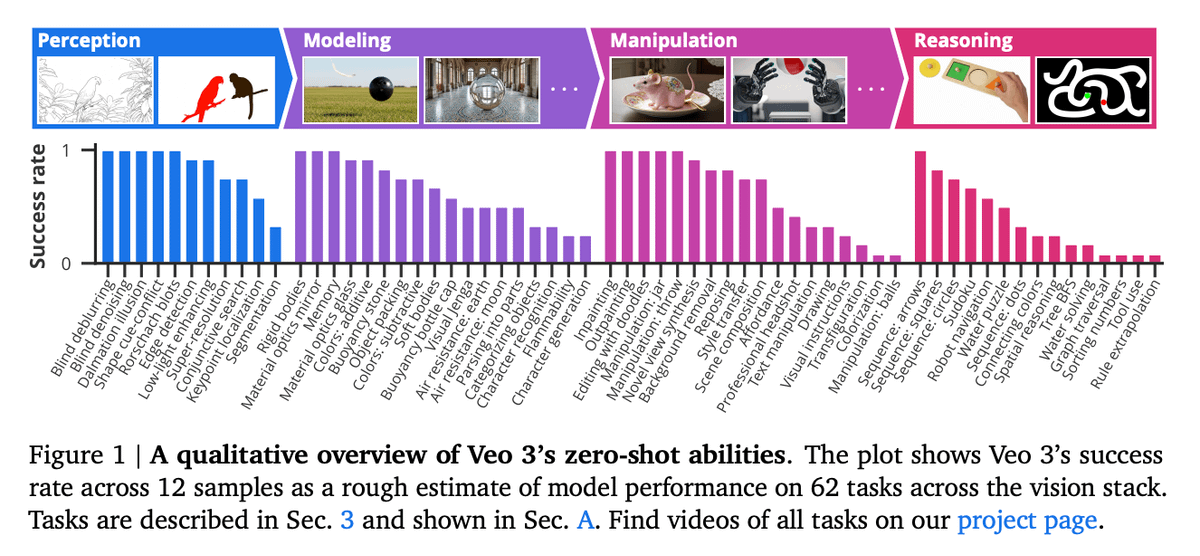
My favorite paper this year: "Video models are zero-shot learners and reasoners"
It illustrates that video models show emergent visual reasoning at scale - they can solve vision tasks they weren't trained for.
This may be the "GPT moment" for vision. Let's break it down 👇
To start - why believe that video models might develop visual reasoning?
A similar thing happened in text. We used to train specific models for each task - but now, LLMs have general language understanding and can tackle lots of tasks that they weren't explicitly trained for.
It's feasible that video models may do the same at scale.
This paper measured 18k+ videos generated by Veo 3 across both qualitative and quantitative tasks.
It found that Veo can perceive, modify, and manipulate the visual world (starting from image + text prompts) - showcasing early reasoning skills that it wasn't explicitly trained for.
Three years ago, I went down the rabbit hole on AI x creative tools - and it's been incredible to see how quickly this space has evolved.
Thrilled to bring together the best founders + creators to share learnings + try new tools!
Our curated group of creators will spend the day in demo sessions featuring the best tools across modalities: @elevenlabsio, @theworldlabs, @krea_ai, @hedra_labs, @ideogram_ai, @heyglif, @LumaLabsAI, @ViggleAI
We're very lucky to have these founders + product leads join us.
@elevenlabsio @theworldlabs @krea_ai @hedra_labs @ideogram_ai @heyglif @LumaLabsAI @ViggleAI Exciting launch today - @LumaLabsAI's Ray 3 dropped, and the team is here to give our creators a demo + chat through the model strengths.
It's a reasoning video model that can generate studio-grade HDR 🤯
AI will change the way we shop - from where we find products to how we evaluate them, when we buy, and much more.
What types of purchases will be disrupted, and where does opportunity exist in the age of AI?
More from me + @arampell 👇
To start - what are the categories of commerce? (for consumers)
We divide them by level of consideration, from impulse buys to life purchases.
These have vastly different processes - you don't buy a new backpack and a car in the same way - which means the way AI touches each purchase category will vary.
Some thoughts on how this might shake out:
1) Impulse buys - the candy bars you pick up at the checkout counter (or their digital equivalent).
You don't do a lot of research in advance, so it's tough for AI to play a role in your shopping process.
But the algorithms on social apps will continue to improve + target you with more relevant impulse purchases (like that cat-shaped water bottle or $15 t-shirt from your favorite show).