Let 2yo out of sight for a minute. Heard her calling for help.
Found her here. She was now asking a stranger for help, not to get down, but to go “higher to the top”.
I was delighted. But said stranger was a jot judgmental towards my delight and seemingly cavalier attitude.
Found her here. She was now asking a stranger for help, not to get down, but to go “higher to the top”.
I was delighted. But said stranger was a jot judgmental towards my delight and seemingly cavalier attitude.
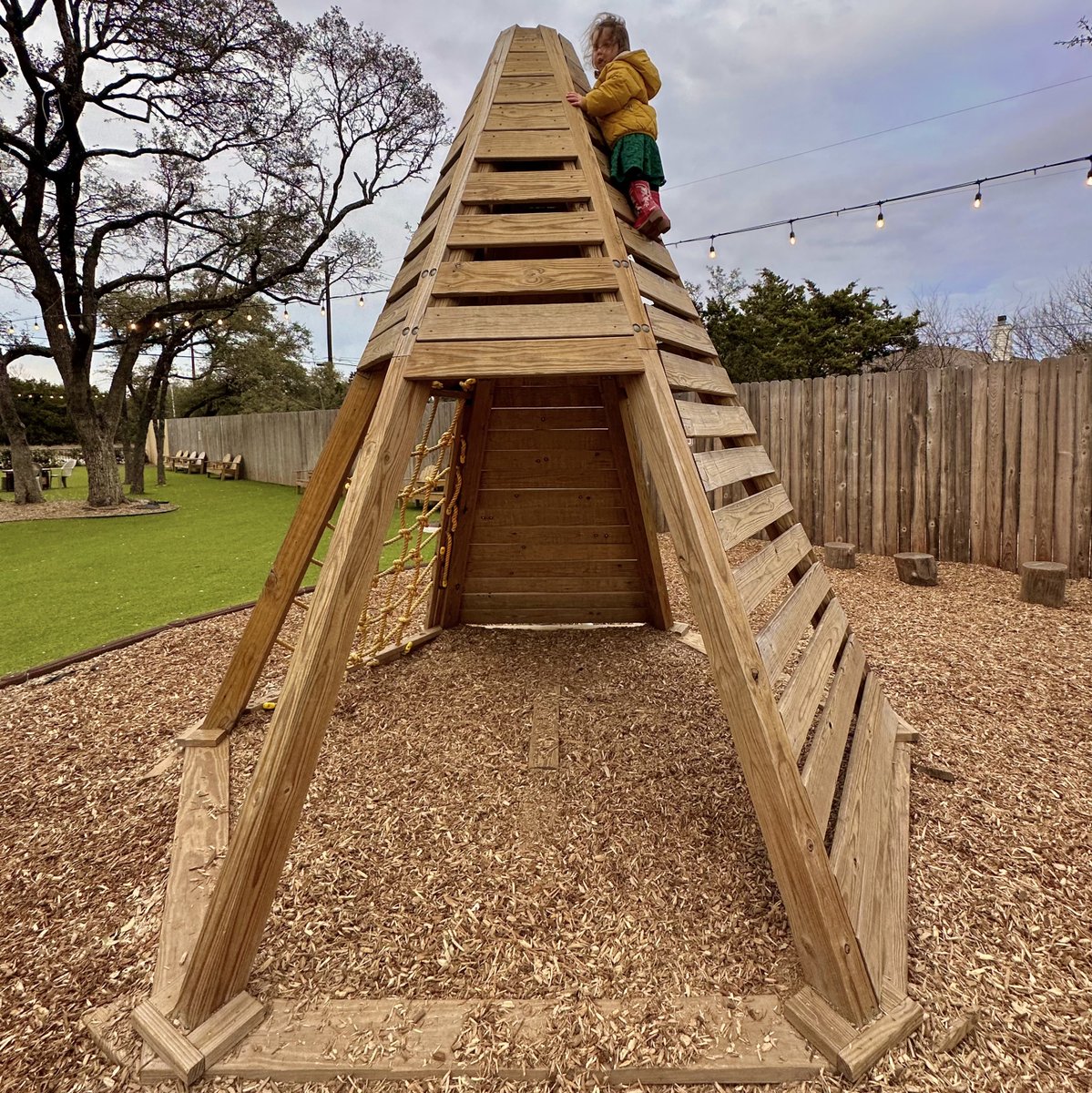
2yo is actually naturally fairly risk averse. Can only take so much credit for her emergent daring but it is partly the result of a sustained campaign of letting her take every risk she chose to take where I thought the reasonable worst case scenario was sub hospitalization.
https://twitter.com/mbateman/status/1429468580484194311
She’s had numerous small burns and cuts and bruises and scares. But this is deliberate on my part.
Children want to exercise their faculties, including their capacity to flirt with danger, to be scared and excited, and to cope with and recover from injury.
Children want to exercise their faculties, including their capacity to flirt with danger, to be scared and excited, and to cope with and recover from injury.
https://twitter.com/mbateman/status/1520834161120063491
One of the proper goals of parenting (and by extension education) is to intelligently help a child develop agency about risk.
Like all agency this requires both choice and competent judgment. Which means knowledge, which means learning by doing and failure.
Like all agency this requires both choice and competent judgment. Which means knowledge, which means learning by doing and failure.
https://twitter.com/mbateman/status/1505371369588117506
Our overly padded world and overly dovish attitude towards what I consider normal low grade dangers—playground exploration, tree climbing, glass, fire, knives and hand tools, etc.—deprives children of the foundations of wisdom and joie de vivre. Not a small thing to forgo.
https://twitter.com/mbateman/status/1346311751416033280
There’s a tiny minority of voices like @FreeRangeKids who are consistently good on these issues.
Outside of this minority, every force in our culture is overwhelmingly oriented towards make this part of parenting at best awkward and at worst traumatic.
Outside of this minority, every force in our culture is overwhelmingly oriented towards make this part of parenting at best awkward and at worst traumatic.
https://twitter.com/mbateman/status/1618021334046609408
I’m pretty fanatical about this issue and still find it hard. There are overly restrictive sociocultural guardrails everywhere, some obvious and some less visible.
But nothing is more risky than too little risk in childhood.
But nothing is more risky than too little risk in childhood.
https://twitter.com/mbateman/status/1589371414544408578
• • •
Missing some Tweet in this thread? You can try to
force a refresh