Stefano Palminteri Profile picture
Feb 25, 2023 13 tweets 7 min read Read on X
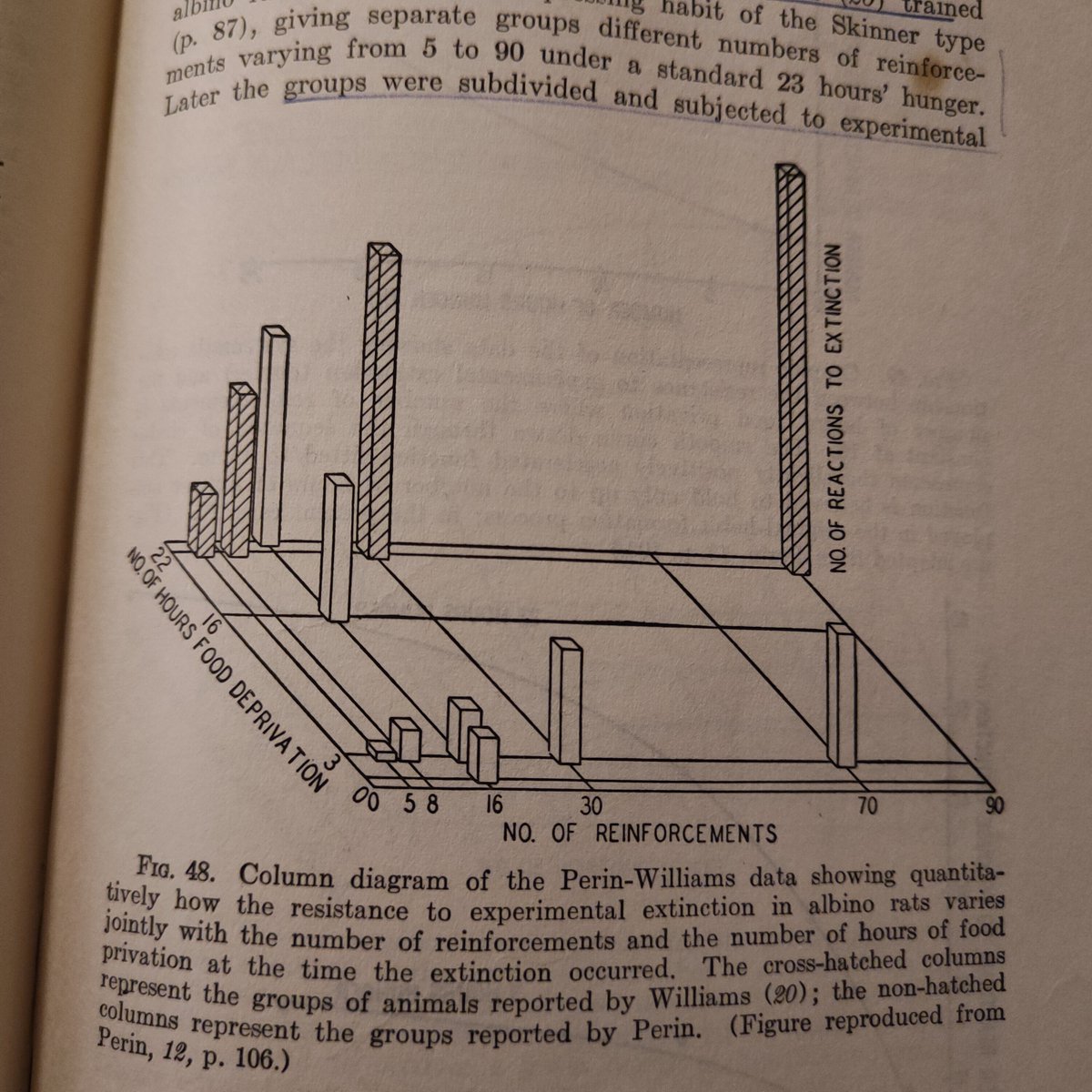
I just finished reading an all-time classic of experiment psychology “Principles of Behavior” by Clark Hull (1943). In the book, the author tries to delineate the first principles of a scientific theory of behaviour, based on a capillary survey of (mainly) animal experiments 1/n
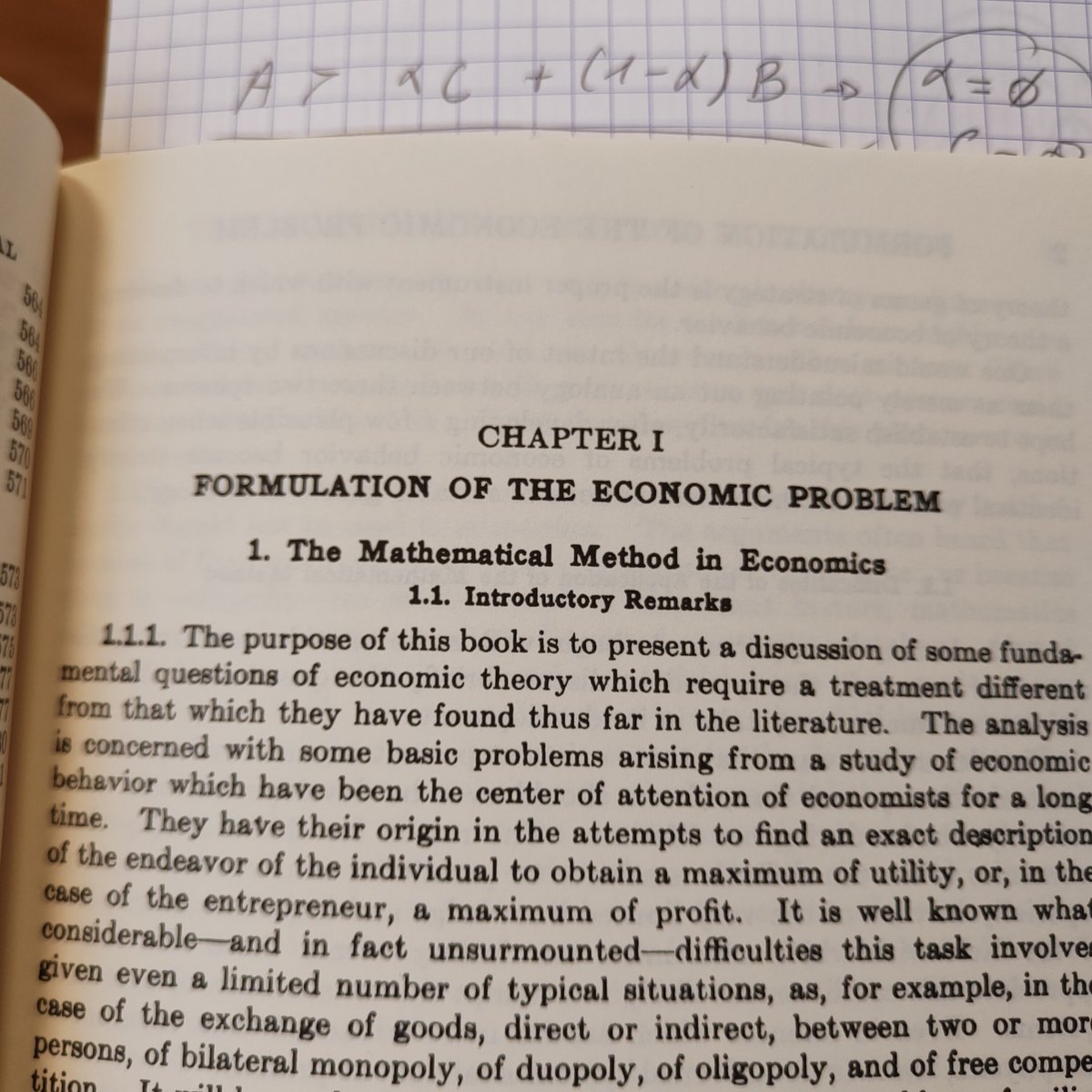
The first chapter presents his epistemological manifesto in favour of a mathematical (logico-deductive) formalization. It reminded me of the preface of “Theory of games" (1944). Back then use of formal approaches to social sciences was presented as a necessary paradigm shift
In chapter II, we dive into the specifics of what an objective theory of behaviour should be. Of prime importance here is the introduction of the notions of intervening variables and observables, which illustrate how the standard narrative about behaviourists is false
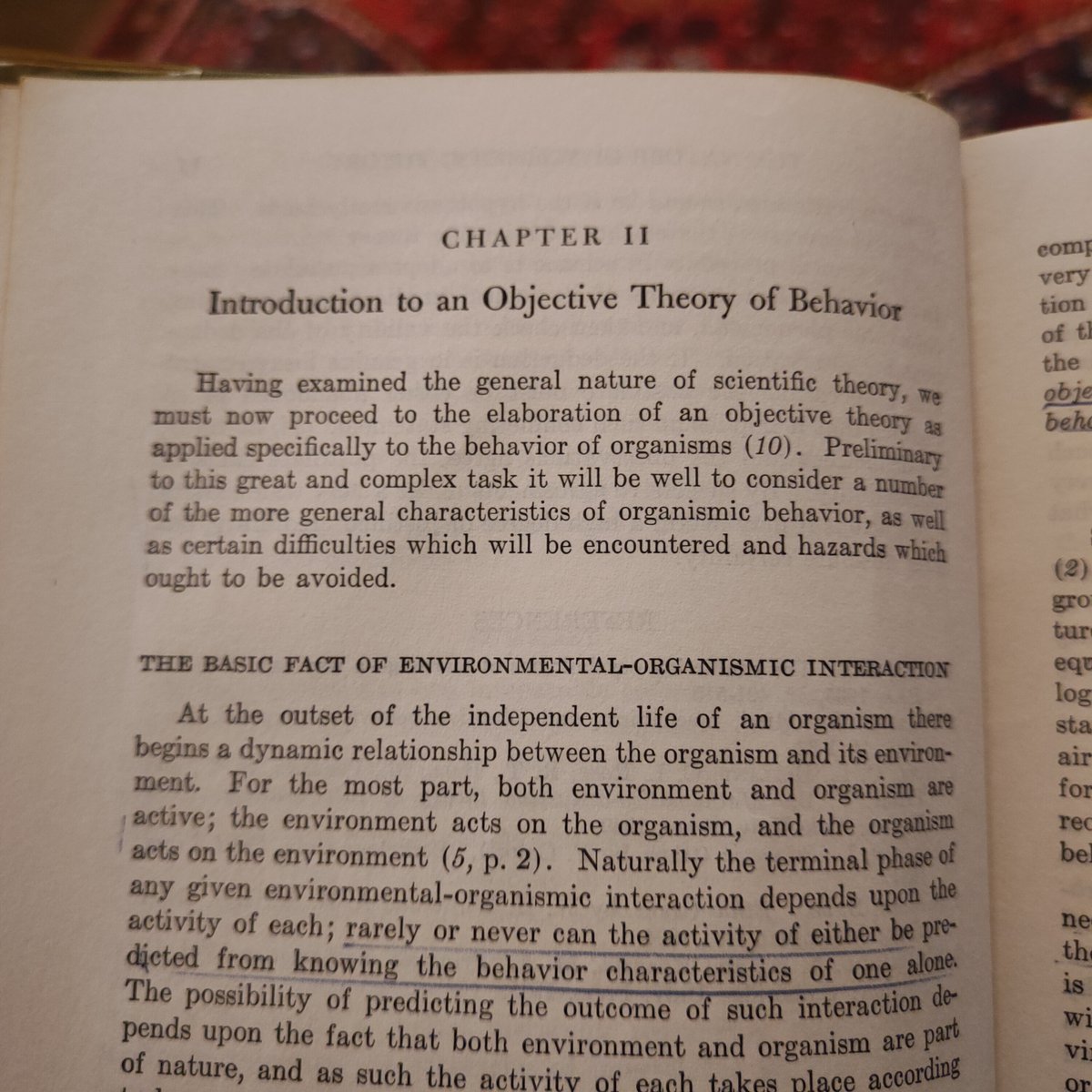
The intervening variable is explicitly described as an inobservable theoretical construct necessary to explain the relationship between stimuli and responses: a "mental" state. We are far away from the picture of behaviourism usually given by the cognitive "revolutionaries"
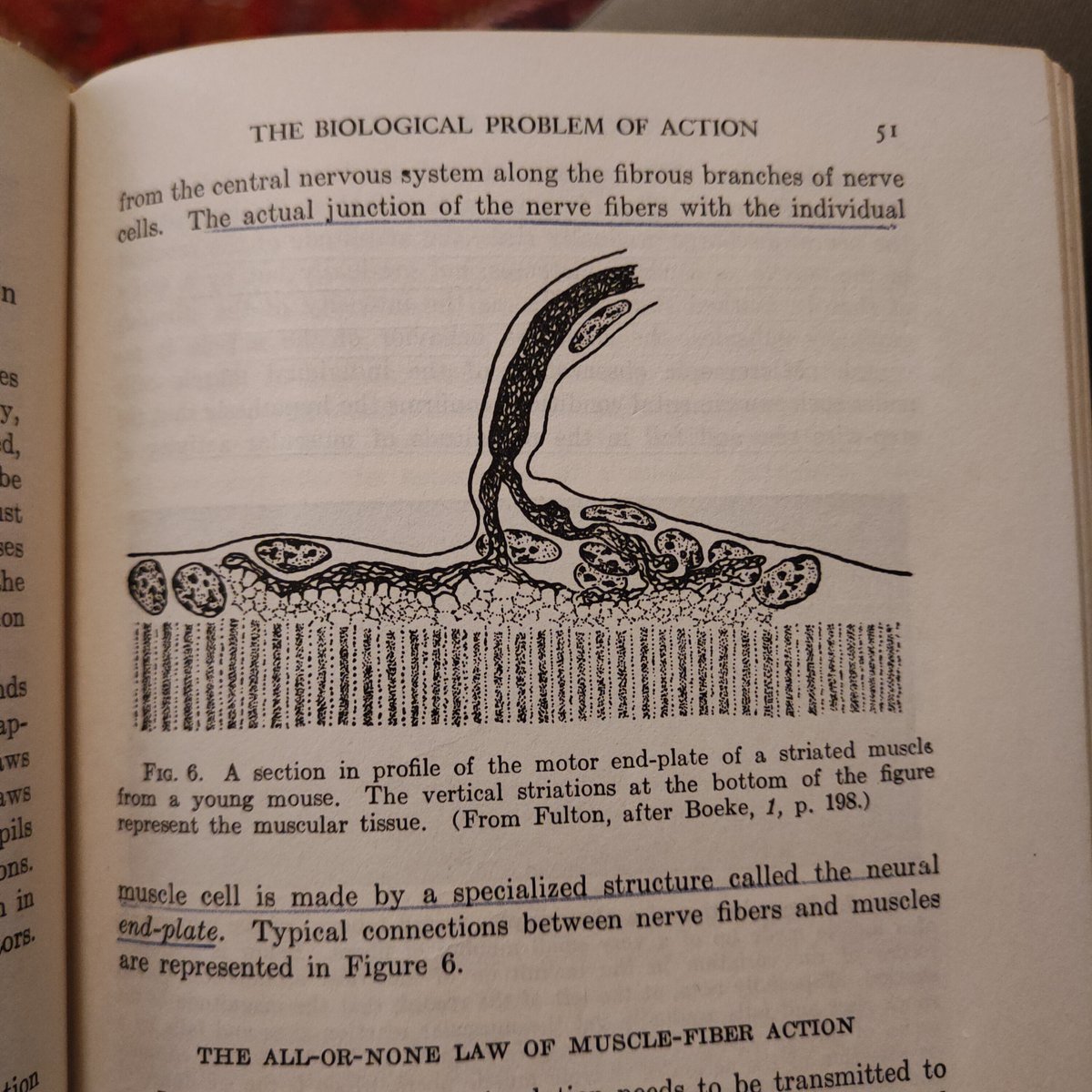
Chapter III and IV summarize the then current notions of perception and action. It is functional to a scientific theory of behaviour because these represent the input and the output of the system. What also clearly emerges from here and is confirmed in the remainder of the...
... the book is the author is clearly persuaded of the fact that behavioural experiments and analysis are a logical way to gain access to the neurophysiological mechanism governing the brain (a position that I share and is, if not dominant, still alive...)
After quickly addressing innate behaviours (Ch. V), Chapter VI finally introduces the acquisition of receptor - effect connections and primary reinforcement, conceived as drive (D) or need reduction.
The notion of Drive is key in Hull's theory. It plays a double role in defining, we now would say, the reward function (in a way similar to that recently proposed by @MehdiKeramati4 and @BorisGutkin) and of a discriminative, contextual, stimulus
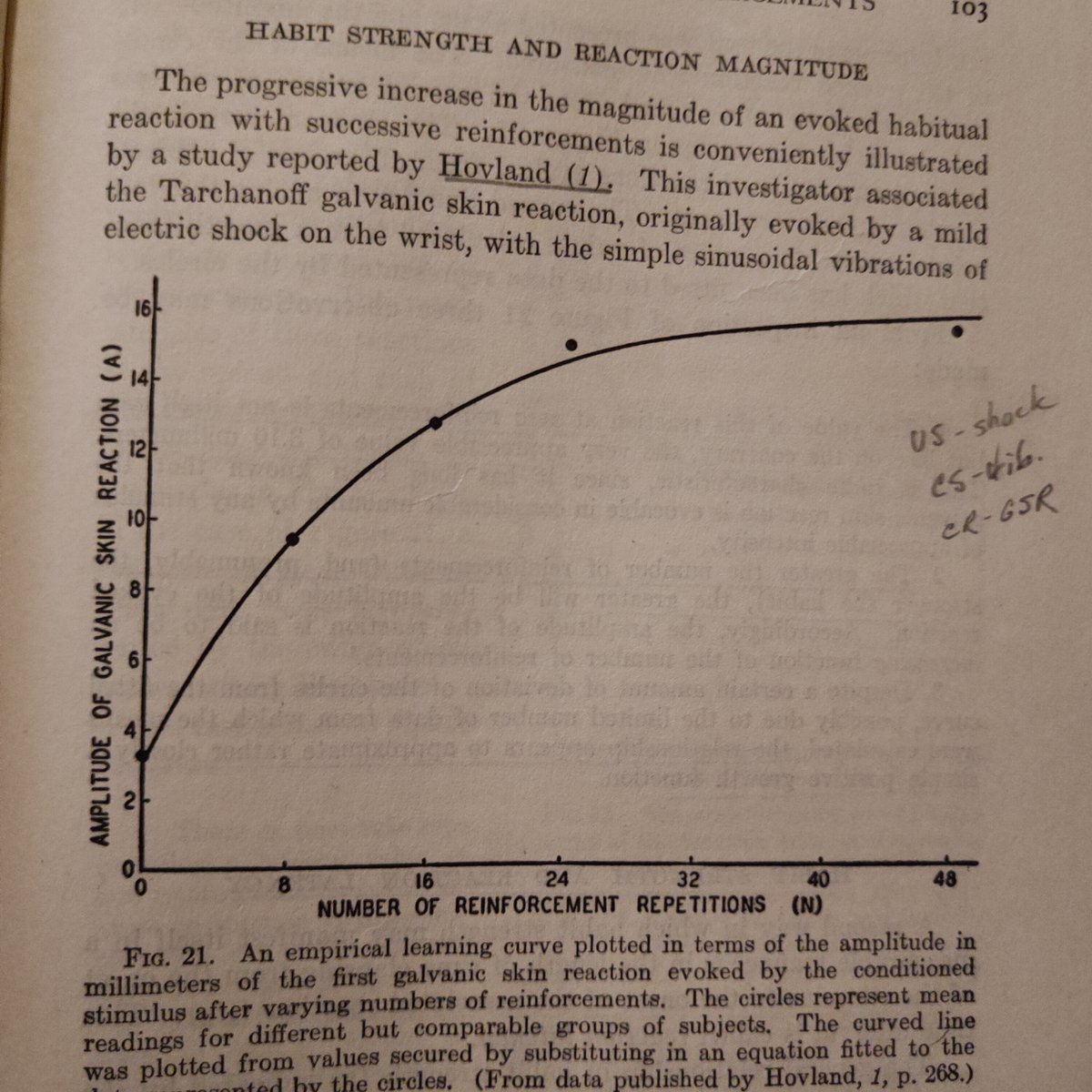
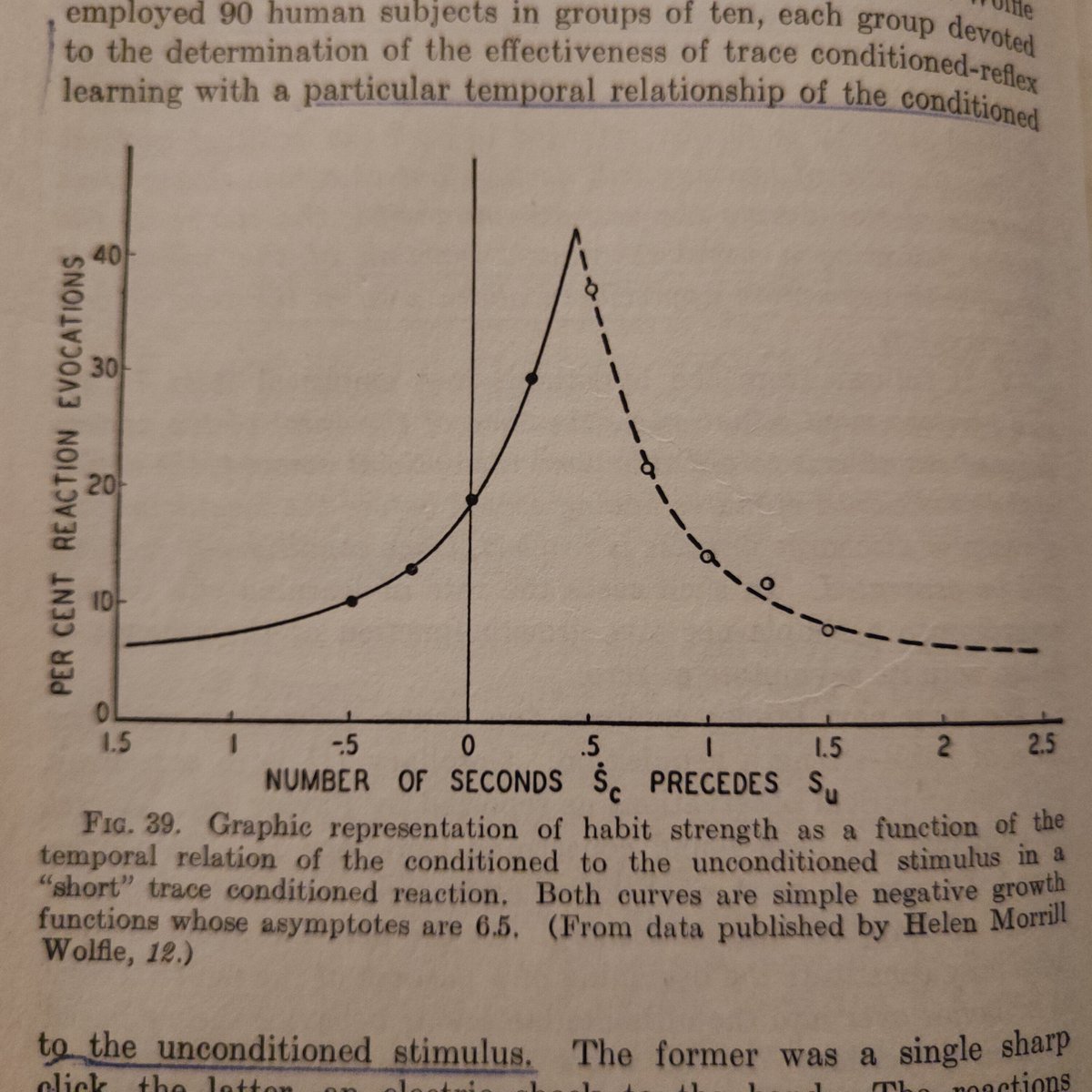
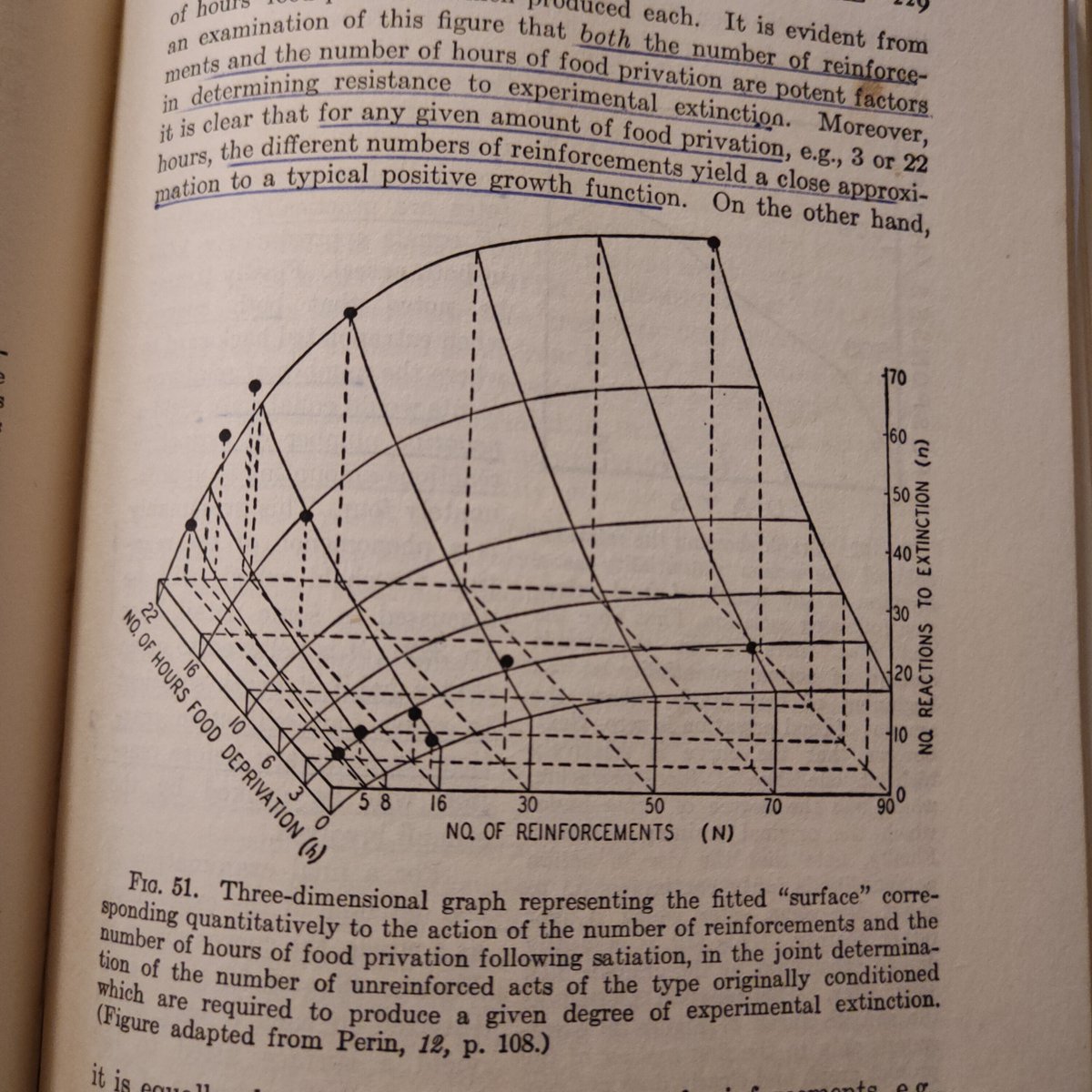
Several Chapters are then dedicated to establishing how "habit strength" (sHr, the key theoretical construct of his theory) is affected by several factors, such as the amount and the delay of reinforcement and the temporal relationship with the stimulus and...
... including the relation between sHr and the level of intrinsic motivation (drive=food deprivation) which, en passant, is illustrated with an honestly pretty cool data visualization (especially given that we are in 1943)
Later chapters are dedicated to more complex scenarios, such as generalization and "patterning". It is sobering to realize that the complexity of the experimental designs used back then is much higher compared to the simplified "dog" and "cat" examples we often use in teaching
A specific treatment is given to the origin of noise (he called it "oscillation) that is hypothesised to derive from intrinsic, random variations of the underlying physiological potentials (@valentinwyart?).
Noise is also pointed out as one of the main causes why formal theories of social sciences have been hard to develop (in addition to anthropomorphism). He concludes the book how it started, with a very eloquent defence of the role of mathematics in social sciences

• • •

Missing some Tweet in this thread? You can try to force a refresh

 

Keep Current with Stefano Palminteri

Stefano Palminteri Profile picture

Stay in touch and get notified when new unrolls are available from this author!

Read all threads

This Thread may be Removed Anytime!

PDF

Twitter may remove this content at anytime! Save it as PDF for later use!

Try unrolling a thread yourself!

how to unroll video
  1. Follow @ThreadReaderApp to mention us!

  2. From a Twitter thread mention us with a keyword "unroll"
@threadreaderapp unroll

Practice here first or read more on our help page!

More from @StePalminteri

Feb 27, 2023
Just posted in @PsyArXiv a short where I collected some suggestions concerning "how to prepare a rebuttal letter". Journals do not provide explicit guidance on this and, in my experience as a reviewer and editor, a great diversity exists in their format..

psyarxiv.com/kyfus/Image
.. however, not all formats are, in my modest and personal opinion, as effective. And by effective here I mean the capacity of delivering all the relevant information (how are you responding to the Reviewer's point) in a clear and efficient manner. I mostly focused on formatting
Tip 0: Before the rebuttal, the cover letter.
I find it extremely helpful when the cover letter mentions, in a narrative manner, the main modifications undertaken during the revision and how they are related to the Reviewers’ main points and the final story of the manuscript Image
Read 12 tweets
Sep 19, 2022
I just finished reading this paper by Meehl on appraisal theory selection in Psychology (and beyond). The paper essentially proposes to amend rigid falsificationism (Popper0) in favor of a more flexible approach including a step of “strategic retreat and defense” (Lakatos) Image
The point here is that when one tests a theory, they never test the Theory "alone", but also a series of ancillary elements (how does the measurement work?) and assumptions (e.g., the ceteribus paribus clause: which is always false in psychology)...
Therefore, an apparent falsification could, in principle derive, from the theory being false OR by any other of the ancillary elements and assumption being false. The question: how do we decide whether or not a “strike is fatal” for a theory? Not an easy question, which…
Read 16 tweets
May 31, 2022
🚨🥳Very glad to share the publication by @TrendsCognSci of this review paper entitled “The computational roots of positivity and confirmation bias in human reinforcement learning” with my usual partner in scientific crime @mael_lebreton (long) thread 🧵
doi.org/10.1016/j.tics… Image
In this paper we summarise the evidence allowing answering this fundamental question: do we (reinforcement) learn equally well from positive or negative prediction errors? From outcomes that confirm our current choices? Image
We started by recognizing that similar biases have already been identified and documented by psychologists and economists in the past in belief updates. However, they are traditionally understood as specific to high-level processing ImageImage
Read 14 tweets
Mar 11, 2022
Just finished reading this old-ish gem by Herbert Simon (1992) that I strongly suggest reading for all interested in the epistemological foundations of behavioural sciences. Many key ideas are extremely clearly and convincingly laid down 1/n Image
The first great thing to mention about the paper is that even one of the "fathers" of cognitive revolution did not believe that a cognitive revolution ever happened 2/n Image
I wrote about this topic in another thread about Leahey's great paper (link below). A cognitive "revolution" never happened: let's get over it. 3/n
Read 7 tweets
Nov 17, 2021
Just finished reading this that I strongly recommend to anyone interested in history of cognitive science (and more broadly in questions related to the advancement of science) and is curious about what happened during the “cognitive revolutions” 1/n
citeseerx.ist.psu.edu/viewdoc/downlo…Image
The paper starts by (extremely clearly and sharply) reminding the elements of Kuhn’s hypothetical structure of scientific revolutions and illustrate criteria proposed by later scholars to “empirically” (or at least more objectively) assess whether a revolution occurred. Image
Image
Image
The paper then analyses the historical contexts and records of the behaviouristic and cognitive revolution and provides compelling arguments to the claim that neither period actually witnessed a scientific revolution (according to Kuhnian -or common sense - definition). Image
Image
Read 8 tweets
Oct 8, 2021
Will huge sample sizes (alone) solve psychology problems (as for example it is claimed they solved behavioural genetics problems)? This classic article clearly illustrate that "not quite". It start from recognising a key difference between psychology and physics 1/n
Physical theories allow point estimate predictions (what the exact value of an empirical measure should be), therefore increasing the number of measures will increase the precision and represent a more stringent test for the theory 2/n
In psychology the situation was (it still is) quite different: theories often make only directional prediction (i.e., RT should higher in condition 1 compared condition 2, but how much higher is not specified). 3/
Read 9 tweets

Did Thread Reader help you today?

Support us! We are indie developers!


This site is made by just two indie developers on a laptop doing marketing, support and development! Read more about the story.

Become a Premium Member ($3/month or $30/year) and get exclusive features!

Become Premium

Don't want to be a Premium member but still want to support us?

Make a small donation by buying us coffee ($5) or help with server cost ($10)

Donate via Paypal

Or Donate anonymously using crypto!

Ethereum

0xfe58350B80634f60Fa6Dc149a72b4DFbc17D341E copy

Bitcoin

3ATGMxNzCUFzxpMCHL5sWSt4DVtS8UqXpi copy

Thank you for your support!

Follow Us!

:(