Here are the big takeaways from the @IPCC_CH Synthesis Report released today.
First, climate change has already caused widespread and substantial losses to almost every aspect of human life on this planet, and the impacts on future generations depend on the choices we make NOW.
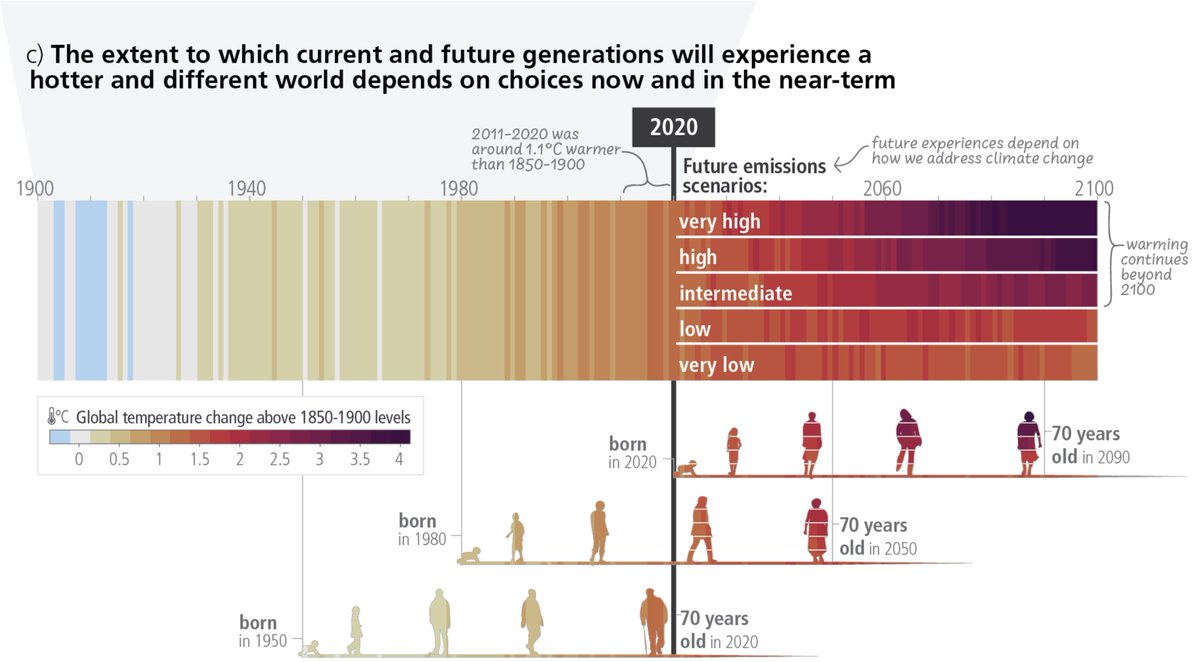
Second, every bit of warming matters. The warmer the planet gets, the more widespread and pronounced the changes in both average climate and climate and weather extremes become.
Third, the impacts are very serious: they directly affect our health, our food sources, our water and more.
Fourth, the percentage of animal species exposed to potentially dangerous conditions increases significantly the faster the world warms. In general, ocean species like coral and tropical species are most at risk.
The "burning embers" diagram originally conceptualized by Steve Schneider and others so long ago has been updated to show even higher risks at lower temperature thresholds. To be honest, not unexpected. The "experiment" we're conducting with our planet is unprecedented.
So given this dire news, surely we are well on our way to cutting our carbon emissions, no?
No.
The synthesis report is crystal clear: we are not doing nearly enough to avoid dangerous impacts, let alone achieve the targets of the Paris Agreement.
Our choices matter and the faster we act, the better off we will all be - all of us who call this planet home.
Finally, so many of the solutions are (a) already available today, and (b) benefit us in so many ways -- addressing health, equity, justice, and even economic concerns while increasing resilience and accelerating the transition to a clean energy future.
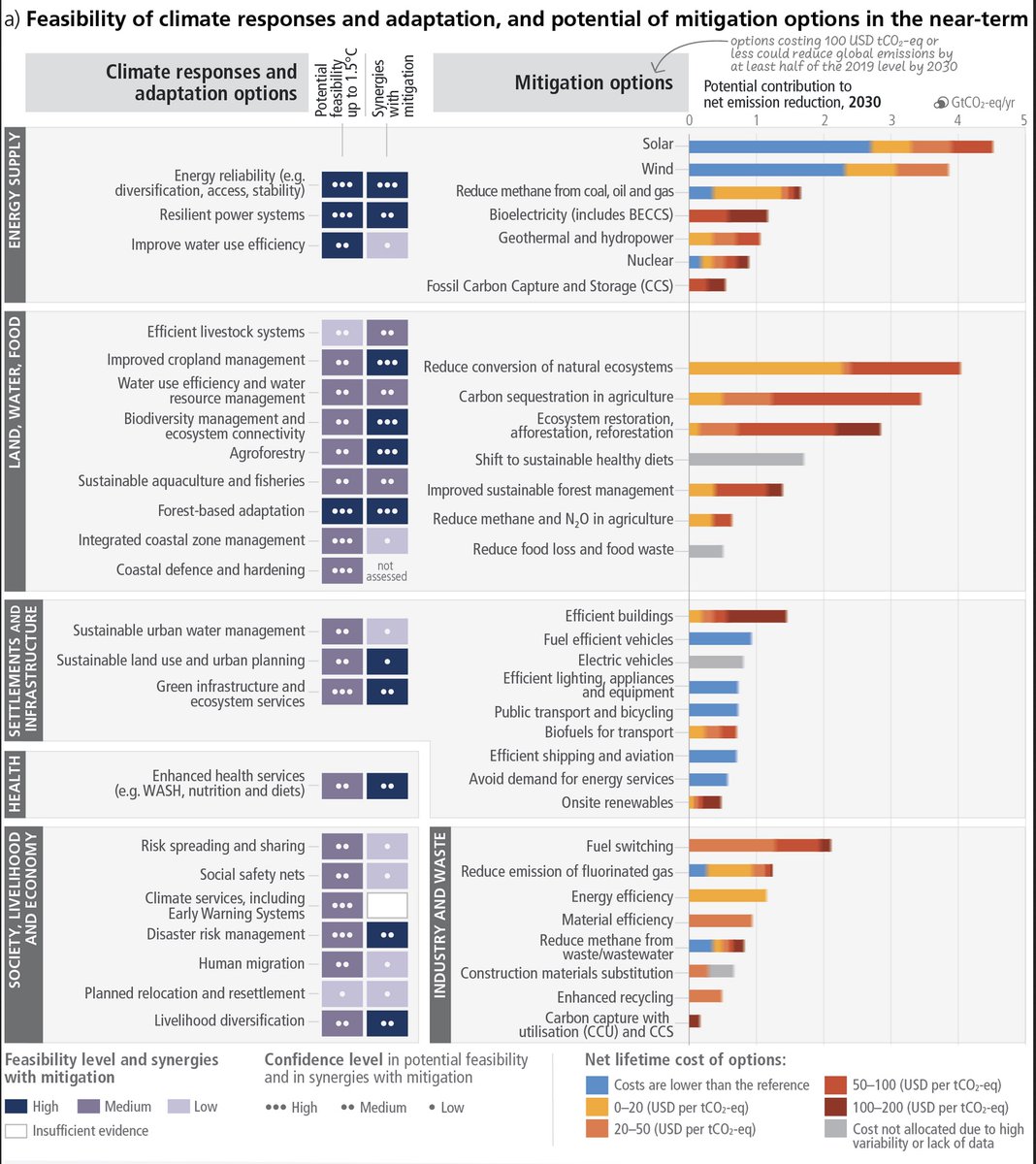
Climate change stands between us and a better future. Many of the solutions are already at hand. At this point, the only question is: what are we waiting for?
Nearly every climate denial argument I’ve ever heard falls into one of these five categories.
1 - it’s not real
2 - it’s not us
3 - it’s not bad
4 - it’s too hard/costly to fix
5 - it’s too late
And you know which is growing the fastest these days? The last one 😳
That’s because it’s growing at both sides: from those who understand it’s a great excuse to continue to delay action, as well as from those who are so paralyzed by fear that it’s more comforting for them to give up then to keep fighting.
There’s so much to be done, and the biggest emotion most people are missing is not fear but efficacy. That’s why I say …
#COP28 wrapped up in the early hours today. Where do we stand? With a stronger mandate to tackle the root causes of climate change than we had before--but with much less than what we need to avoid "dangerous interference with the climate system" and meet our Paris goals. 🧵
According to the International Energy Agency (IEA), the terms of the agreement provide about 30% what's needed to reach the 1.5C target. iea.org/news/iea-asses…
There's lots of announcements and news coming out of #COP28. I'm here to rank them for you from a climate scientist's perspective, using 🌴 for the wins and 🤦♀️ for the facepalms.
Did I miss something? Let me know and I'll add it to this list! #ClimateAction #COP28FromHome 🧵
On Day 1, 198 nations ratified the framework for making COP27's loss + damage fund operational, and the first pledges were made. The EU led with $245M, while the US pledged $17.5M or about 0.002% of its defense budget.
This fund is badly needed, as nations least responsible for the problem are those bearing the brunt of the impacts. However, this is just a fraction of the $200-$250 billion developing countries will need **every year** by 2030 to adapt to climate change. germanwatch.org/en/cri
Today, the 5th US National Climate Assessment was released. I've been an author now for 4 assessments - so what's new with this one, and why does it matter? (thread) nca2023.globalchange.gov
First, previous NCAs are still very relevant. If you want to know more about everything from climate scenarios to tipping points, check out the 2017 Climate Science Special Report and for great answers to the most common FAQs, see science2017.globalchange.gov nca2018.globalchange.gov
However, over the last 5 yrs there have been significant advances in:
🌍 the science, esp. extreme event attribution
🤝 understanding the interconnectedness & inequality of the impacts
🚀 Adaptation & mitigation solutions
... all over a background of growing public concern.
Today, @pontifex released Laudato Deum, an update on the 2015 encyclical. It's not so much a breath of fresh air as it is a bucket of ice water, straight to the face of those who are standing in the way of and delaying climate progress. Here are a few highlights:
On the science: "Despite all attempts to deny, conceal, gloss over or relativize the issue, the signs of climate change are here + increasingly evident. No one can ignore the fact that in recent years we've witnessed extreme weather phenomena." I agree. nytimes.com/2021/08/17/opi…
On inequity: "There are those who would place responsibility on the poor, since they have many children. As usual, it would seem that everything is the fault of the poor. Yet the reality is that a low, richer percentage of the planet contaminates more than the poorest 50%." 🔥🔥
45 climate scientists were asked what we thought of this years' climate disasters. Here are the highlights of what we said (thread) theguardian.com/environment/20…
We all pretty much agree that "despite it certainly feeling as if events had taken a frightening turn, global heating to date is entirely in line with 3 decades of scientific predictions. But being proved right is cold comfort, as our warnings had so far been largely in vain."
Malte @meinshausen offered a zinger: "Climate science’s projections are pretty robust over the last decades. Unfortunately, humanity’s stubbornness to spew out ever higher amounts of greenhouse gases has also been pretty robust."