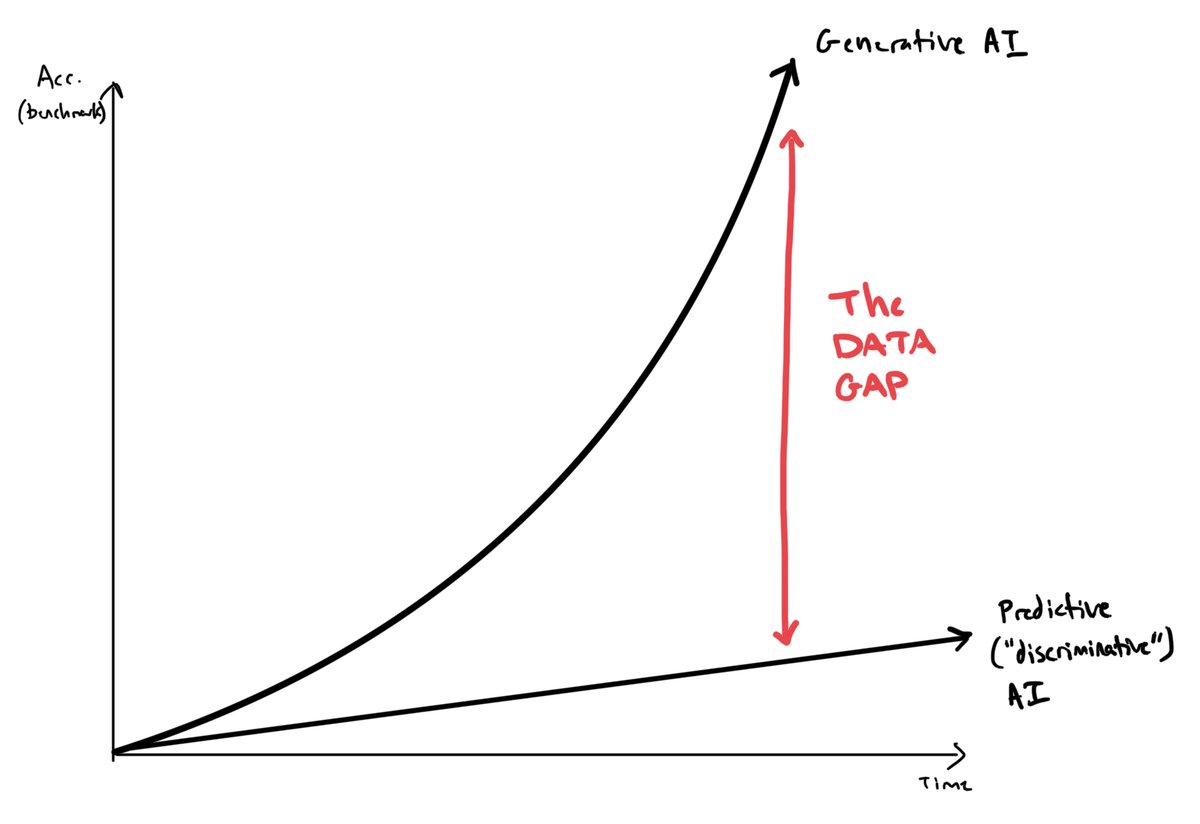
Read on Twitter
1/ Prediction: Everyone will soon be using foundation models (FMs) like GPT-4.
However, they'll be using FMs trained on their own data & workloads:
"GPT-You", not GPT-X
Tl/dr:
- Closed APIs aren't defensible
- The durable moat is data
- The last mile generates the real value
However, they'll be using FMs trained on their own data & workloads:
"GPT-You", not GPT-X
Tl/dr:
- Closed APIs aren't defensible
- The durable moat is data
- The last mile generates the real value
2/ *Closed APIs aren't defensible*
- Recent examples like @StanfordCRFM Alpaca tinyurl.com/yc78bnct shows that cloning closed API-based FMs like ChatGPT can be done for a few $100 on top of small OSS base FMs (e.g. here, fine-tuning LLaMa 7B via exs from the ChatGPT API).
- Recent examples like @StanfordCRFM Alpaca tinyurl.com/yc78bnct shows that cloning closed API-based FMs like ChatGPT can be done for a few $100 on top of small OSS base FMs (e.g. here, fine-tuning LLaMa 7B via exs from the ChatGPT API).
3/
- Since Alpaca dozens of others have cloned this cloning procedure (e.g. Dolly github.com/databrickslabs…)
- Will these withstand legal scrutiny? Enough potential legal issues w/ original FM training on web data may muddle things... but either way, the key point still stands...
- Since Alpaca dozens of others have cloned this cloning procedure (e.g. Dolly github.com/databrickslabs…)
- Will these withstand legal scrutiny? Enough potential legal issues w/ original FM training on web data may muddle things... but either way, the key point still stands...
4/ *The durable moat is data*
- Recent progress has shown that *data* is the secret sauce and real differentiator for FMs (e.g. ChatGPT is just GPT-3 fine-tuned with human feedback)
- Training on open web data can only get you so far for complex, enterprise-specific tasks.
- Recent progress has shown that *data* is the secret sauce and real differentiator for FMs (e.g. ChatGPT is just GPT-3 fine-tuned with human feedback)
- Training on open web data can only get you so far for complex, enterprise-specific tasks.
5/
- Examples of FMs trained on proprietary, domain-specific data like BloombergGPT arxiv.org/abs/2303.17564 show the way forward: enterprises (and people!) using the durable moat of their own private data to build powerful, domain-specific FMs.
- Examples of FMs trained on proprietary, domain-specific data like BloombergGPT arxiv.org/abs/2303.17564 show the way forward: enterprises (and people!) using the durable moat of their own private data to build powerful, domain-specific FMs.
6/
- Recent OSS progress shows that FM model architectures are commoditizing (and standardizing)
- This means proprietary data will soon be the only durable moat.
- This data will be the edge that determines AI success.
- However: developing this data takes effort...
- Recent OSS progress shows that FM model architectures are commoditizing (and standardizing)
- This means proprietary data will soon be the only durable moat.
- This data will be the edge that determines AI success.
- However: developing this data takes effort...
7/ *The last mile generates the real value*
- Getting real, complex AI use cases to production-level accuracy takes significant data labeling & development!
- See arxiv.org/abs/2302.10724, opensamizdat.com/posts/chatgpt_… - ChatGPT loses to specialized fine-tuned models 75%+ of the time!
- Getting real, complex AI use cases to production-level accuracy takes significant data labeling & development!
- See arxiv.org/abs/2302.10724, opensamizdat.com/posts/chatgpt_… - ChatGPT loses to specialized fine-tuned models 75%+ of the time!
8/
- Fine-tuning significantly out-performs ZSL/prompt approaches (e.g. see arxiv.org/pdf/2012.15723…)
- Even the OpenAI docs recommend min. 100 labeled examples/class for fine-tuning (for a 100-way classifier = 10K+ examples!), which empirical data shows is often a significant min
- Fine-tuning significantly out-performs ZSL/prompt approaches (e.g. see arxiv.org/pdf/2012.15723…)
- Even the OpenAI docs recommend min. 100 labeled examples/class for fine-tuning (for a 100-way classifier = 10K+ examples!), which empirical data shows is often a significant min
9/
- However, this data development is not just a chore- it's the source of a powerful flywheel.
- The more you fine-tune, the more powerful your FM becomes for your data & workloads, and the more value accrues!
- The "base" FM will matter less and less- as long as you own it.
- However, this data development is not just a chore- it's the source of a powerful flywheel.
- The more you fine-tune, the more powerful your FM becomes for your data & workloads, and the more value accrues!
- The "base" FM will matter less and less- as long as you own it.
10/ Tl/dr: the future will be "GPT-You", not GPT-X
- Closed APIs aren't defensible
- The durable moat is data
- The last mile generates the real value
Stay tuned for more on what we're building @SnorkelAI to support developing FMs on *your* data, for *your* tasks...
- Closed APIs aren't defensible
- The durable moat is data
- The last mile generates the real value
Stay tuned for more on what we're building @SnorkelAI to support developing FMs on *your* data, for *your* tasks...
• • •
Missing some Tweet in this thread? You can try to
force a refresh