Kuhn’s idea of a paradigm is flawed: paradigms are not incommensurable, mature sciences do not have only 1 paradigm,& paradigms do not have their own standards of assessment. In contrast, the narrower idea of metatheory, abstract&general ideas used in theory-building, is useful🧵 
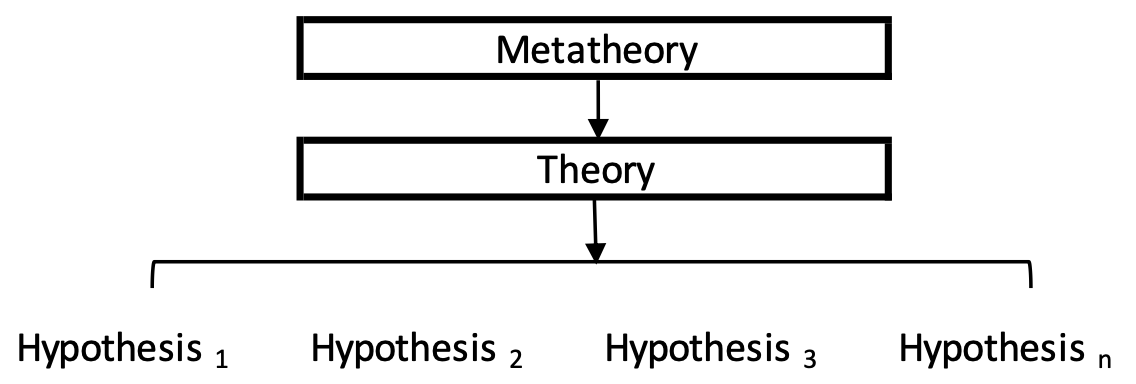
1/18 Problem I. Much of what is presented as theory is no more than stand-alone hypotheses or lists of variables, ie, ideas that are not actually theories.
On this, see Sutton & Staw, “What Theory Is Not,” Administrative Science Quarterly (1995). ➡️ funginstitute.berkeley.edu/wp-content/upl…
On this, see Sutton & Staw, “What Theory Is Not,” Administrative Science Quarterly (1995). ➡️ funginstitute.berkeley.edu/wp-content/upl…
2/18 Problem I. This way of thinking about “theory” leads to a big problem: the chaotic proliferation of stand-alone hypotheses. And, as a quick look at journals shows, the increased focus on hypothesis testing does not provide a solution to this problem.
3/18 Solution I. One way to proceed in a more systematic way is to think in terms of paradigms. Paradigms are usually identified by certain metatheoretical commitments. Work within paradigms also routinely systematizes a range of ideas and at times relies on axiomatic reasoning.
4/18 Solution I. An example of what such research looks like is Patrick James’s new book on realism in IR.👇

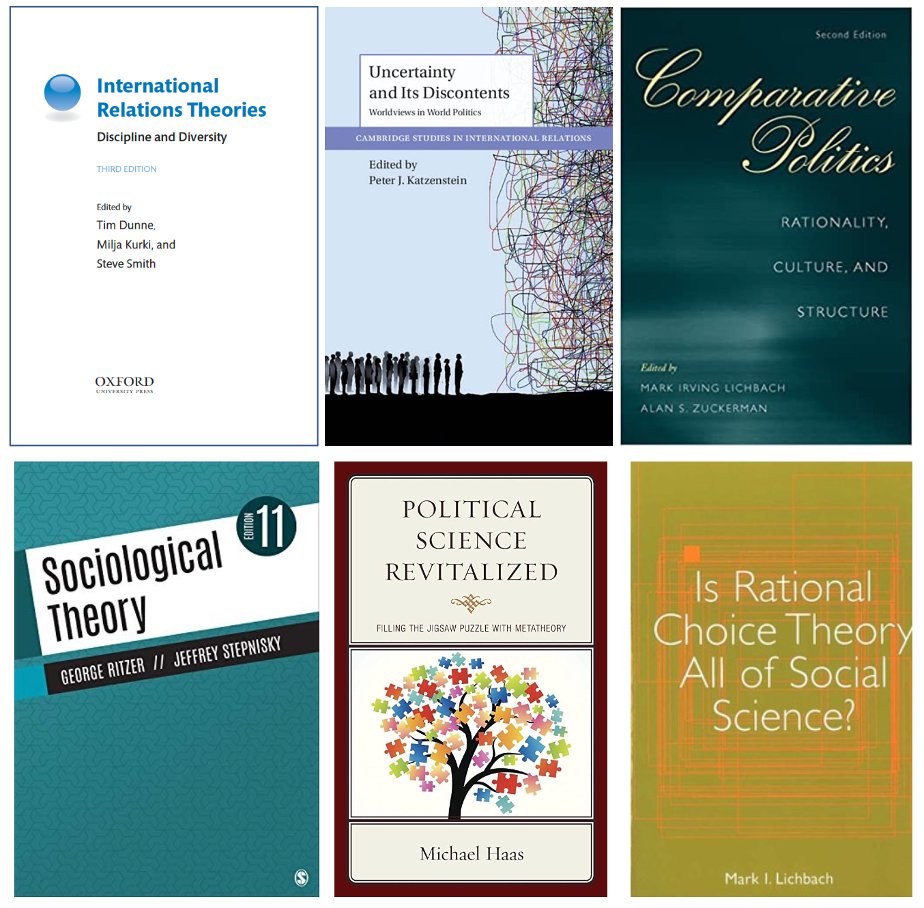
5/18 Solution I. A number of works that reconstruct (& in some cases assess) the paradigms used by social scientists also offer clues about the way in which research since World War II might be organized into families of theories.👇
6/18 Problem II. However, a consideration of paradigms quickly reveals a new problem. It seems clear that social scientists do not want one paradigm to be hegemonic, the Kuhnian ideal. But this push for diversity has a downside, the first sign being the proliferation of paradigms
7/18 Problem II. Lichbach & Zuckerman (2009) stick to the rule of 3: they fit large bodies of research into three paradigms.
But IR theory has moved well beyond its three standard paradigms (realism, liberalism, constructivism).👇
But IR theory has moved well beyond its three standard paradigms (realism, liberalism, constructivism).👇

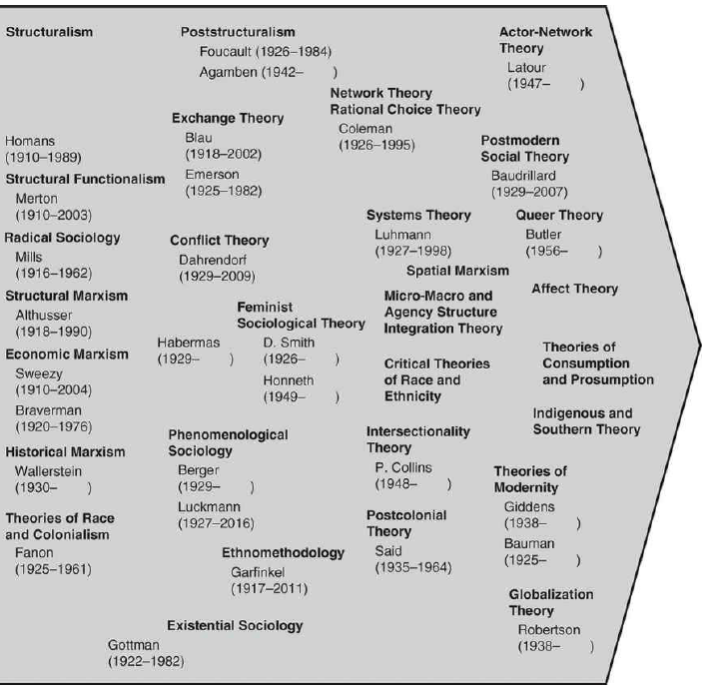
8/18 Problem II. Ritzer and Stepnisky show that since the days when structural-functionalism was dominant, the theoretical schools in sociology have diversified.👇
So we must ask: At what point does richness become disorder?
So we must ask: At what point does richness become disorder?
9/18 Problem II. Making matters worse, it is become increasingly unclear on what basis paradigms (or schools of thought) are distinguished.
Take the example of IR. Walt distinguished the 3 standard paradigms in IR in terms of what I would call substantive features of politics.👇
Take the example of IR. Walt distinguished the 3 standard paradigms in IR in terms of what I would call substantive features of politics.👇

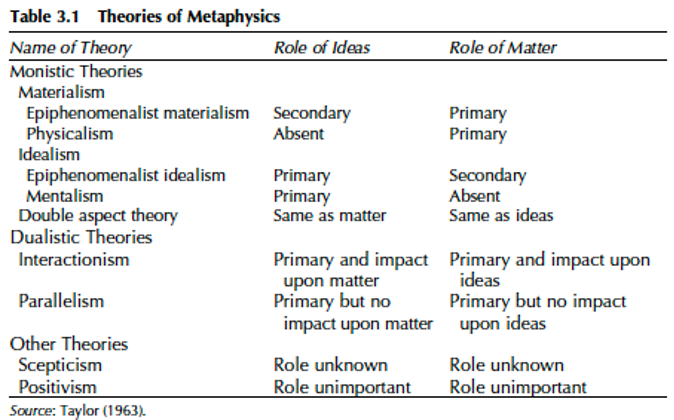
10/18 Problem II. In contrast, Michael Haas distinguished among paradigms in IR in terms of the classic ontological distinction between materialism and idealism.👇
11/18 Problem II. Adding a new twist, Patrick Jackman organized research in IR more along epistemological lines.👇
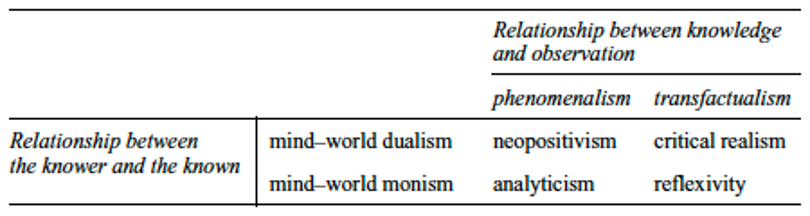
12/18 Problem II. Finally, in a recent book, Peter Katzenstein suggests that IR scholars can be distinguished in terms of their “worldviews” and uses two dimensions, that I take to be about ontology and epistemology.👇

13/18 Problem II. We are left, then, with a range of different ways of organizing bodies of research, with partly shared & partly different theoretical foundations. Further, for those immersed in philosophy, some obvious gaps in the criteria used to distinguish paradigms jump out
14/18 Solution II. Some have tired of discussions about paradigms & propose to move beyond paradigms.👇
This echoes Merton’s old call to move past Parsonian grand theory & focus on mid-range theorizing. & maybe there is something to gain from a moratorium on paradigmatic debates
This echoes Merton’s old call to move past Parsonian grand theory & focus on mid-range theorizing. & maybe there is something to gain from a moratorium on paradigmatic debates

15/18 Solution II. Another solution is to build better metatheories.
This could be done by: (1) more clearly distinguishing between general ideas (e.g., the materialism-idealism option) from substantive ones (e.g., power is basically economic or military); …
This could be done by: (1) more clearly distinguishing between general ideas (e.g., the materialism-idealism option) from substantive ones (e.g., power is basically economic or military); …
16/18 Solution II. (2) making better use of research on ontology and epistemology;
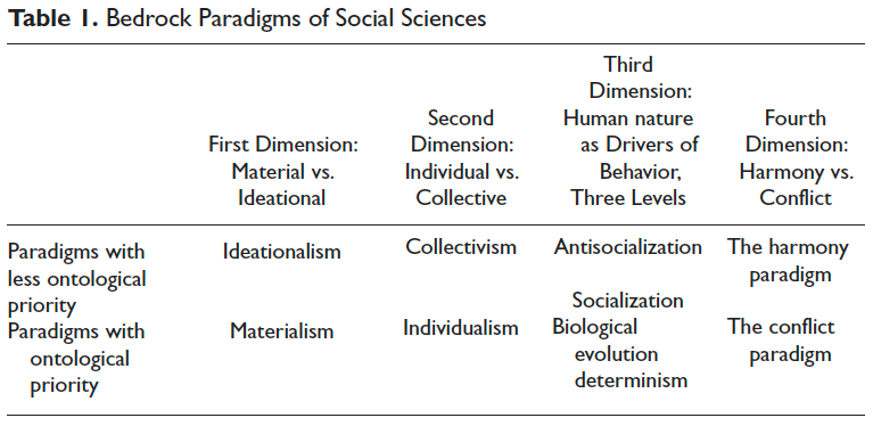
For example, with regard to ontology, a good suggestion is that by @ShipingTang to focus on “bedrock paradigms of social science”👇
For example, with regard to ontology, a good suggestion is that by @ShipingTang to focus on “bedrock paradigms of social science”👇
17/18 Solution II. (3) +explicitly identifying & distinguishing the substantive assumptions used in research.
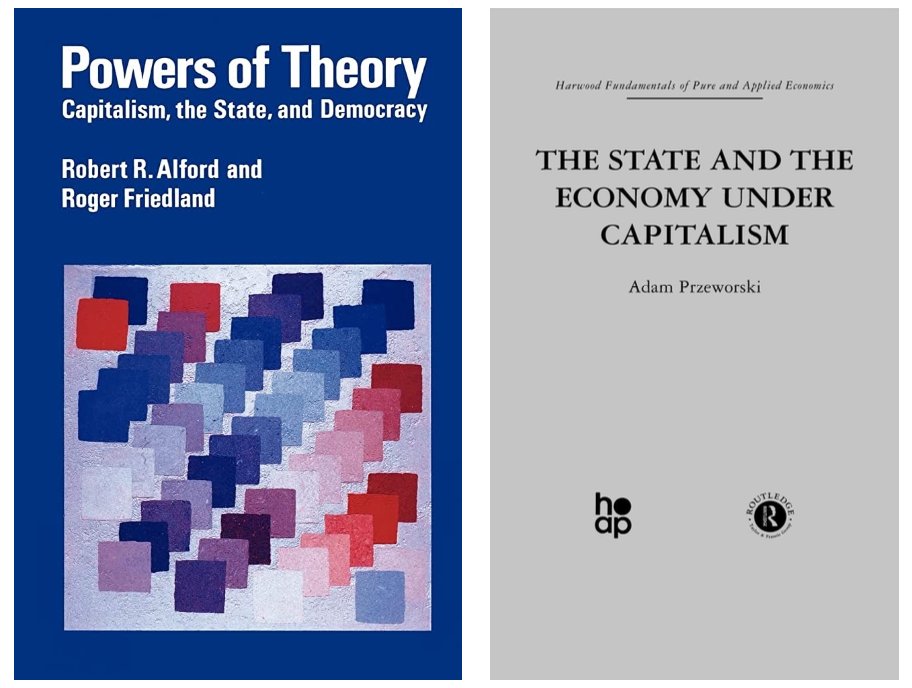
These principles are tailored to the processes that are studied & will vary by field. An eg is whether we study politics with a pluralist, class or statist perspective👇
These principles are tailored to the processes that are studied & will vary by field. An eg is whether we study politics with a pluralist, class or statist perspective👇
18/18 The Bottom Line. A hypothesis is not a theory. Theory is built, explicitly or tacitly, on the basis of metatheoretical principles.
So we should (1) theorize and do so in a more self-aware manner, and (2) scrutinize and evaluate our metatheories.
So we should (1) theorize and do so in a more self-aware manner, and (2) scrutinize and evaluate our metatheories.
• • •
Missing some Tweet in this thread? You can try to
force a refresh