Read on Twitter
Yield curve dynamics are crucial to understand if you want to become a better macro investor.
A thread.
1/ twitter.com/i/web/status/1…
A thread.
1/ twitter.com/i/web/status/1…

Yield curve dynamics represent a crucial macro variable, as they inform us on today’s borrowing conditions and on the market future expectations for growth and inflation.
2/
2/
An inverted yield curve often leads towards a recession because it chokes real-economy agents off with tight credit conditions (high front-end yields) which are reflected in weak future growth and inflation expectations (lower long-dated yields).
3/
3/
A steep yield curve instead signals accessible borrowing costs (low front-end yields) feeding into expectations for solid growth and inflation down the road (high long-dated yields).
4/
4/
Rapid changes in the shape of the yield curve at different stages of the cycle are a key macro variable to understand and incorporate in your portfolio allocation process.
So, let's explore the 4 main yield curve regimes.
5/
So, let's explore the 4 main yield curve regimes.
5/
Bull Flattening = lower front-end yields, flatter curves.
Think of 2016: Fed Funds already basically at 0% and weak global growth.
Yields stay put at the front-end and could meaningfully move lower only at the long-end, hence bull-flattening the curve.
6/
Think of 2016: Fed Funds already basically at 0% and weak global growth.
Yields stay put at the front-end and could meaningfully move lower only at the long-end, hence bull-flattening the curve.
6/
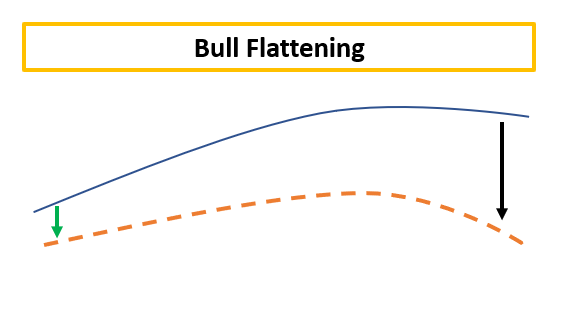
When this happens, long bonds do very well and growth stocks tend to overperform value, as tech disproportionately benefits from low interest rates.
Also, 60/40 portfolios deliver great returns!
7/
Also, 60/40 portfolios deliver great returns!
7/
Bull Steepening = lower front-end yields, steeper curves.
Late 2020, early 2021: the Fed was keeping rates pinned at 0% and stimulating via QE but the economy was flooded with fiscal stimulus and ready for reopening.
8/
Late 2020, early 2021: the Fed was keeping rates pinned at 0% and stimulating via QE but the economy was flooded with fiscal stimulus and ready for reopening.
8/
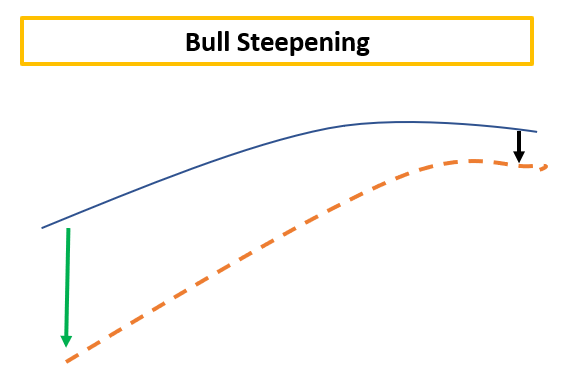
The friendly borrowing conditions and the massive upcoming growth boost could mostly be reflected through higher long-end yields, while 2-year interest rates were pinned at 0% by the Fed.
Bull-steepening of the curve.
9/
Bull-steepening of the curve.
9/
This tends to happen ahead of recessions: short-dated bonds start to price in meaningful Fed cuts in response to weak economic conditions, and they rally harder than long-end bonds.
A transition from a flat curve to a bull steepening is very troublesome for markets.
10/
A transition from a flat curve to a bull steepening is very troublesome for markets.
10/
On the other hand bull steepening can be very positive for markets if accompanied by strong growth.
That means the Fed is keeping policy loose (low front-end yields) and higher growth and inflation expectations feed into the long-end (higher long bond yields).
11/
That means the Fed is keeping policy loose (low front-end yields) and higher growth and inflation expectations feed into the long-end (higher long bond yields).
11/
Bear Flattening = higher front-end yields, flatter curves.
2022 was the bear flattening year: Powell raised rates aggressively to fight inflation, but he ended up choking the economy off.
12/
2022 was the bear flattening year: Powell raised rates aggressively to fight inflation, but he ended up choking the economy off.
12/
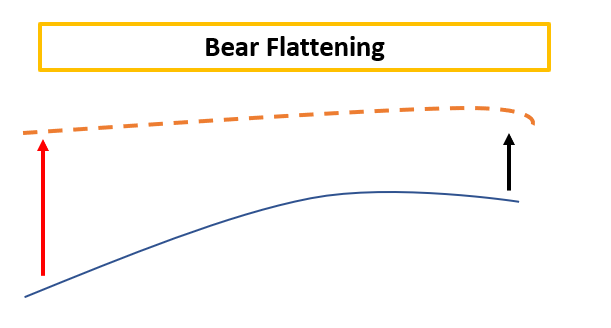
This was reflected in lower future growth and inflation expectations at the long-end of the curve.
Front-end rates went higher, but the curve bear-flattened
When this happens in conjuction with weaker growth, cyclical stock sectors and tech tend to underperforms (see 2022)
13/
Front-end rates went higher, but the curve bear-flattened
When this happens in conjuction with weaker growth, cyclical stock sectors and tech tend to underperforms (see 2022)
13/
Bear Steepening = higher front-end yields, steeper curves.
Do you remember 2009? The worst of the GFC was behind us and (monetary-mechanics-illiterate) investors were afraid that QE would lead to runaway inflation and the Fed would be forced to start acting on it.
14/
Do you remember 2009? The worst of the GFC was behind us and (monetary-mechanics-illiterate) investors were afraid that QE would lead to runaway inflation and the Fed would be forced to start acting on it.
14/
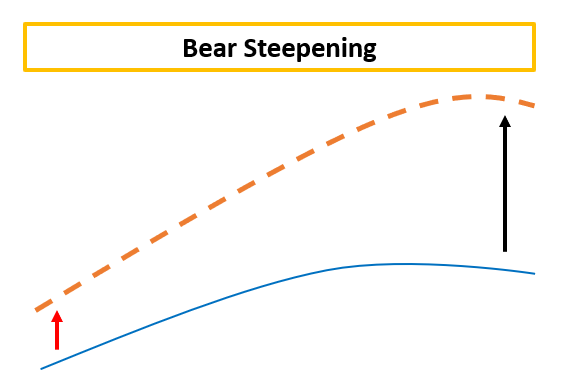
Front-end yields moved a bit higher, but long-end yields took most of the hit as investors (mistakenly) bumped the inflation risk premium up = the curve bear-steepened.
It's a very rare occurrence, and it is generally associated with higher risk premia.
15/
It's a very rare occurrence, and it is generally associated with higher risk premia.
15/
Rapid changes in the shape of the yield curve when growth is at turning points are a key variable to consider for a successful asset allocation process.
If you enjoyed this thread and want more macro educational content...
16/
If you enjoyed this thread and want more macro educational content...
16/
...you are going to find plenty on TheMacroCompass.com.
I'll be waiting for you to join this macro learning journey!
17/17
I'll be waiting for you to join this macro learning journey!
17/17
• • •
Missing some Tweet in this thread? You can try to
force a refresh