We are approaching the 50th anniversary of the “Zebra killings” – the “Death Angel” anti-White terror campaign that panicked San Francisco and claimed at least 23 victims (likely *many* more), including 15 killed, 8 seriously wounded, and one raped.
Long 🧵on the Zebra terror.
Long 🧵on the Zebra terror.
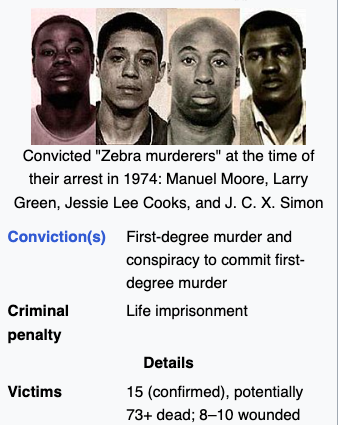


Some of the “Zebras” met while they were serving time in San Quentin State Prison in 1973. Here, Jesse Lee Cooks would often share his fantasies of mass-murdering Whites – especially children or the elderly.

While at San Quentin, Cooks, Anthony Harris (who eventually turned informant and entered witness protection) and Manuel Moore learned about the “Death Angels” – a cult dedicated to murdering Whites and starting a race war.
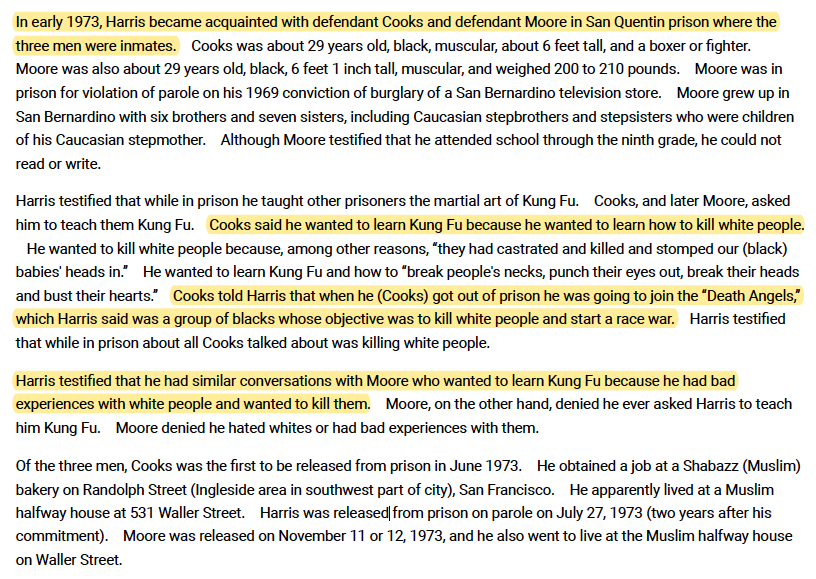

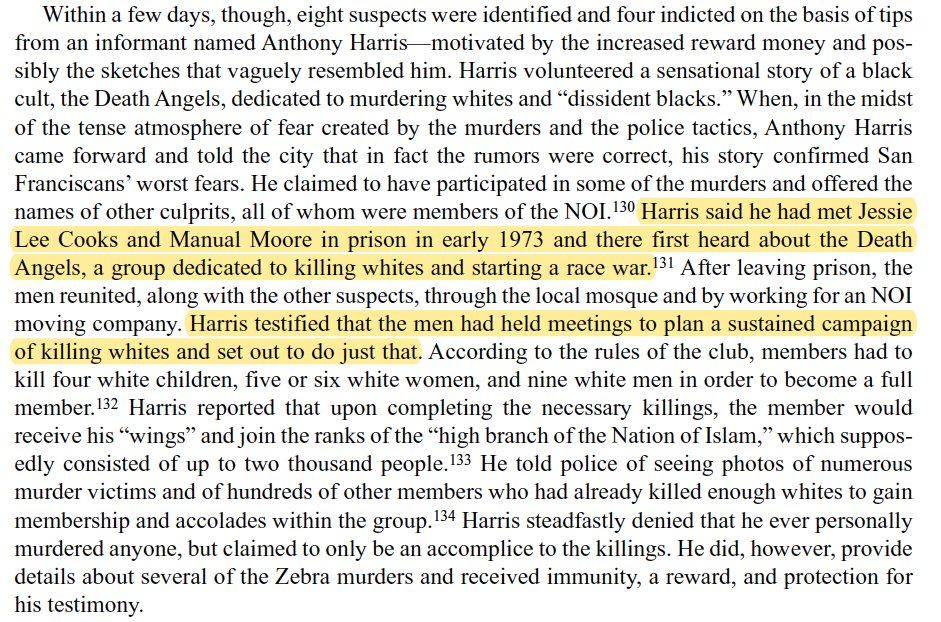
In America’s endlessly fascinating criminal justice system, young Black men were often indoctrinated into becoming White-hating fanatics before the state released them back into society. And all the while prison officials looked on with learned helplessness.

Once out of the joint, Cooks, Harris, and Moore soon connected with Larry Green and JCX Simon through a Nation of Islam mosque in San Francisco, and a NoI-affiliated business called “Black Self-Help Moving and Storage Company.”
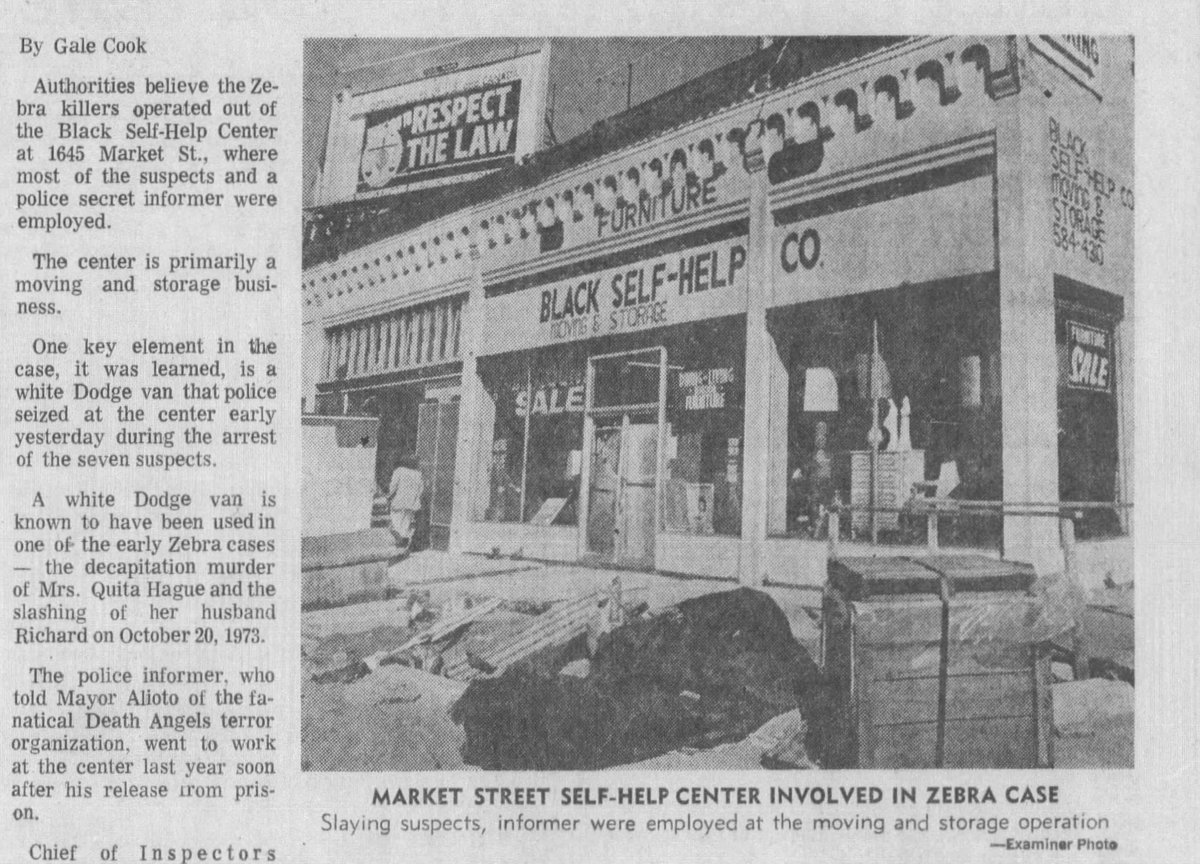
Unlike the trio from San Quentin, Simon and Green (and the owner, Tom Maney) had come from relatively comfortable middle-class backgrounds. But Green and Simon’s bloodlust would prove to be just as insane of that of the hardened criminals.
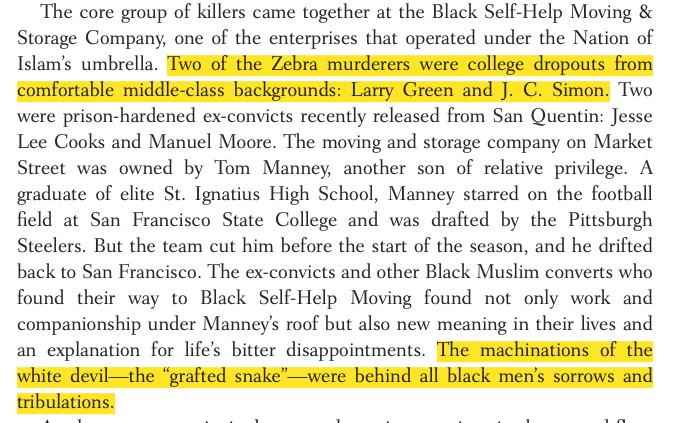
At secret meetings the Zebras heard more NoI incitement: Whites were “devils” and “grafted snakes” who should be destroyed. The propaganda seems to have been effective. In their selection of victims and the savagery of the attacks, the Zebras displayed fanatical hatred.


When the killing started and how many were killed will never be known for certain. But what became known as the “Zebra killings" began on October 20, 1973. On that night, the Death Angels first attempted a proper “slaughter of the innocents” – murdering a group of White children.

The Zebras grabbed three White kids off the street, intending to load them into their van, take them to an isolated spot, and butcher them with a machete. But 15-year old Frank Stewart was clever – He distracted Harris by yelling “Cops!” - and all three kids managed to escape.

Eleven-year-old Michelle Carrasco - escaping the demons who wanted to use her for a blood-sacrifice - found sanctuary in a nearby Catholic Church.

In their first attempted murder-kidnapping the Zebras had been outwitted by three children. But they were still determined to butcher some “white devils” that night. They snatched a young couple off the street. Quita Hague nearly got away, but she came back for her husband.

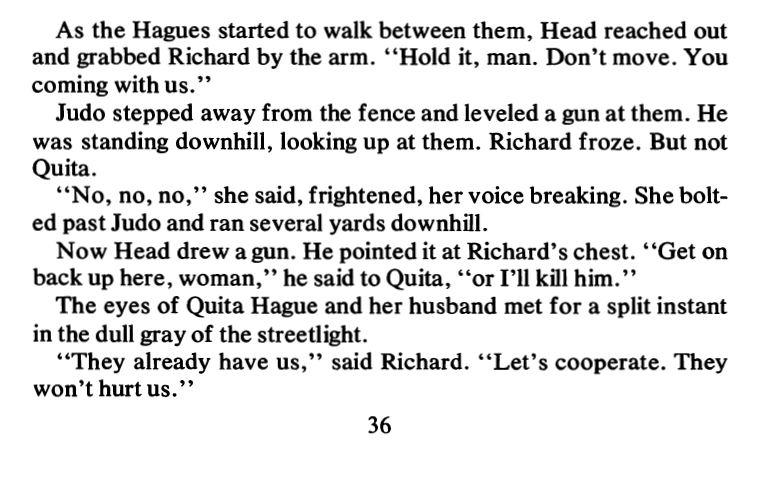
“Let’s cooperate. They won’t hurt us” Richard reassured Quita. These were the last words he would get to say to his wife. He was beaten unconscious with a tire iron, as Cooks and Harris took turns molesting the weeping Quita.


Earlier a police car had pulled up and asked the three young Black men what they were up to. If the cops had been a little more suspicions at that moment – if they had peaked inside the van, the Hagues and many other lives would have been spared - But that would have been racist.
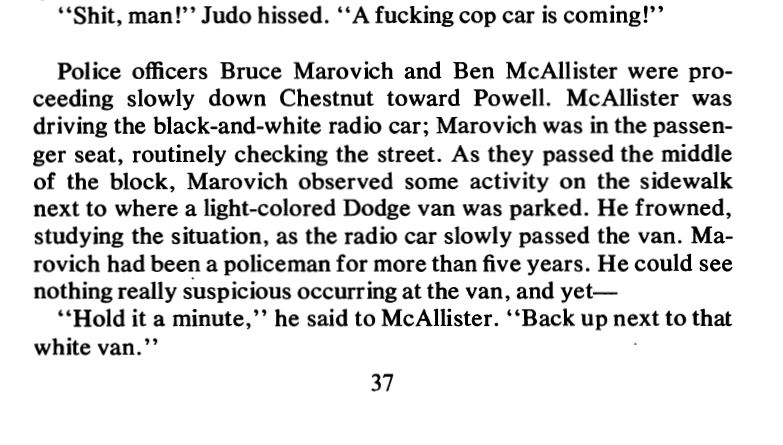

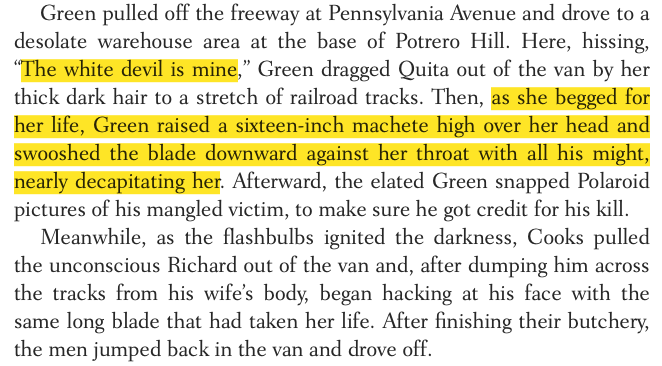
As Quita begged for her life, Green slashed at her repeatedly with the machete, nearly decapitating her. Cooks savagely hacked at the unconscious Richard and left him for dead. Incredibly, he survived and would later testify at the Zebra trial.

Cooks, who had accidentally left Richard Hague alive on October 20, tried to make up for his "mistake" in the days that followed. On the 23rd, he raped a 27-year-old White woman. On the 29th, he shot and killed another young White woman - Frances Rose, 28 in her Ford Mustang.


Patrolmen Tom O’Connell - “an articulate young Irishman”- and his partner Bill Kelly were nearby then they heard the report of the shooting. With the luck associated with their ethnicity, they quickly spotted a man who met the vague description.

Cooks had the loaded .22 automatic in his belt – O’Connell and Kelly still had their sidearms holstered as they got out of the patrol car. Cooks could have drawn first and taken his chances.

But the would-be Death Angel who fantasized about massacring White children ... suddenly was not so tough. He surrendered meekly.

Surprisingly, Cooks quickly confessed to the murder. And he was way ahead of his time with the justification he gave to the police – He told them that he became enraged at Rose and shot her because she had provoked him by dropping the n-bomb.

One might have hoped that the arrest of the bloodthirsty Cooks would have slowed-down the killing spree. Instead, it accelerated. On November 25, Saleem Erakat was executed in the back of his grocery store. On December 11, Paul Dancik was gunned-down at a payphone.


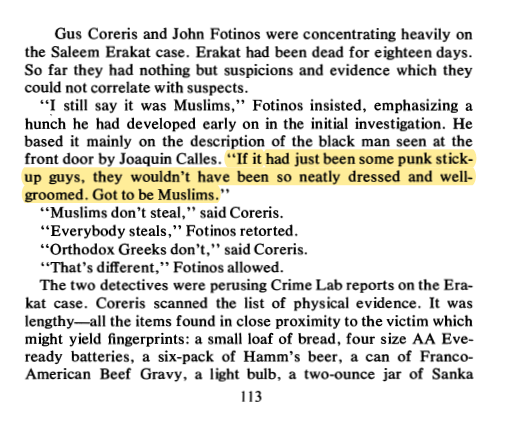
After the murder of a Jordanian Muslim by a Black Nation of Islam member, two Greek Orthodox detectives - Gus Coreris and John Fotinos - took the lead on the investigation. Based on witness descriptions and other circumstantial clues, they soon suspected the NoI connection.

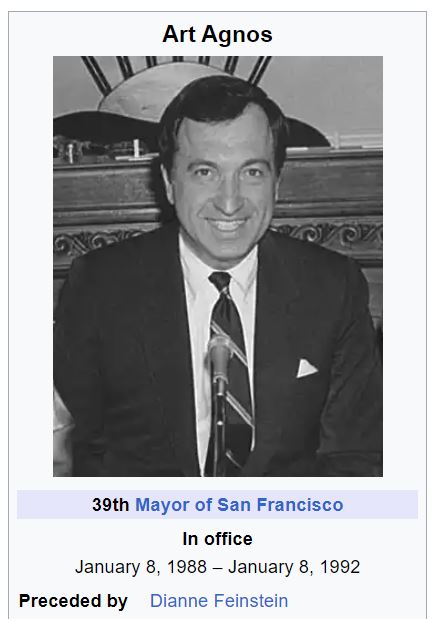
On December 13, Moore shot Art Agnos. Agnos would survive and go on to become Mayor of San Francisco. It is not clear what lessons Agnos took from this near-fatal brush with reality. He remained a staunch liberal, governing well to the left of his predecessor Dianne Feinstein.

Meanwhile, Moore was freaking-out. He had fired two shots point-blank into a white devil, and the guy had just stood there staring at him. Still determined to score “Death Angel” points that night, he shot and killed 30-year-old Marietta DiGirolamo less than 90 minutes later.


Detectives Coreris and Fotinos visited fellow-Hellene Agnos in the hospital. They spoke Greek to him, so that their explosive information would not be overheard by the staff – A Black Muslim death cult was on a killing spree. Agnos, the good liberal, did not believe them.

The holiday season bloodbath continued: On December 20, Simon shot and killed 81-year-old Ilario Bertuccio. About two hours later, Moore shot 21-year-old college student Teresa DeMartini three times. She survived, but was crippled.


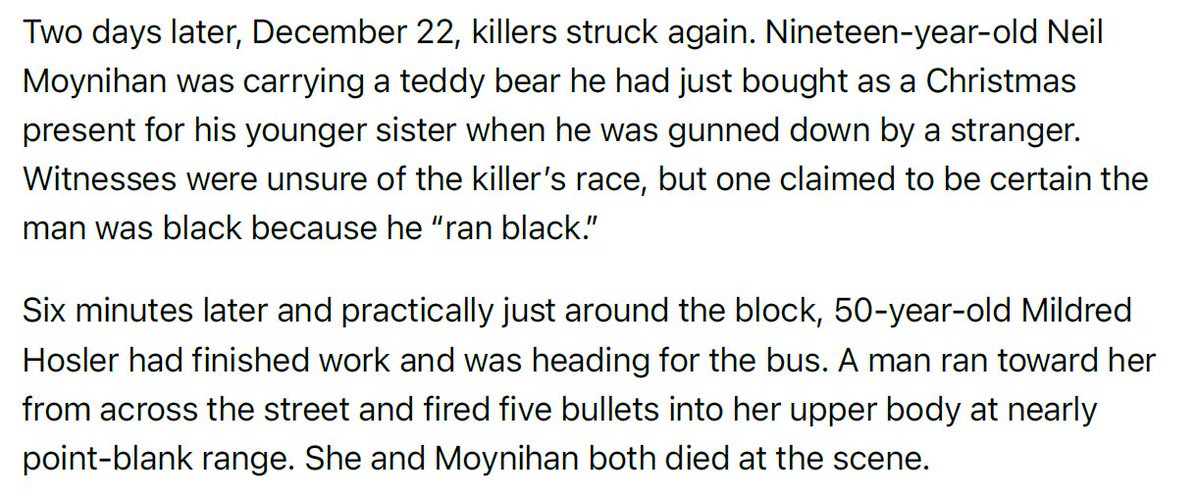
Two days later, Green got back into the act: He shot and killed 19-year-old Neil Moynihan, who was carrying a teddy bear he had just bought as a Christmas present for his little sister. Minutes later Green stuck again, gunning-down 50-year-old Mildred Hosler.

On Christmas Eve 1973, the cult carried out their most gruesome murder. A young White man was kidnaped off the street and taken to Black Self Help, where he was tortured, butchered, and chopped to pieces. The remains – missing the head, hands and feet - were never identified.


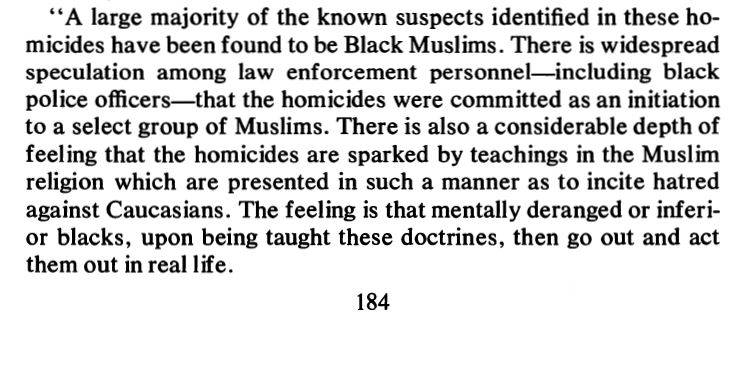
At this point the California Department of Justice believed they were facing a much wider conspiracy than what would later be known as the “Zebra Killings.” They were tacking 64 “execution-type murders in California during the past three calendar years.”
The Zebras took things to another level on the night of January 28, 1974. Apparently in high spirits after Muhamad Ali’s victory against Joe Frazier, the Zebras decided to celebrate with a murder-spree. They shot five (three young women and two elderly men), leaving four dead.


San Francisco, already on edge, plunged into full panic mode – Gun applications soared; police warned citizen to stay home at night.

The police announced that “Operation Zebra” - a massive, unprecedented manhunt - was underway. Indeed, it had been since the December shootings. By all accounts, the name “Zebra” came from a police radio frequency, and was not a wry commentary on the racial aspect of the case.


Understandably the police were feeling the heat. But the records showed that they had responded with lightning speed to every shooting - lending credence to the "When seconds count - the police are minutes away" meme.


A group of women started a protest campaign over movie and TV depictions of San Francisco. Considering the virulent anti-White propaganda that the Zebras had actually been consuming, it's amusing that anyone thought that Dirty Harry movies were to blame for the violence.

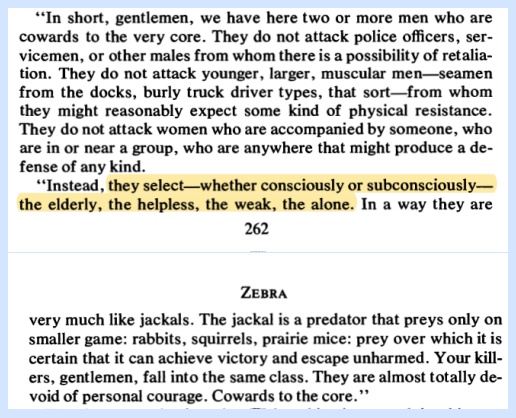
The detectives consulted with a criminal psychologist. He was not of much help. But, noting how the killers tended to prey on weak victims, he correctly predicted that one of them would come forward as an informant, and that they would all be taken without a fight.

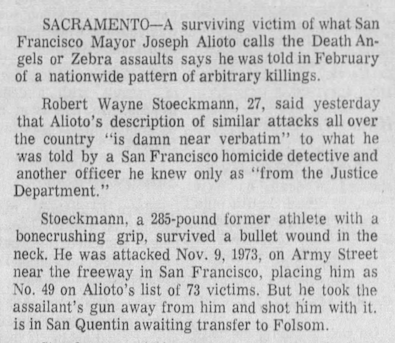
The risk of attacking a victim who was *not* helpless was demonstrated back on November 9, 1973, when a would-be Death Angel tried to kill the “285 pound former athlete” Robert Stoeckmann. Stoeckmann, after being shot in the neck, disarmed his attacker, and shot him three times.

Perhaps due to the aggressive police patrols, the Zebras laid-low for over two months. On April 1, 1974 Green struck again, gunning-down 19-year-old Thomas Rainwater and 21-year-old Linda Story, two idealistic Salvation Army cadets. Rainwater died. Badly wounded Story survived.

In Howard Clark’s Zebra book, the author suggests that wider NoI organization leadership was aware of the Zebra killers activities and worried that things had gotten out of hand. In Clark’s telling, the leaders tried unsuccessfully to get the Zebras to take a break.


Moore got back to work on April 14, 1974, shooting two White teenage boys at a bus stop - 18-year-old Ward Anderson and 15-year-old Terry White. Both young men survived, and were able to identify Moore at line-ups and at the Zebra trial.

Two days later, Simon shot 23-year-old Nelson Shields three times in the back, killing him instantly. With the investigation seemingly stalled, and the would-be Death Angels still running wild, no one had reason to guess at that moment that Shields would be the last Zebra victim.
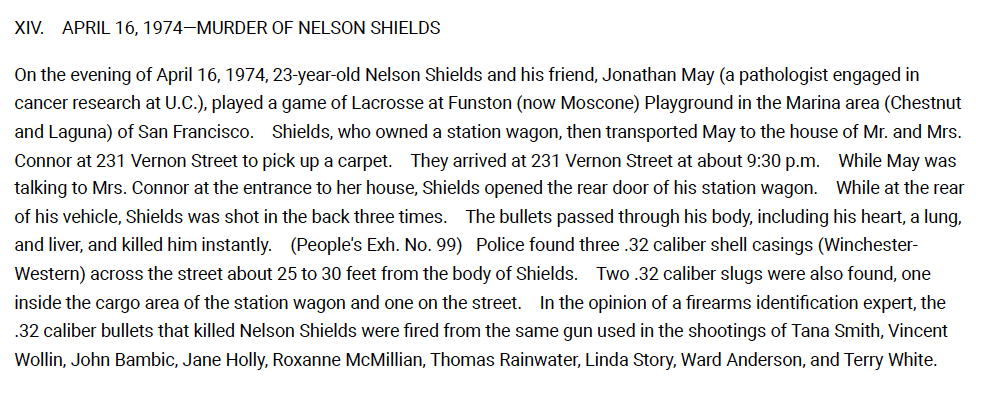
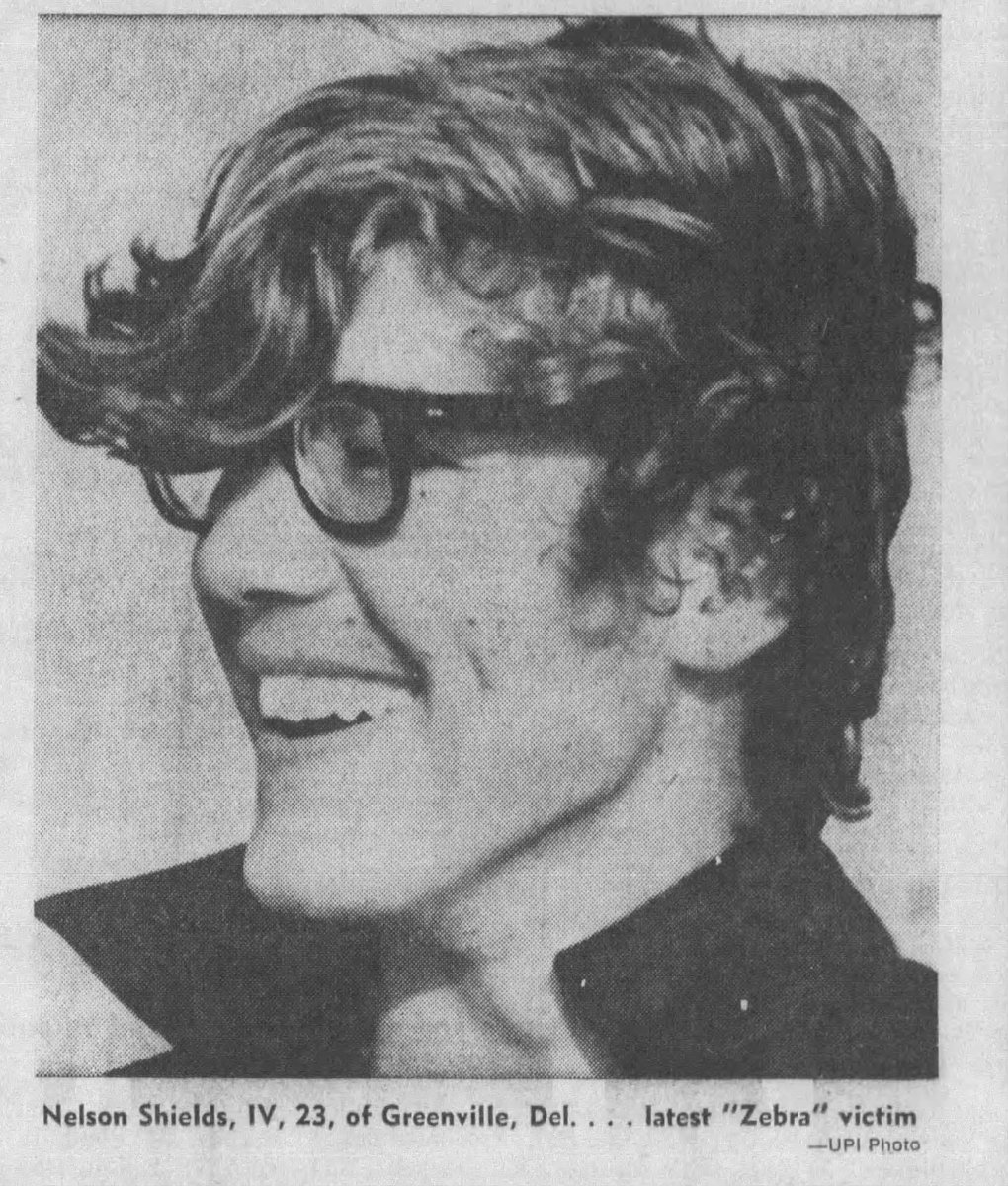
The day after the Shields murder, the Mayor Alioto and SFPD leadership, in near desperation, announced “Extreme Measures.” The police would be stopping and searching anyone who resembled just-released sketches of the suspects.
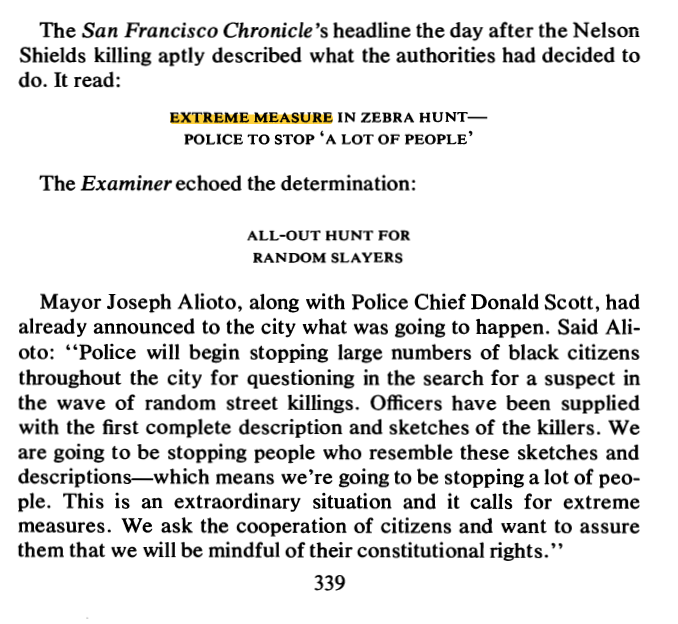

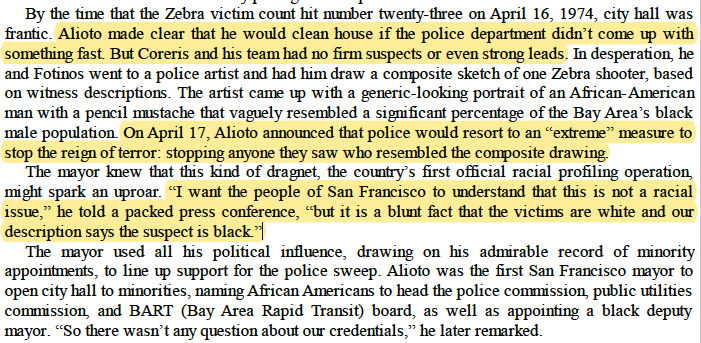

There is some dispute as to how the sketches came to be made. In theory, the sketches depicted Moore and Simon - But they scared the hell out of Anthony Harris.


Harris had quit the murder cult and moved to Oakland with a new wife. He now had a lot to think about – Would the Zebras kill him for defecting? Would he be arrested for his role is the killing spree? Or could he avoid prison and collect $30K if he told the police what he knew?

Leftists and Black activists were unhappy about the "stop and search" tactics. But given the grave threat of more bloodshed, and panic in the city, they put aside their concerns and cooperated … Just kidding - they filed lawsuits, protested, and physically attacked the mayor.
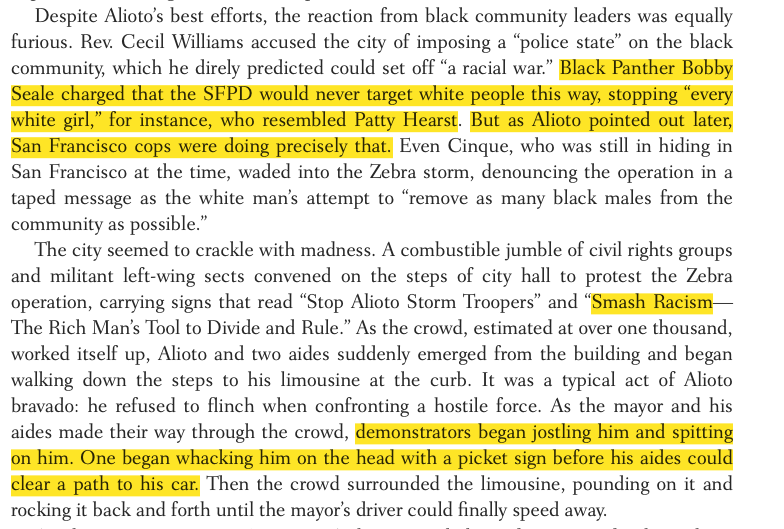
As soon as the detectives interviewed Harris, they knew the case was cracked. Harris related details of the killings that were not released to the public. He confirmed the well-founded suspicion of a NoI connection to the killers. And soon NoI members were hunting for Harris.

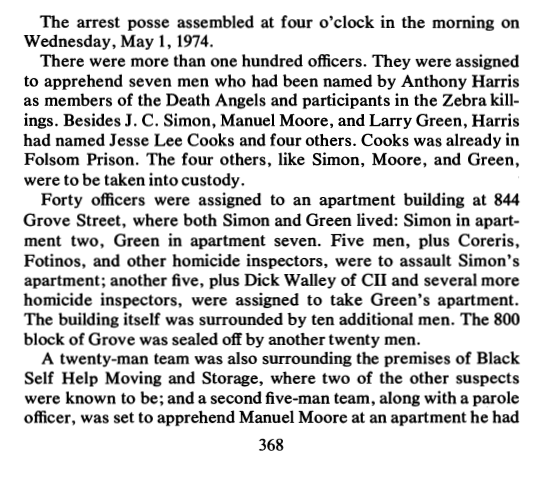
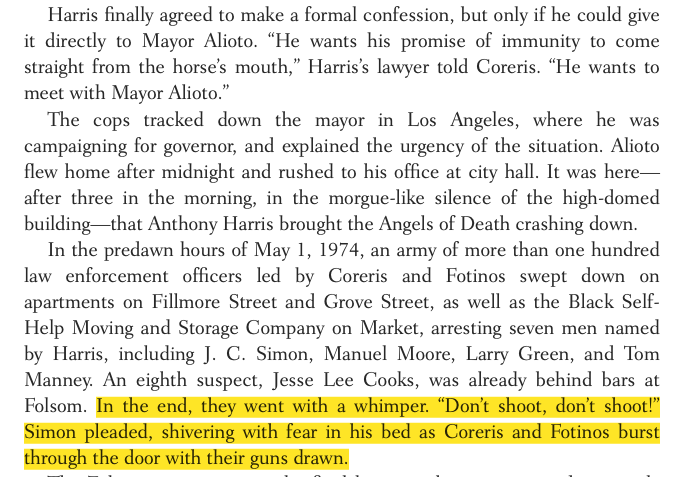
On May 1, 1974, the police executed a massive raid against Black Self Help, and the residences of the suspects. As had been predicted, no resistance was offered by the would-be Death Angels.
After a trial that lasted over a year, the four accused were convicted on all counts. Three of the Zebras died in prison: Simon (2015), Moore (2017), and Cooks (2021). Harris disappeared into witness protection. Green is still imprisoned - next parole hearing expected in 2025.


How many victims were there? How many killers? The California Department of Justice was tracking 64 NoI-suspected, "Black-on-White" homicides. Harris had sworn that there were hundreds of Death Angels in California alone. Was Harris exaggerating? Were the police wrong?


There were no further charges in the San Francisco Zebra case. The prosecutors felt they did not have enough evidence - Even against Thomas Manney, the owner of Black Self Help - who had loaned the killers his car and one of the murder weapons.

• • •
Missing some Tweet in this thread? You can try to
force a refresh