Read on Twitter
The Atlantic's Helen Lewis (@helenlewis) with a sensible piece on the U.S. as growing outlier in pediatric gender medicine. I'm featured in it, along with @heterodorx.
Some thoughts. 🧵
theatlantic.com/ideas/archive/…
Some thoughts. 🧵
theatlantic.com/ideas/archive/…
Helen acknowledges the weak evidence and the course change in Europe, but says that U.S. bans are "unhelpful, illiberal, and in many cases disturbingly punitive."
No doubt, some are overly punitive--e.g., if they try to criminalized parents who agree to these interventions.
No doubt, some are overly punitive--e.g., if they try to criminalized parents who agree to these interventions.
"Unhelpful"? That's a complicated question. Helpful toward what end? If the goal is to protect minors from medical harm, then we have to do a realistic assessment of our options.
Helen, @heterodorx and I agree that the ideal solution is for the medical establishment--especially the professional associations and government health agencies like HHS--to resist pressures from activists and adhere to proper scientific standards.
But these organizations and institutions have persistently refused to do so. And their refusal PREDATES red state efforts to ban "gender-affirming care."
For example, the AAP's position was articulated at least as far back as 2018; the first bans weren't proposed until 2020, if memory serves, and pediatricians like @JuliaMasonMD1 have been trying to get the @AmerAcadPeds to do a systematic review for several years now.
Thus, if by "unhelpful" Lewis means that bans are what cause medical groups to defer to activists--whether within their own ranks (e.g., Jason Rafferty) or external--then that is clearly not true.
To put it bluntly, "they started it."
To put it bluntly, "they started it."
But I think Lewis means something more nuanced here, which is that bans, especially when coupled with laws that focus on other issues (e.g., drag shows), are causing liberal elites to close ranks and defend what, in less polarized circumstances, they would be unlikely to defend.
The logic, in other words, is one of tribalism and negative affective polarization. And it's making scientific debate very difficult. I agree with Lewis, but where I think we may disagree is over policy solutions.
Lewis' piece is one of several in recent months to draw attention to the problem without proposing an alternative solution. To some extent, I can't blame her: Journalists are not supposed to offer well-thought out policy solutions.
But every criticism of a policy implies that a better solution exists, and I've yet to hear what would be a feasible and effective policy alternative to bans, an alternative that can bring us into alignment with Sweden and Finland and prevent harmful medicalization.
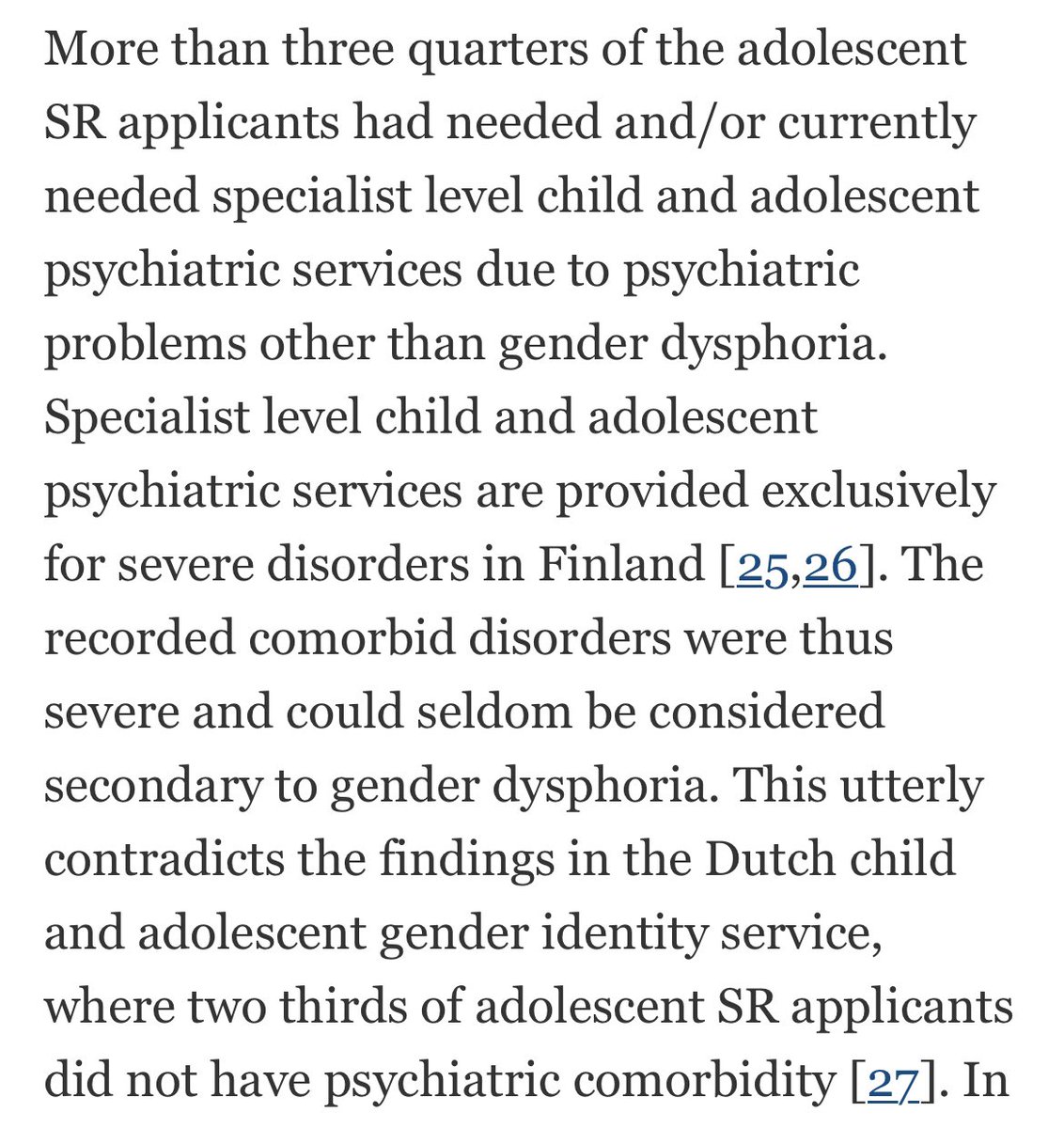
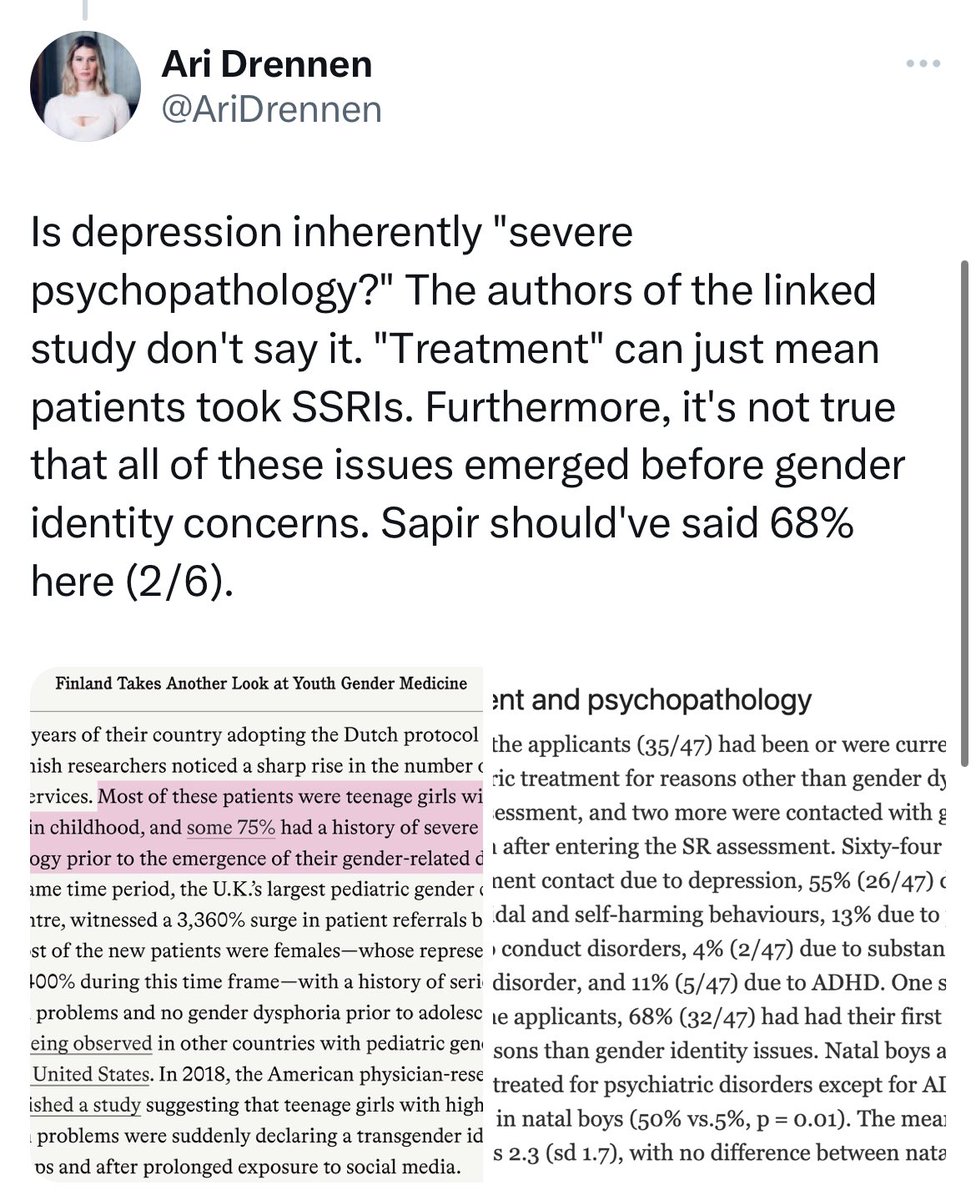
This assumes, of course, that Sweden et al. are themselves adhering to the best scientific evidence and medical ethics, an assumption that is questionable to say the least. This is, as Finland's COHERE admits, a medical experiment on kids.
tandfonline.com/doi/full/10.10…
tandfonline.com/doi/full/10.10…
But let's assume Sweden et al. are getting it right. Can we do the same here? The challenges are significant. Not only is our health system highly decentralized and harder to control and reform. Not only is it permeated with profit motives in a way that European systems are not.
But it seems also more vulnerable to activist pressures, and we must remember that groups like AAP and WPATH are first and foremost professional interest groups. Given the structure of the AAP, there is no guarantee that its leadership speaks on behalf of members.
The decentralized U.S. political system equates to a policy process with multiple "veto points" that simultaneously act as opportunity points. This allows well-organized interests to shape policy without building popular/professional support or engaging in democratic persuasion.
Collective action problems ensue. One way to overcome these problems is counter-organization (e.g., SEGM), but the "gender affirming care" juggernaut has far more resources and institutional supports.
Another option: government regulation. This could take the form of FDA-supervised clinical trials with tight controls, not unlike what's happening in the Europe.
But as any student of bureaucratic politics knows, when you shift the locus of policymaking to individual agencies, especially on an issue as fraught as this, you risk bureaucratic capture. American bureaucracy is not as insulated from political pressures as European bureaucracy.
Which brings us back to bans, and to Lewis' claim that they are "illiberal." If well-crafted and moderate (e.g., no punishments for parents), they need not be illiberal. On the contrary, in present circumstances, they might the only viable method of protecting kids from harm.
I take "illiberal" to mean something that denies people their basic rights. But no child has a "right" to experimental and potentially dangerous drugs and surgeries, especially when we know with reasonable confidence (as Lewis notes) that most dysphoric kids will grow out of it.
As I and Corinna say in the piece, bans are an unfortunate concession to reality. That reality is that, at the moment at least, the choice is between unregulated "gender-affirming care" and limiting these interventions to age 18+.
Why? Because those who practice affirmative care have proven time and again that they simply cannot be trusted to regulate themselves. They are committed to the "affirming" ideology that takes kids at their word and eschews exploratory therapy.
city-journal.org/article/making…
city-journal.org/article/making…
Democrats might have shown interest in treating trans medicine as an open scientific debate rather than a "civil rights" issue pitting good against evil. had they done so, we might have had laws that are more nuanced and moderate.
I think it's time for those who agree that the science of ped gender med is shaky but dislike bans to start proposing feasible alternatives to bans. I've made a few suggestions along with @JKetcham91, but these are hardly well-developed policy plans.
city-journal.org/article/how-to…
city-journal.org/article/how-to…
Lewis' article is probably the best statement I've read from a sober, evidence-focused, left-of-center perspective. It should be the start of a conversation among Democrats and liberal voters about to rein in an irresponsible medical establishment.
• • •
Missing some Tweet in this thread? You can try to
force a refresh