The Ringwatchers Profile picture
May 12, 2023 14 tweets 23 min read Read on X
Super Heavy’s engine shielding is quite an impressive system, and Elon Musk has been talking a lot about this with Booster 9. Let’s take a closer look at how SpaceX isolates and protects all 33 engines on the Booster. (1/14)

📸 @CosmicalChief
Animations provided by @ChameleonCir Image
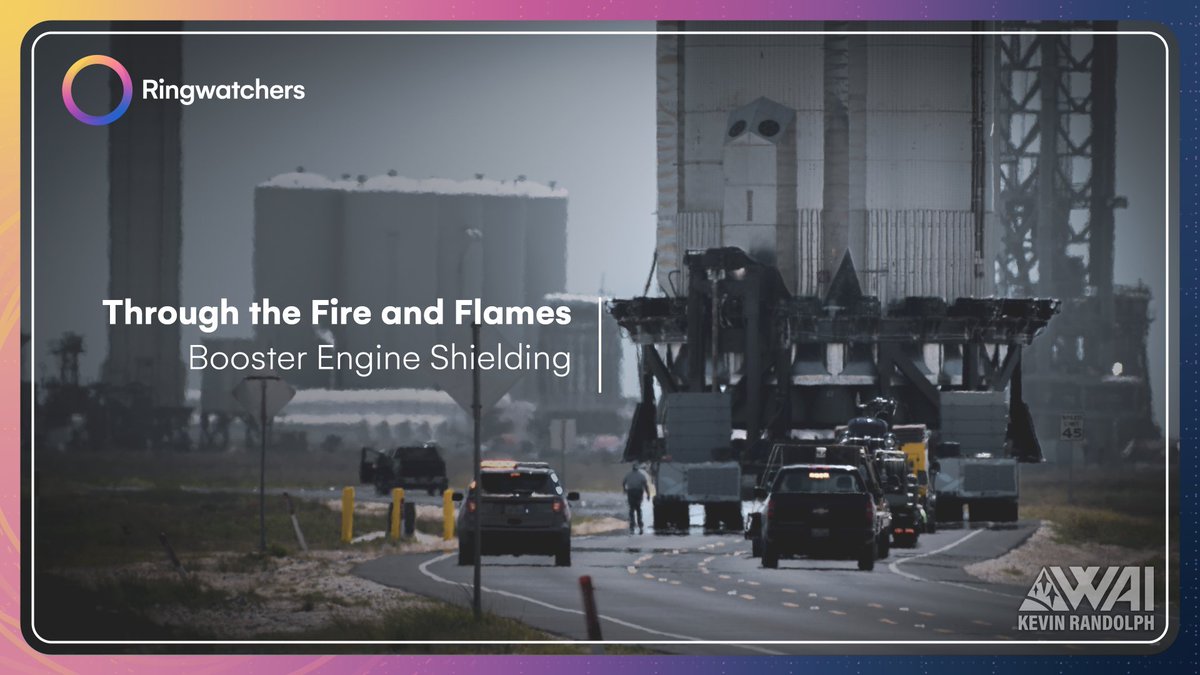
@CosmicalChief @ChameleonCir Getting right into it, the covers are unsurprisingly made of stainless steel, and many areas beneath the vehicle are covered in this black material, which could be related to the extra heating in that area. (2/14)

📸 @SpaceX @RGVaerialphotos
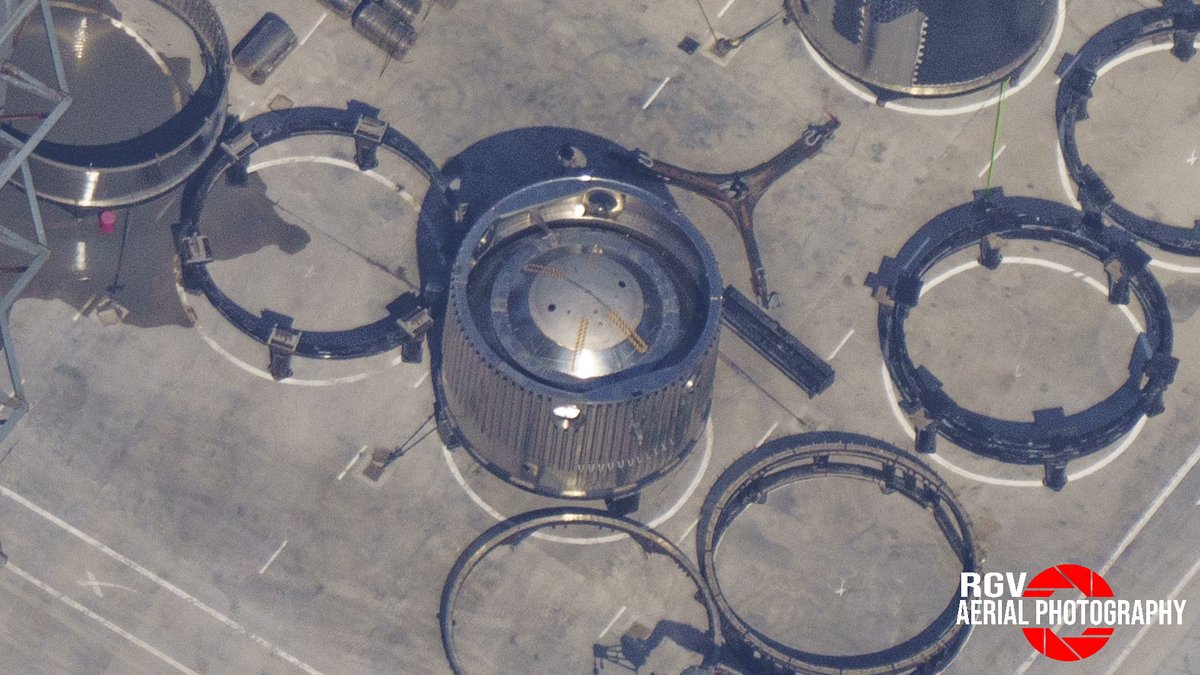
@CosmicalChief @ChameleonCir @SpaceX @RGVaerialphotos These 13 circular pieces surrounding the center engine mounts get added to the aft section in the tents before stacking. SpaceX is always working towards reducing the number of tasks to be completed after final stacking. (3/14)

📸 @LabPadre @NASASpaceflight @SpaceX
@CosmicalChief @ChameleonCir @SpaceX @RGVaerialphotos @LabPadre @NASASpaceflight Moving to the outer ring of 20 engines. These panels that go between each engine get installed. They have a dividing wall mounted perpendicular to the interior face, protecting each engine from the engine next to it in case of a… high-energy event. (4/14)

📸 @CosmicalChief
@CosmicalChief @ChameleonCir @SpaceX @RGVaerialphotos @LabPadre @NASASpaceflight The outer 20 engines are prepared for installation, and 2 halves are joined around the top of the bell of each engine before integration. Once again, SpaceX is trying to do as much as possible before integrating components. (5/14)

📸 @CosmicalChief
@CosmicalChief @ChameleonCir @SpaceX @RGVaerialphotos @LabPadre @NASASpaceflight For this thread, we’ll ignore the normal engine installation order and put all 20 fixed outer engines in now. On the exterior side, curved panels cover the engine after the installation is complete. (6/14)

📸 @RGVaerialphotos @NASASpaceflight
@CosmicalChief @ChameleonCir @SpaceX @RGVaerialphotos @LabPadre @NASASpaceflight On the interior, curved panels close each isolated chamber. We have seen how the dividing walls split off in 2 directions, allowing these panels to be bolted into them and have also seen matching curved parts on the preinstalled shielding. (7/14)

📸 @SpaceX @CosmicalChief
@CosmicalChief @ChameleonCir @SpaceX @RGVaerialphotos @LabPadre @NASASpaceflight Now we’ll move to the center engines. Just like the outer 20, all 13 have a part of their shielding pre-installed before they move over to the vehicle. (8/14)

📸 @CosmicalChief
@CosmicalChief @ChameleonCir @SpaceX @RGVaerialphotos @LabPadre @NASASpaceflight For ease of visibility, we’ll only install one for now. When the engine is completely plumbed and wired in, 2 halves of a curved component get added to the top, and 2 halves of a cylinder close out the remaining exposed area. (9/14)

📸 @LabPadre
@CosmicalChief @ChameleonCir @SpaceX @RGVaerialphotos @LabPadre @NASASpaceflight That curved component interfaces with the 13 circular portions that we mentioned earlier and uses a similar concept to a swivelling ball joint. You can see how we believe this works in the animation below. (10/14)
@CosmicalChief @ChameleonCir @SpaceX @RGVaerialphotos @LabPadre @NASASpaceflight Essentially every open surface will have plates placed over, also featuring that black material layer, which creates what could be called a false-ceiling. This false-ceiling is used to protect the pipes, wires, and more. (11/14)

📸 @SpaceX
@CosmicalChief @ChameleonCir @SpaceX @RGVaerialphotos @LabPadre @NASASpaceflight Now we’ll just quickly put the remaining 12 center engines in place, and you now have all 33 engines in their own isolated enclosures. Flight 1 showed that Raptor still isn’t perfect, so having this kind of protection really is important. (12/14)

📸 @SpaceX
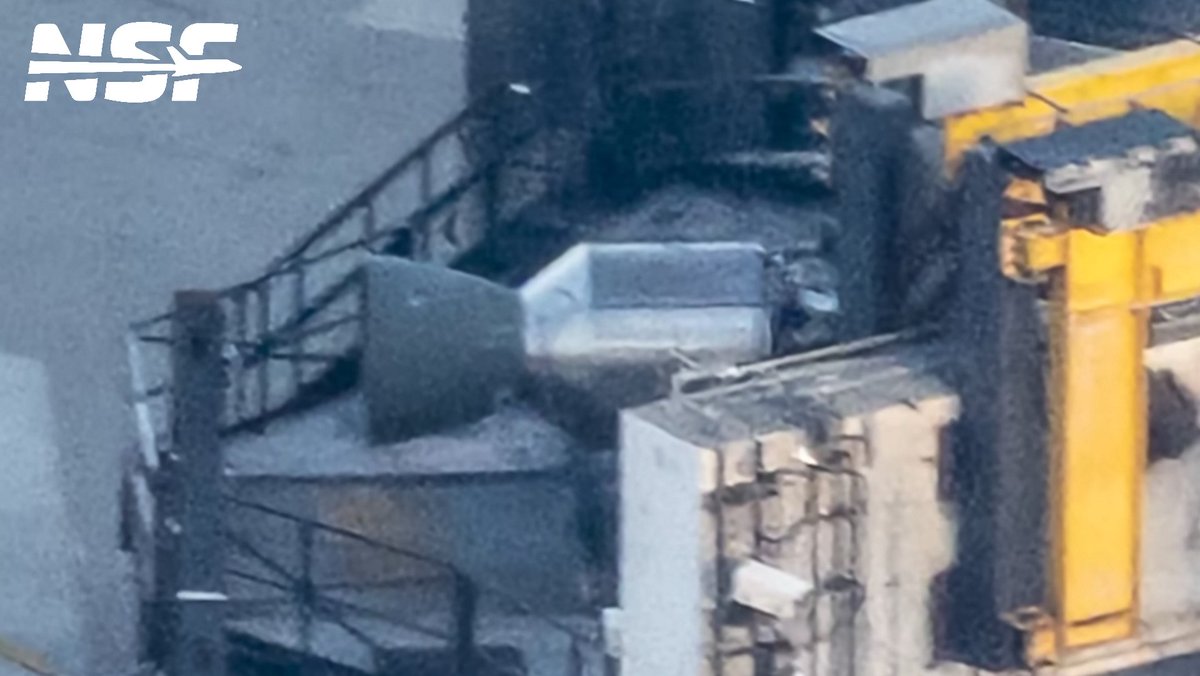
@CosmicalChief @ChameleonCir @SpaceX @RGVaerialphotos @LabPadre @NASASpaceflight SpaceX has even tested some of its engines at the McGregor testing facility with the shielding installed. You can see an engine here with the same style covers as the center engines, just without the black material overtop. (13/14)

📸 @NASASpaceflight Image
@CosmicalChief @ChameleonCir @SpaceX @RGVaerialphotos @LabPadre @NASASpaceflight Hopefully, you’ve learned at least something new about the engine enclosures on the Super Heavy Booster, and how it’s a lot more than it may appear to be. Like the Booster, the Ship also has its own unique shielding, but maybe that could be a topic for another day. (14/14)

• • •

Missing some Tweet in this thread? You can try to force a refresh

 

Keep Current with The Ringwatchers

The Ringwatchers Profile picture

Stay in touch and get notified when new unrolls are available from this author!

Read all threads

This Thread may be Removed Anytime!

PDF

Twitter may remove this content at anytime! Save it as PDF for later use!

Try unrolling a thread yourself!

how to unroll video
  1. Follow @ThreadReaderApp to mention us!

  2. From a Twitter thread mention us with a keyword "unroll"
@threadreaderapp unroll

Practice here first or read more on our help page!

More from @Ringwatchers

Jul 31, 2023
As SpaceX prepares to structurally qualify its new interstage design, intended to be used for hot staging, let’s look at the new parts that will be used for this, and what we can learn from these new parts. (1/12)

The test article at the Massey’s testing site is labelled the “Hot Stage Load Head”, and will be used to qualify the interstage against the aerodynamic forces it will experience during flight. There are 3 main components to this. (2/12)

🖼️ @ChameleonCir Image
The bottom barrel section is the old Booster 11 forward dome section that was reassigned to become a test article for this, seemingly back in January of this year, possibly suggesting when this design decision was made. (3/12)

📸 @RGVaerialphotos Image
Read 12 tweets
Jul 14, 2023
Ship 24.2. A confusing test article with a confusing name that has had a confusing life thus far. Today we’re going to talk about how SpaceX is planning to structurally verify the Starship Payload Bay, and why this monstrosity exists. (1/16)

🖼️ @ChameleonCir Image
Ship 24.2 will be a 7-ring tall article composed of 3 main sections: a top ring with a dome and 24 external attachment points, a Ship Payload Bay that features a PEZ dispenser rack, and a bottom ring with a hatch in the side. (2/16)

🖼️ @ChameleonCir
Knowing that this is a 7-ring tall test article, we were able to quickly determine that the newly reconfigured nosecone cage is the perfect height to support this. We’ll come back to this later. (3/16)

📸 @RGVaerialphotos
🖼️ @ChameleonCir
Read 16 tweets
Jul 10, 2023
With this new photo from Elon Musk, there’s been a lot of discussion about what exactly we’re seeing. Today’s quick thread is going to go a bit deeper into what we can learn from this photo. (1/10)

For starters, let’s figure out the positioning of things. The Quick Disconnect is located in the upper right of the photo, and aft flaps can be identified from the frames the motors sit in. This means that the tiled side is on the lower left of this photo. (2/10)

📸 @elonmusk
We can immediately see the Hydraulic Power Unit that powers Ship 25’s Thrust Vector Control in the lower left of this image. Ship 25 is the last Starship to use this, as B9+ and S26+ use an electric TVC system. (3/10)

📸 @elonmusk
Read 10 tweets
Jun 17, 2023
Some interesting developments have been happening lately with Starship 28, with one of the major ones being the removal of its sliding Payload Bay door. Let’s take a closer look at how this was done, and what it could mean. (1/6)

📸 @CosmicalChief Image
On June 15th, crews attached a crane to Ship 28’s sliding door, and after somehow reorienting it inside of the vehicle, slid it out. We’ve included an animation of how it was removed if it’s hard to tell from the recording. (2/6)

📸 @NASASpaceflight
🖼️ @ChameleonCir
This is simply the sliding panel that we all see from the outside of the Ship. On Ship 28, you can see that it’s now missing, and what is likely related to the actuation mechanism can be seen hanging in the doorway. (3/6)

📸 @CosmicalChief
🖼️ @ChameleonCir
Read 6 tweets
Jun 11, 2023
Ship 25 has had quite a life so far, and it hasn’t even had its first static fire. Let’s take a look at why this Starship has been so confusing, why many thought it was retired, and how it’s different from Ship 24. (1/13)

📸 @RGVaerialphotos Image
@RGVaerialphotos Ship 25 was fully stacked in the Highbay on September 12th, 2022, and was moved to the Launch Complex for cryogenic testing on October 19th. It conducted 3 cryo tests, before being moved back to the Highbay to receive its engines. (2/13)

📸 @NASASpaceflight @LabPadre
@RGVaerialphotos @NASASpaceflight @LabPadre In the Highbay, all 6 engines were installed on Ship 25, and the PEZ Dispenser slot on the front was welded closed. Ship 25’s engines still use hydraulically-powered TVC, which changes to electric on Ship 26. (3/13)

📸 @LabPadre
Read 13 tweets
Jun 3, 2023
One of the major changes on Booster 10 is the beginning of the transition to using SpaceX’s new, flatter smooth domes. While the transition to using these smooth domes hasn’t been as smooth as many hoped, let’s take a closer look at this Super Heavy. (1/6)

📸 @CosmicalChief Image
@CosmicalChief August 18th, 2022 saw one of these new domes lifted onto the sleeving stand, and it was sleeved by a Booster common dome sleeve shortly thereafter. The common dome separates the CH4 and LOX tanks inside of the vehicle. (2/6)

🎥 @CosmicalChief @NicAnsuini
@CosmicalChief @NicAnsuini Prior to this change, the common dome looked like one of the normal older style domes, just with a hole in it for the massive CH4 transfer tube to pass through. (3/6)

📸 @CosmicalChief @RGVaerialphotos
Read 7 tweets

Did Thread Reader help you today?

Support us! We are indie developers!


This site is made by just two indie developers on a laptop doing marketing, support and development! Read more about the story.

Become a Premium Member ($3/month or $30/year) and get exclusive features!

Become Premium

Don't want to be a Premium member but still want to support us?

Make a small donation by buying us coffee ($5) or help with server cost ($10)

Donate via Paypal

Or Donate anonymously using crypto!

Ethereum

0xfe58350B80634f60Fa6Dc149a72b4DFbc17D341E copy

Bitcoin

3ATGMxNzCUFzxpMCHL5sWSt4DVtS8UqXpi copy

Thank you for your support!

Follow Us!

:(