Read on Twitter
We really shouldn't have missed this; it's important:
agupubs.onlinelibrary.wiley.com/doi/10.1029/20…
agupubs.onlinelibrary.wiley.com/doi/10.1029/20…
High hazard dams -- those that will kill a whole lot of people if they fail -- generally have spillways designed to pass the 'probable maximum flood', a hydrological estimate based on a meteorological construct called 'probable maximum precipitation'. 

That, by the way, is the most dangerous dam in Australia -- Wivenhoe Dam upstream of Brisbane, passing the 2011 flood. Its official 'population at risk' from a flood-induced dam failure is 159,000.
But even with its major 2005 spillway upgrade, Wivenhoe still can't even pass the *current* PMF. You see dam engineering has been playing this game for half a century -- meteorologists kept coming up with bigger PMPs, making (much!) bigger PMFs, requiring even bigger spillways...
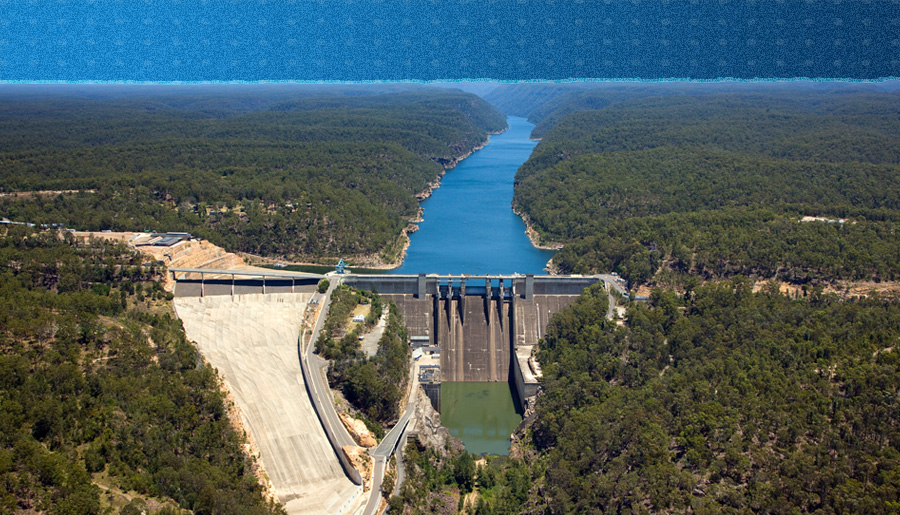
...Often retrofitted at huge cost. This is Warragamba upstream of western Sydney -- the auxiliary spillway on the left was added in 2001 at a cost of about $300M in today's dollars (it would cost far more now; construction cost escalation greatly exceeds the CPI).
PMP estimates increased hugely in the 1970s and 80s, leading to a long and expensive game of catch-up in dam engineering. But they've been relatively stable for a quarter of a century now, since the Bureau of Meteorology settled on generalised methods:
bom.gov.au/water/designRa…,
bom.gov.au/water/designRa…,
But it was obvious to anyone paying attention that stability could not continue in the face of rapid global heating. The main variable in maximal precipitation estimates is how much moisture the atmosphere can deliver, which depends fundamentally on how much it can hold...
...And that increases rapidly and very non-linearly as the atmosphere warms: engineeringtoolbox.com/maximum-moistu…
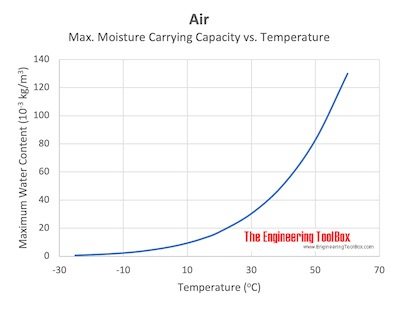
The paper projects an ~one-third increase in probable maximum precipitation in 75 years under a high-warming scenario. (Large dams are commonly designed for multi-hundred year lives.)
• • •
Missing some Tweet in this thread? You can try to
force a refresh