SQL is going to die at the hands of an AI. I’m serious.
@mayowaoshin is already doing this. Takes your company’s data and ingests it into ChatGPT. Then, you can create a chatbot for the data and just ask it questions using natural language.
This video demoes the output.
🤯
Mayo is going to teach a course on Maven. He’ll walk you through how to do this and by the end of the course, you’ll have a fully working AI chatbot that anyone in your company can use to query your data.
I've seen it behind the scenes and it is powerful.
Sign up the waitlist so you can get more information on how this works and where you can apply it: bit.ly/mayo-oshin-cou…
The video of Mayo looking through the Tesla 10K via a chatbot he trained on the data.
His course is here in case you want to learn to do this for your data! bit.ly/mayo-oshin-cou…
• • •
Missing some Tweet in this thread? You can try to
force a refresh

How to Control Midjourney using “Additive Prompting” - a lesson from @nickfloats
AI prompt recommendations are useless. It’s far more useful to understand the underlying technique to build your own prompts for your custom use case.
Let’s dive in 👇
Midjourney is the most powerful AI visualizer out there. It enables anyone to build photorealistic images with words. The challenge is that Midjourney prompting is finicky and requires experience to truly master.
Additive Prompting involves these 4 steps:
1. Start simple.
Many prompters try to start by getting a beautiful image like Nick’s on the first try. The problem is you don’t really know which part of the prompt actually made the difference.
Instead, start with a basic prompt and then build from there.
Before, you needed to use almost a dozen tools to get a course off the ground.
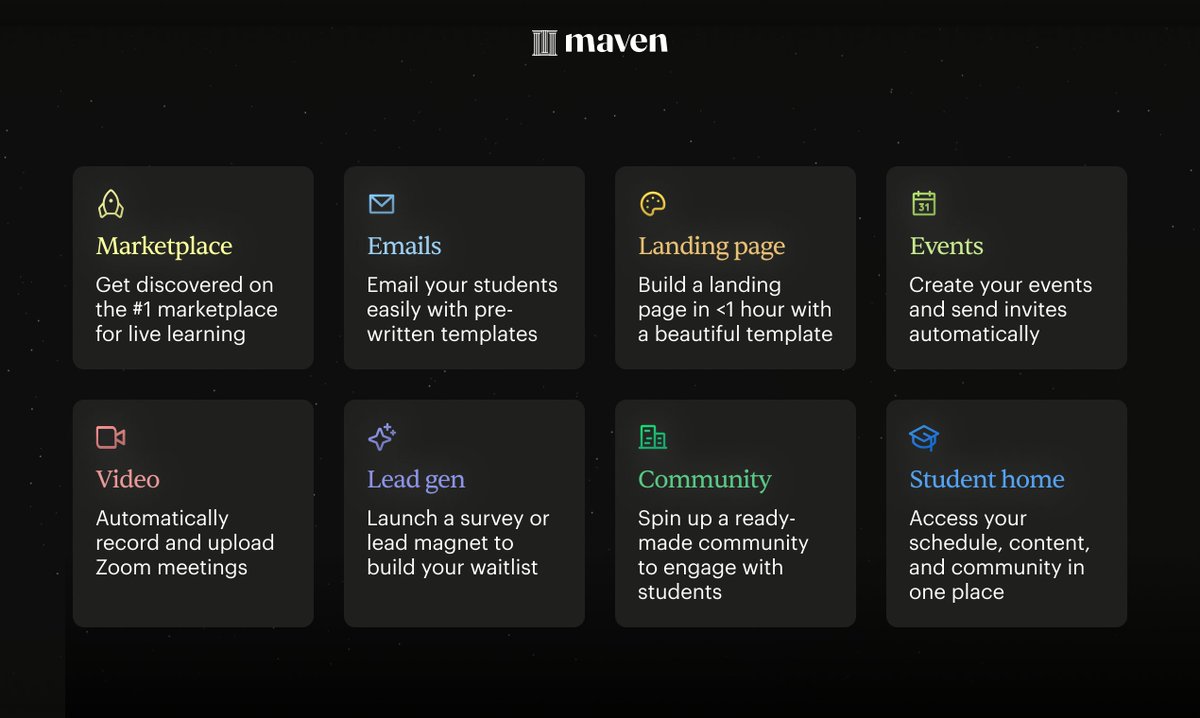
With Maven, you can spin up a new course w/our all-in-one tool that covers: email marketing, landing page, Zoom integrations, syllabus, community, & more.
A few ways Maven simplifies your ops:
• Record and upload Zoom sessions
• Send calendar invites to your students
• Pre-written email campaigns
• Ready-made surveys
• Spin up a community
With admin and logistics off your plate, you can focus on teaching.
The last two weeks in SF have been amazing. I've also learned a few things that make me optimistic for its future.
The food, the vibe, the drinks, the people. I grew up in the Bay Area and while I wish SF was more favorable to tech, it is amazing to see SF in its "true form". Eclectic, stunningly beautiful, and urban.
TBH the homelessness is still heartbreaking and I see people doing drugs in public way more than I'd like. But it's actually not that different from my experience in Austin in 2021 and people forget this but it's way way better than SF in the 90's.
Company off-sites are becoming more regular and we just had ours at Maven last week. Thought I'd share a bit about what we do to make ours special.
3 rules: 1. 50% fun 2. In person isn't critical for company ops 3. 80/20 rule
A bunch more details on how we run them...
Logistics:
- We're 25 ppl all in N. America so we pick a place within 3 hours drive of an int'l airport (Sedona, upstate NYC, Montreal, Costa Rica)
- We've tried 7, 4, and 3 days. I think we'll settle on 4 days as 3 always feels short and more than 4 is too much.
1. 50% of our off-site is dedicated to fun, social events so people can mingle. We don't get this time while remote and its the most important thing that happens at an off-site.
That means 1 full day is dedicated to outdoor activities, sometimes onsite sometimes a day trip.
The hardest part in starting a $100m business: picking the right idea to work on.
Pick wrong and you’ll spend years working away with little to no results.
Pick right and you'll have a much better chance to succeed.
Here’s how I’ve decided what ideas to work on…
Disclaimer/
I feel like I’ve picked the right market 3x (Udemy, Lyft, Sprig)
That said, Udemy isn’t the clear category winner I hoped for.
I was a (very) small player at Lyft.
Was right about food delivery but picked the wrong model w Sprig.
/Disclaimer over
5-step process for coming up with startup ideas:
Explore to find a market that you’re interested in
Research to understand the landscape
Define an attack strategy
Test your strategy
Get early traction