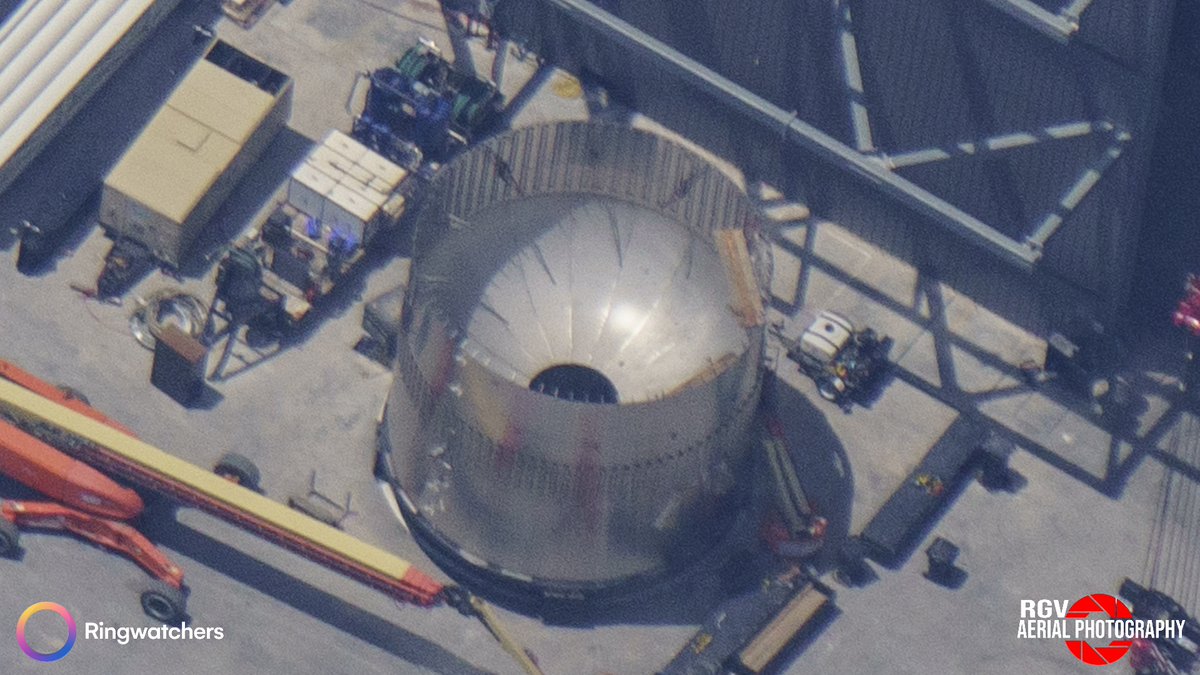
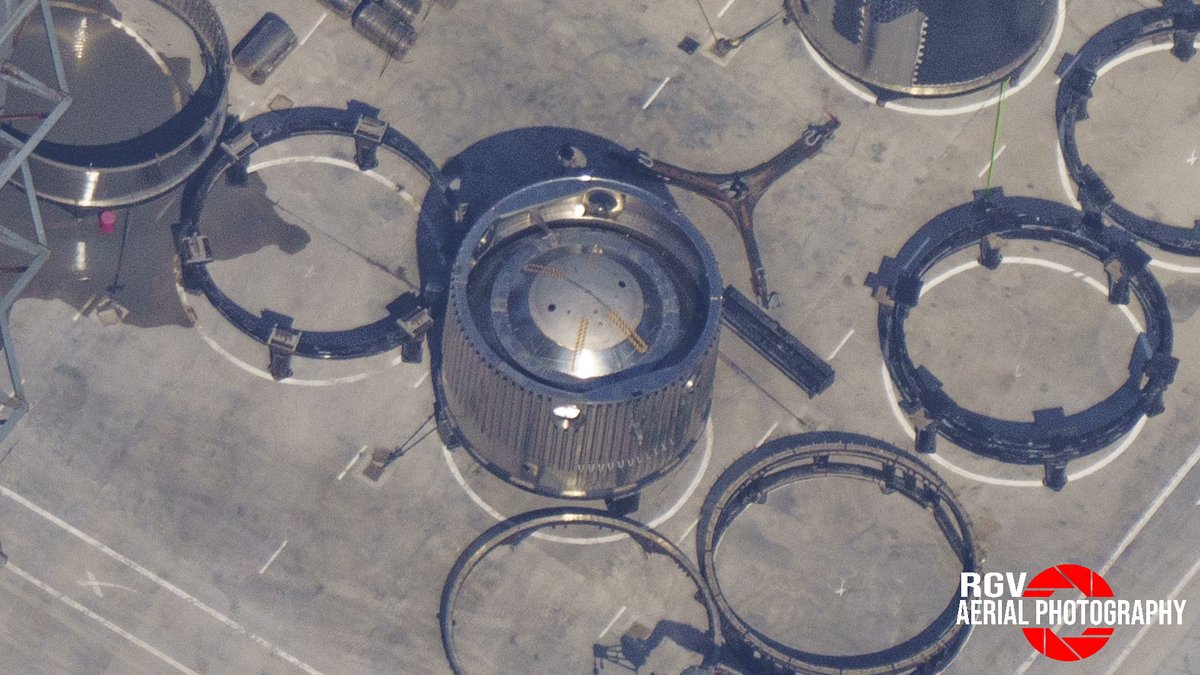
One of the major changes on Booster 10 is the beginning of the transition to using SpaceX’s new, flatter smooth domes. While the transition to using these smooth domes hasn’t been as smooth as many hoped, let’s take a closer look at this Super Heavy. (1/6)
📸 @CosmicalChief
@CosmicalChief August 18th, 2022 saw one of these new domes lifted onto the sleeving stand, and it was sleeved by a Booster common dome sleeve shortly thereafter. The common dome separates the CH4 and LOX tanks inside of the vehicle. (2/6)
🎥 @CosmicalChief @NicAnsuini
@CosmicalChief @NicAnsuini Prior to this change, the common dome looked like one of the normal older style domes, just with a hole in it for the massive CH4 transfer tube to pass through. (3/6)
📸 @CosmicalChief @RGVaerialphotos
@CosmicalChief @NicAnsuini @RGVaerialphotos This new dome design uses fewer panels, and therefore has less welds. Using these likely simplifies and speeds the production rate of domes, which is undoubtedly a good thing. (4/6)
📸 @RGVaerialphotos
@CosmicalChief @NicAnsuini @RGVaerialphotos For now, the only places these new domes have been implemented is the Booster common dome, but over time we hopefully will see these pop up in more places, simplifying the construction of Starship and Super Heavy. (5/6)
🖼️ @ChameleonCir
For the rest of B10, there are always the less visible changes, but a lot of it seems to be quite similar to Booster 9. That’s not a bad thing though, and hopefully this new generation of Boosters is able to get a Ship into space. (6/6)
Apologies for the repost. One of the photos had the wrong watermark on it.
• • •
Missing some Tweet in this thread? You can try to
force a refresh

As SpaceX prepares to structurally qualify its new interstage design, intended to be used for hot staging, let’s look at the new parts that will be used for this, and what we can learn from these new parts. (1/12)
The test article at the Massey’s testing site is labelled the “Hot Stage Load Head”, and will be used to qualify the interstage against the aerodynamic forces it will experience during flight. There are 3 main components to this. (2/12)
🖼️ @ChameleonCir
The bottom barrel section is the old Booster 11 forward dome section that was reassigned to become a test article for this, seemingly back in January of this year, possibly suggesting when this design decision was made. (3/12)
Ship 24.2. A confusing test article with a confusing name that has had a confusing life thus far. Today we’re going to talk about how SpaceX is planning to structurally verify the Starship Payload Bay, and why this monstrosity exists. (1/16)
🖼️ @ChameleonCir
Ship 24.2 will be a 7-ring tall article composed of 3 main sections: a top ring with a dome and 24 external attachment points, a Ship Payload Bay that features a PEZ dispenser rack, and a bottom ring with a hatch in the side. (2/16)
🖼️ @ChameleonCir
Knowing that this is a 7-ring tall test article, we were able to quickly determine that the newly reconfigured nosecone cage is the perfect height to support this. We’ll come back to this later. (3/16)
With this new photo from Elon Musk, there’s been a lot of discussion about what exactly we’re seeing. Today’s quick thread is going to go a bit deeper into what we can learn from this photo. (1/10)
For starters, let’s figure out the positioning of things. The Quick Disconnect is located in the upper right of the photo, and aft flaps can be identified from the frames the motors sit in. This means that the tiled side is on the lower left of this photo. (2/10)
📸 @elonmusk
We can immediately see the Hydraulic Power Unit that powers Ship 25’s Thrust Vector Control in the lower left of this image. Ship 25 is the last Starship to use this, as B9+ and S26+ use an electric TVC system. (3/10)
Some interesting developments have been happening lately with Starship 28, with one of the major ones being the removal of its sliding Payload Bay door. Let’s take a closer look at how this was done, and what it could mean. (1/6)
On June 15th, crews attached a crane to Ship 28’s sliding door, and after somehow reorienting it inside of the vehicle, slid it out. We’ve included an animation of how it was removed if it’s hard to tell from the recording. (2/6)
This is simply the sliding panel that we all see from the outside of the Ship. On Ship 28, you can see that it’s now missing, and what is likely related to the actuation mechanism can be seen hanging in the doorway. (3/6)
Ship 25 has had quite a life so far, and it hasn’t even had its first static fire. Let’s take a look at why this Starship has been so confusing, why many thought it was retired, and how it’s different from Ship 24. (1/13)
@RGVaerialphotos Ship 25 was fully stacked in the Highbay on September 12th, 2022, and was moved to the Launch Complex for cryogenic testing on October 19th. It conducted 3 cryo tests, before being moved back to the Highbay to receive its engines. (2/13)
@RGVaerialphotos@NASASpaceflight@LabPadre In the Highbay, all 6 engines were installed on Ship 25, and the PEZ Dispenser slot on the front was welded closed. Ship 25’s engines still use hydraulically-powered TVC, which changes to electric on Ship 26. (3/13)
A nosecone, a dome section, and a handful of ring sections. These are among some unusual Starship parts that we have been following for quite a while now, that are widely speculated to be related to the HLS Lander. Let’s take a look at some of these. (1/21)
@RGVaerialphotos So, fair warning, this is going to be a long one, but a lot has been happening and while we wanted to get this out sooner in a more concise manner, every time we got close, some new paradigm-shifting piece would show up. (2/21)
@RGVaerialphotos We're going to be treading through some speculative ground, so be careful. People often get set on the coolest theory and forget that there may not be much backing it up. We don’t tend to do this, but as it turns out, it can be fun. (3/21)