The Shalwar Kameez is Pakistan’s national attire and a dress now worn throughout the country.
But it only became this popular in the past century.
So what did our ancestors wear before the Shalwar Kameez?
A collection of unique attires. (🧵)
The fashion of loose trousers combined with tunic like shirts arrived in our region in continuous waves from Central Asia starting with the Kushans two millennia ago
Over the course of time small local variants of this combination arose in various parts of today’s Pakistan.
A Yousafzai Pashtun in his traditional clothing - 1815.
Two punjabis, a man from Rawalpindi and a Bania from elsewhere. - Punjab 1860
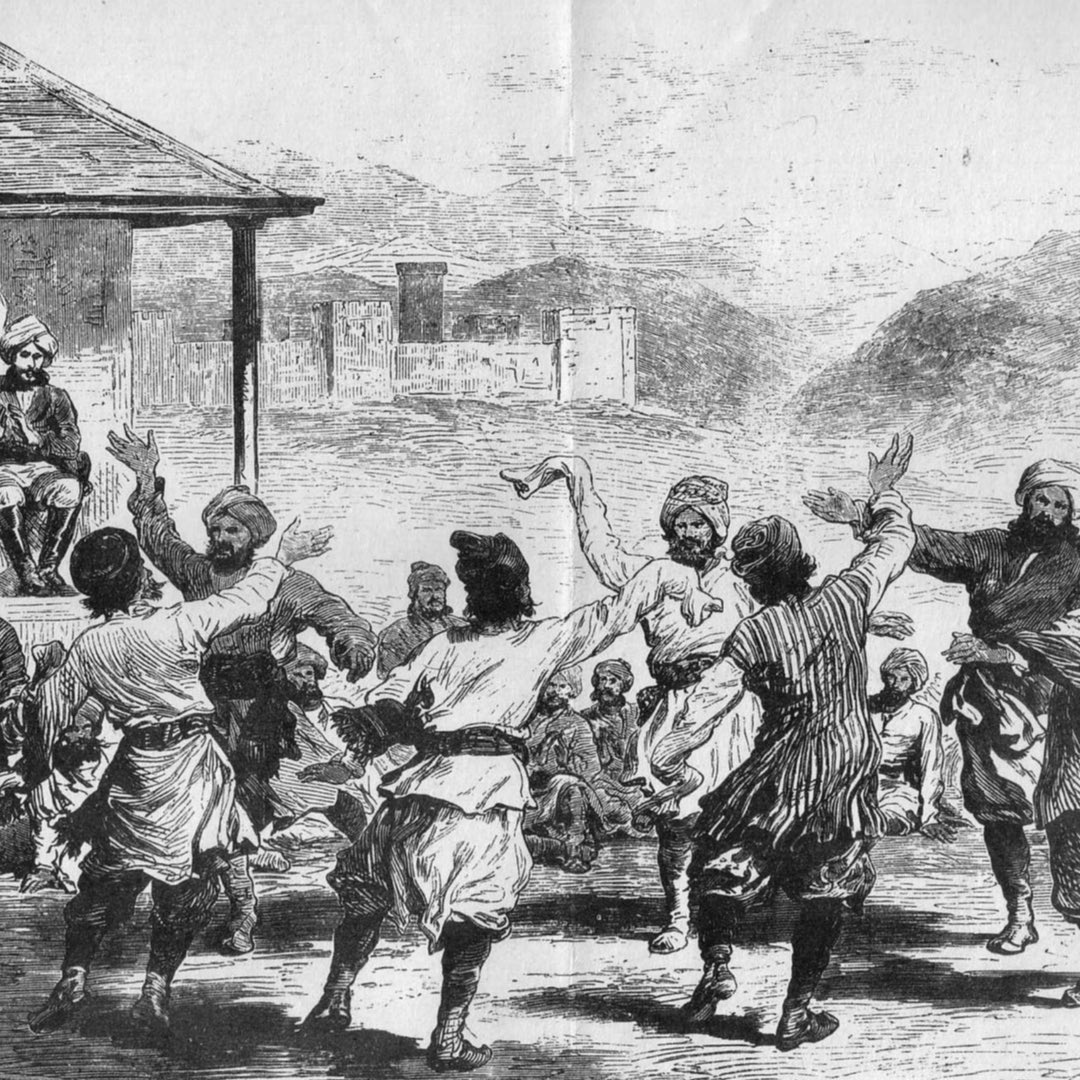
Baloch men looking upon followers of the Zikri sect as they engage in a ritual dance. - 1891
A soldier (possibly Baloch) in Sindhi attire serving in the Talpur army of Sindh - early 19th century.
An inhabitant of Kashgar - could be perhaps a mistake with Kashkar (Chitral’s old name derived from Kashgar) owing to the Chitrali cap and attire of the man.
Even if not a mistake, the dress is near identical to the old attire of Chitral.
A native of the walled city of Peshawar (known as the Peshawaris) in the traditional winter dress of Peshawar - 1815
A group of dancing Gilgitis - 1866.
Balti soldiers in the army of the Maharaja of Kashmir - 1883.
Men from Ladakh and soldier of the Maharaja - mid to late 19th century.
The dress of the two men is close to what people from the northwestern portions of J&K wore and perhaps also of the central vale.
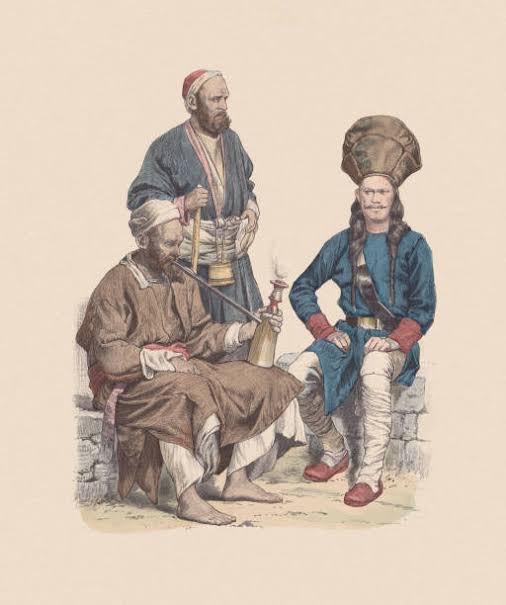
Dress of the males within the tribes of Nuristan from before their Islamization.
This thick fur clothing was seen in some photos of Nuristani refugees in Chitral in the early 20th century.
Tanolis of the Hazara region of today’s Khyber Pukhtunkhwa province - early 20th century
• • •
Missing some Tweet in this thread? You can try to
force a refresh

Pakistan and Afghanistan are currently the farthest they’ve been in very long. But there was a time when both countries were moving in the opposite direction.
When rumours began of Pakistan and Afghanistan forming a single state in the 50s. (🧵)
Since the independence of Pakistan in 1947 the country had only seen a turbulent relationship with Afghanistan either due to Afghan irredentism or its own policy towards handling the frontier that Afghanistan was very interested in.
Then a shift took place in the early 50s.
In the 1950s some Afghan and Pakistani diplomats started hinting towards a need (and in some cases a plan) for both states to merge under a confederation as the only method to overcome the differences that had so far riddled the relationship b/w them.
There’s an Olive Tree in Pakistan which was brought from Palestine over a 150 years ago and planted here.
A tree planted by a Christian missionary which for over a century grew in complete silence till it was discovered a few years ago.
This is the story of that tree. (🧵)
When the British first arrived in Punjab and its adjoining Trans Indus areas (later a part of NWFP), many amongst the officer class supported evangelism in the regions.
Various Christian missionaries wandered the rugged frontier in hopes of spreading Christianity.
Somewhere in the 1860s or the 1870s a missionary named Reverend TJL Mayer found for himself a home in a hill station called Sheikh Badin between Lakki Marwat and Dera Ismail Khan.
Mayer sought to leave a mark on the place & for this he procured an olive cutting from Palestine.
It was the summer of 1919. As the Afghan forces clashed with the British in what became the third Anglo-Afghan war, a new front opened in the tallest portion of the Hindu Kush mountains.
Afghanistan and Chitral were about to collide. It was time for the battle of Birkot. (🧵)
When the Third Anglo-Afghan war began the Afghan emir had asked Chitral’s mehtar to expel the British and join the cause. The ample rejection of this advice was followed by a series of Afghan raids and Chitrali counter raids into the bordering regions of both sides.
On one side were Afghan forces under a local commander on the other were the Chitralis led by heir apparent Nasir-ul-Mulk, a small garrison of the British Indian army, and a few Nuristani non-Muslims who had been expelled from Nuristan by the Afghans and given refuge in Chitral.
In early 1915 a group of Afridi soldiers fighting on the western front defected to the German side.
Their exit was the cause of much talk, gossips, and questions all of which culminated with the spreading of the ultimate rumour:
Kaiser Wilhelm II had accepted Islam. (🧵)
Mir Dast Afridi was a sepoy in the British Indian army posted in France. His quick thinking and courage during the 2nd battle of Ypres won him much fame and a Victoria cross from the empire.
Only Mir Dast had a brother in the same army. Who took a very different route.
Mir Dast’s brother - named Mir Mast - was also posted in France. Soon it dawned upon him that he was on the battlefield against the allies of the Ottomans who controlled the Holy Lands.
His faith in the Union Jack collapsed and he soon found himself crossing over to the Germans.
It is quite surprising how Pakistan is the only country that doesn’t recognise Armenia as a state yet Armenians have had a vast presence in our regions for hundreds of years. Armenians travelled, traded, and settled across South Asia.
Old Lahore had an entire Armenian quarter.
Armenian merchants must’ve started arriving in South Asia earlier but it was around the beginning of the 17th century where we learn of a thriving Armenian quarter in Lahore and of Armenians openly practicing their faith in the city, most probably owing to Akbar’s policies.
The importance and size of the Armenian settlers can be estimated by how around 1711 there was a resident Armenian Bishop in Lahore, indicating both the existence of a church and the need of a bishop to regulate matters for the community in the city.
When the ancient Greeks ruled over much of what is today Pakistan, their states functioned on a currency of silver coins known as the ‘Drachmas’.
Thousands of years later in Pakistan’s extreme northwest the word for silver in the Khowar language is still ‘Drokhum’.
The Greeks initially entered the Indus Basin through Alexander the Great’s expeditions along the Indus in 327 CE. Alexander left behind various provinces and governors almost all of whom were swiftly removed by the locals as Alexander exited and Greek authority was challenged.
After a Mauryan interlude came the Greeks from Bactria who created a state known now as the ‘Indo-Greek kingdom’ with its capital near today’s Sialkot. They imparted Greek influences to the region which were strong enough to survive the extinction of the Greek kingdom itself.