"In a book on government containing 358 ahAdIs, 92 are on jihAd and mujAhids (crusaders) and martyrs. This is understandable, for jihAd is central to Islam and mujAhids are its Army of Liberation.
1/4
Without jihAd, there is no Islam. JihAd is a religious duty of a Muslim state. All lands not belonging to the territory of Islam (dAr al-islAm) must be conquered by the Muslims, and are therefore called the “territory of war” (dAr al-harb).
2/4
But it is left to the discretion of the imAm to decide when the attack should begin. According to some fiqh schools, one campaign at least must be undertaken against the unbelievers every year, but since this is not always practical, it is enough+
3/4
if he keeps his army in preparedness and trains it for jihAd."
4/4
Ref:
Understanding the Hadith
Pg 123
• • •
Missing some Tweet in this thread? You can try to
force a refresh

"Muhammad warns against the coming bad days when people will arise “who will adopt ways other than mine and seek guidance other than mine” and yet “they will be a people having the same complexion as ours and speaking our language.”
1/6
What should a believer do if he lives in those times? He “should stick to the main body of the Muslims and their leader” (4553). In those days “there will be leaders who will not be led by my guidance and will not adopt my ways.
2/6
There will be among them men who will have the hearts of devils in the bodies of human beings.” Under the circumstances, answering a follower, Muhammad says: “You will listen to the AmIr [ruler] and carry out his orders; even if your back is flogged and your wealth is snatched,
"Muhammad tells his followers that after him there will be no prophet but many KhalIfas. Somebody asks him what to do when there are more KhalIfas than one. Muhammad says: “The one to whom allegiance is sworn first has a supremacy over the others”(4543).
Infact, “When oath of allegiance has been taken for two KhalIfas, kill the one for whom the oath was taken later” (4568). Very thorough.
This injunction was followed to the letter by ’Umar. As he lay dying, he appointed a board of six electors to choose the new KhalIfa after him
Some of the guiding principles he laid down for the council were: 1. If the electors choose someone unanimously, then that person is designated as the KhalIfa. 2. If any five of them agree on one man and the sixth disagrees, then the dissenter should immediately be killed.
“The Caliphate will remain among the Quraish even if only two persons are left on the earth,” Muhammad says (4476). This principle has been held very high in the Muslim world, though the Shias limit the office still further to the descendants of Muhammad,+
and specifically to the branch descended from ’AlI, the Prophet’s cousin and son-in-law, and his wife FAtima, the Prophet’s daughter.
As a result, for six hundred years, though the center of power of Islam shifted from Mecca to Damascus to Baghdad, the Caliphate remained with+
the Quraish till HalAku, the grandson of Genghis Khan, put to death the last KhalIfa at Baghdad. Later, a shadowy Caliphate, shorn of temporal power yet still Quraish, emerged in Egypt. Then it passed on to the Turkish SultAn UsmAn (AD 12991326), who added to his many titles+
Though Muhammad and the Meccans had entered into a ten-year truce, he made secret preparations to invade Mecca.
“O God, take eyes and ears from Quraish so that we may take them by surprise,” he prayed to Allah, and stealthily+
1/10
advanced on Mecca with ten thousand men.
Ibn IshAq tells us that when the Apostle reached Marr al-ZaharAn, the Quraish were completely ignorant of the fact and did not even know what he was doing. He took Mecca by surprise.
2/10
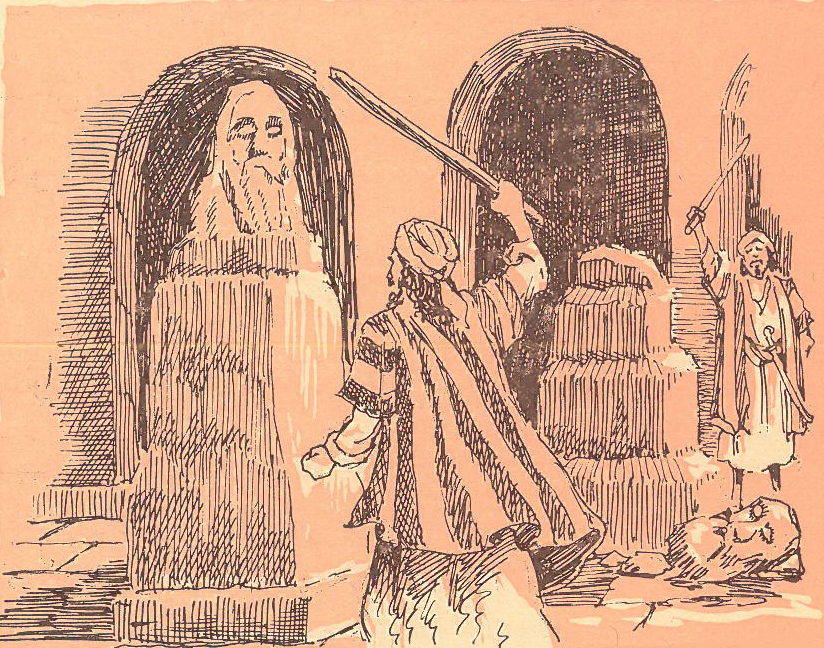
Eventually Muhammad entered the city and destroyed the idols around the Ka’ba, declaring: “Truth has come and falsehood has vanished” (4397).
"Those who follow the Prophet must become new men with a new conscience and new loyalties. They must be hardened in the difficult school of Islam. They must become participants in its blood-rites.
1/3
They must become parties to an act which is effective in the measure that it is compromising.
A man who still has some integrity is un-safely independent. In any case the followers should not be allowed to feel superior and to refrain from an act simply because they+
2/3
regard it as iniquitous or cruel. They must learn to have a conscience equal to their prescribed part and acts and to be worthy of their new role."
3/3
"Commanded by Allah through Gabriel, Muhammad approached the fort of the Quraiza, where they had gathered for shelter. He told them: “O ye brothers of monkeys and swines, we have arrived, Allah has disgraced you and brought+
1/11
His vengeance upon you.”
The Apostle “besieged them for twenty-five nights until they were sore pressed and God cast terror into their hearts.” They surrendered
unconditionally and were taken captive.
2/11
Traditions and the pious biographies of the Prophet tell gleefully and in detail about the fate of the prisoners.
We give the story as summarized by W. Muir in his Life of Mahomet, vol. III, pp. 276-279:
The men and women were penned up for the night in separate+