Read on Twitter
I see so many people using Chat GPT for useless tasks.
So I’ve created the Ultimate Guide to Producing Converting & Engaging SaaS Videos with ChatGPT-4.
The info in this thread helped us create videos that made $100k+:
🧵
So I’ve created the Ultimate Guide to Producing Converting & Engaging SaaS Videos with ChatGPT-4.
The info in this thread helped us create videos that made $100k+:
🧵
Step 0: Follow the right people
There are people who consistently provide exceptional AI-related content:
@thatroblennon
@Claybight
@dickiebush
@thealexbanks
@itsPaulAi
@moritzkremb
@aisolopreneur
To achieve a top level of AI knowledge, follow these guys who are experts.
There are people who consistently provide exceptional AI-related content:
@thatroblennon
@Claybight
@dickiebush
@thealexbanks
@itsPaulAi
@moritzkremb
@aisolopreneur
To achieve a top level of AI knowledge, follow these guys who are experts.
Step 1: Ensure the perfect targeting
Identify your audiences’:
* Fears
* Frustrations
* Goals
* Aspirations
This way, you will know exactly what your audience feels and you can tailor your content to precisely hit their interest.
Identify your audiences’:
* Fears
* Frustrations
* Goals
* Aspirations
This way, you will know exactly what your audience feels and you can tailor your content to precisely hit their interest.
Example: Video Ad for SaaS Booth AI
Task: Create a 30-second video ad for social media
Goal: generate leads
Make sure to give AI enough context to achieve the best results.
Task: Create a 30-second video ad for social media
Goal: generate leads
Make sure to give AI enough context to achieve the best results.
Prompt:
“You are a {person with huge knowledge about the topic} specializing in {relevant niche}.
What are common fears, frustrations, goals, and aspirations of {target audience}?
Present bullet points with 5 examples of each.
Give the answer in a person’s own words.”
“You are a {person with huge knowledge about the topic} specializing in {relevant niche}.
What are common fears, frustrations, goals, and aspirations of {target audience}?
Present bullet points with 5 examples of each.
Give the answer in a person’s own words.”
Step 2: Generating hooks
Hooks are as important for videos as they are for Twitter threads.
Coming up with hook ideas can be frustrating and it takes a lot of time.
But, thanks to the preparation work we did in Step #1, we’ll make the process so much quicker.
Hooks are as important for videos as they are for Twitter threads.
Coming up with hook ideas can be frustrating and it takes a lot of time.
But, thanks to the preparation work we did in Step #1, we’ll make the process so much quicker.
Prompt:
“Using the FFGA you learned above, give me a list of 20 hooks targeting e-commerce owners who struggle with producing and sourcing product photos.
Make them short. Bias towards question-based hooks.”
“Using the FFGA you learned above, give me a list of 20 hooks targeting e-commerce owners who struggle with producing and sourcing product photos.
Make them short. Bias towards question-based hooks.”
This will give you a huge list of hook ideas you can build upon.
If you want results in a nicely formatted way, add this to your prompt:
“[Use headings, subheadings and bullet points to present the information.]”
If you want results in a nicely formatted way, add this to your prompt:
“[Use headings, subheadings and bullet points to present the information.]”
Step 3: Script
We got some great results from asking Chat GPT about our audiences’ FFGA.
This alone will help you tremendously.
You could go from being stuck to writing 10 scripts in 30 minutes.
But let’s not stop there.
We got some great results from asking Chat GPT about our audiences’ FFGA.
This alone will help you tremendously.
You could go from being stuck to writing 10 scripts in 30 minutes.
But let’s not stop there.
Writing a script is not as simple as telling ChatGPT to “write a video script for {company X}”.
Remember, the more specific you are, the better results you’ll get.
* Be detailed
* Provide context
* Know the company’s features in & out
Remember, the more specific you are, the better results you’ll get.
* Be detailed
* Provide context
* Know the company’s features in & out
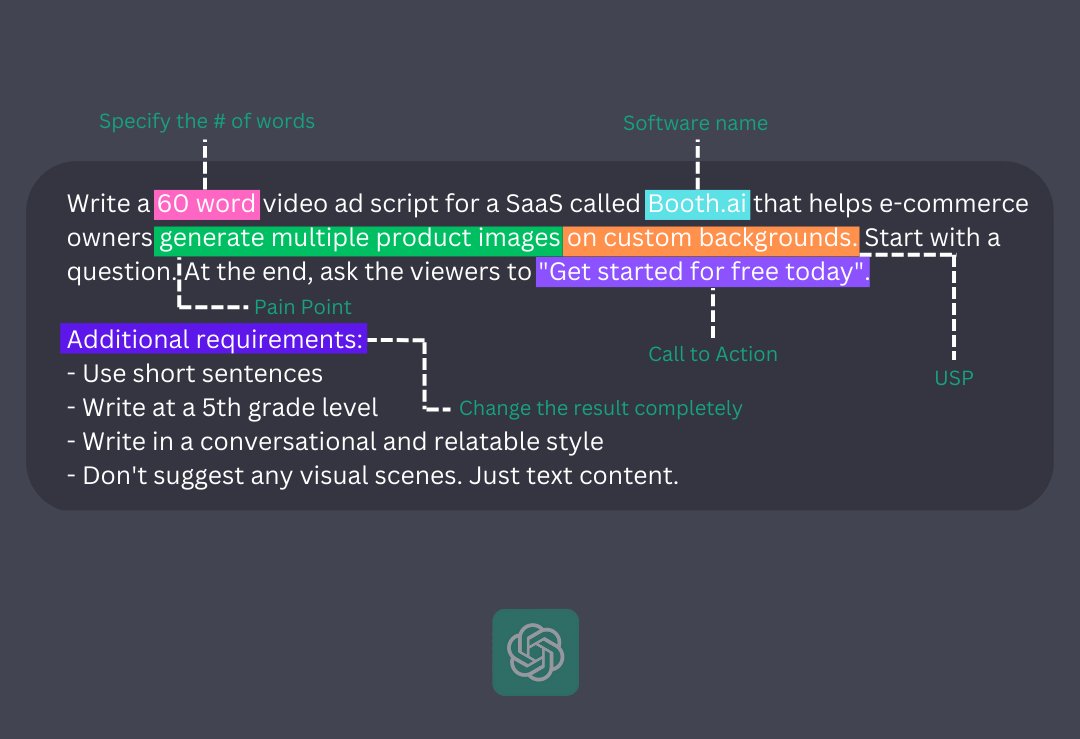
Prompt:
Write a {# of words} video ad script for {niche and name of the company} that helps {target audience} {pain point it’s solving} {how? USP}. Start with a question. At the end, ask the viewers to “{CTA}”.
Additional requirements:
* {r1}
* {r2}
* {r3}
* {r4}
Write a {# of words} video ad script for {niche and name of the company} that helps {target audience} {pain point it’s solving} {how? USP}. Start with a question. At the end, ask the viewers to “{CTA}”.
Additional requirements:
* {r1}
* {r2}
* {r3}
* {r4}
I always experiment with different angles.
Use the hooks we generated in the previous step.
Tweak a few things.
And get great results.
It also saves A LOT of creative power.
Use the hooks we generated in the previous step.
Tweak a few things.
And get great results.
It also saves A LOT of creative power.
If you are a SaaS owner and want to:
⚡ Stand out
⚡ Increase conversions
⚡ Generate high-quality leads
We know exactly how to help you do that with video content.
Just click the link below to book a call:
calendly.com/mediax/15disco…
⚡ Stand out
⚡ Increase conversions
⚡ Generate high-quality leads
We know exactly how to help you do that with video content.
Just click the link below to book a call:
calendly.com/mediax/15disco…
That's it!
If you found this thread valuable:
1. Follow me @_mikeVideo for more of these.
2. Retweet the tweet below to share this thread with your audience👇
If you found this thread valuable:
1. Follow me @_mikeVideo for more of these.
2. Retweet the tweet below to share this thread with your audience👇
https://twitter.com/1536061663581175809/status/1669002079845732353
• • •
Missing some Tweet in this thread? You can try to
force a refresh