No robust evidence for the status of European Tree Frogs (Hyla arborea) as a historically lost British species. Two threads: 1/25 
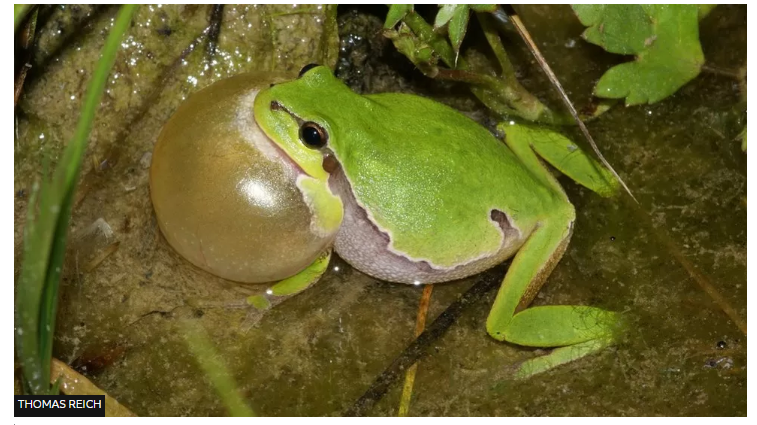
It can be a challenge to prove ‘lost native’ status and kudos to @harvey_tweats for his efforts in making a case, however I think these fall far short of a threshold that would justify reintroduction 2/
https://x.com/harvey_tweats/status/1668365598080868352
I want to make it abundantly clear that we need translocation and reintroduction practitioners like @CelticReptile, but decisions on target species need to have a strong evidence basis 3/
For example the case for Pool Frog (Pelophylax lessonae), for which native status was belatedly proven based on multiples lines of robust evidence (detailed eyewitness accounts, specimens, DNA, fossil evidence etc) 4/link.springer.com/article/10.100…
On European Tree frogs (hereafter ‘Hyla’) Harry starts with Thomas Browne’s off-repeated quote “the little Frogge of an excellent Parrat-green, that usually sits on trees and bullies” 5/

Snell (2006) argued that the Browne reference could be used as evidence in support of Hyla as a native saying ‘it is strange that an unmistakable description of the treefrog Hyla, apparently in Britain, was given in 1646 by Sir Thomas Browne’ 6/ researchgate.net/publication/28…

Raye (2017) also used this claim as evidence in his paper claiming possible native status 7/thebhs.org/publications/t…
The Browne quote has been widely repeated in the media - e.g. cc @HarryCockburn in this Independent article making the case for Tree Frogs as native 8/independent.co.uk/news/uk/home-n…
However, all Browne actually said in his book the 'Pseudodoxia Epidemica' was that Tree Frogs were unlike another species of frog the ‘the aquatile or water Frogge’ which was present in their millions in every ditch in the land 9/archive.org/details/Browne…
This reference to these 2 ‘types’ is preceded by a mention of another frog ‘Temporaria’ reproducing without copulation; we now know that frogs do not arise from putrefaction and Browne’s text simply represents what little was known of basic biology in 1646 10/
Occam’s Razor says that the hyperabundant species present in every ditch was Common Frog (Rana temporaria) and that is the same as the mythical ‘Temporaria’ 11/
Moreover, I don’t see why Browne’s quote implies that Hyla was in the UK, only that he knew the genus. Browne studied in various places in Europe - principally in Padua and Montpellier (The British Medical Journal, 1965, 2, 5477) where he could have met with the taxon 12/
Browne's book also discusses the natural history of many species which did not occur in the UK, like Fire Salamanders which he believed (along with many of his time that) lived in the flames. Maybe worth treating these references with a pinch of salt? 13/

I can’t see any reason why this quote is of any use to anyone in pushing native status for Hyla… so on to the next one… which is listing by Dr Christopher Merrett in his book Pinax rerum naturalium Britannicarum 14/

This book was subject to scathing criticism at the time (see Notes and Records of the Royal Society of London , Vol. 54, No. 1) described as ‘bungling’ by contemporaries so would seem not to be a solid reference for the status of Hyla 15/

Merrett mentions ‘Ranunculus viridis‘ likely copying Browne and also mentions other species like Peacocks and Pheasants which were obviously not native. Merrett didn’t do any original field work and historical authors generally copied each other - reinforcing falsehoods 16/
Contra @harvey_tweats Gilbert White was very clear that Hyla wasn’t native to Britain: “Merret, I trust, is widely mistaken when he advances that the rana arborea is an English reptile; it abounds in Germany and Switzerland.” 17
https://x.com/harvey_tweats/status/1668376931920670721

Snell (2006) doesn’t list other sources of historical records, but Raye (2017) explores more sources and assimilates some powerful historical evidence against native status of Hyla 18/

Harvey highlights the importance of Tree Frogs in medicine, even advancing that overconsumption could have precipitated their extinction 19/
https://x.com/harvey_tweats/status/1668376931920670721
Yet, we have very good evidence from Raye (2017) that the species was imported from abroad for medicine use and that it wasn’t obtainable from the UK see also: 20/
https://x.com/LeafyHistory/status/1668850438890835970

It is difficult to envisage national extinction of an abundant small frog driven by over-consumption and if the species was native and medically important there ought to be a better paper trail for its existence here 21/
So the historic literature case, by and large, rests on one well traveled person mentioning the species with no context about where he knew it from 22/
So what of the other evidence?
Hyla was present in the UK in previous interglacial periods based on the fossil record e.g. Stuart (1995) 23/citeseerx.ist.psu.edu/document?repid…
Hyla was present in the UK in previous interglacial periods based on the fossil record e.g. Stuart (1995) 23/citeseerx.ist.psu.edu/document?repid…
However despite a good Holocene fossil frog record, no Hyla remains have been uncovered - ergo - the species didn’t make it back to the UK 24/ brill.com/view/journals/…

End of 1st thread 1/25
some folks who may be interested: @MarkAvery, @PeteMRCooper, @JMBagniewska, @BenGoldsmith, @JLowenWildlife, @DaniRabaiotti, @alexraeder1, @moorsman, @woodlandbirder
@ThreadReaderApp unroll
• • •
Missing some Tweet in this thread? You can try to
force a refresh