Some interesting developments have been happening lately with Starship 28, with one of the major ones being the removal of its sliding Payload Bay door. Let’s take a closer look at how this was done, and what it could mean. (1/6)
On June 15th, crews attached a crane to Ship 28’s sliding door, and after somehow reorienting it inside of the vehicle, slid it out. We’ve included an animation of how it was removed if it’s hard to tell from the recording. (2/6)
This is simply the sliding panel that we all see from the outside of the Ship. On Ship 28, you can see that it’s now missing, and what is likely related to the actuation mechanism can be seen hanging in the doorway. (3/6)
This is NOT what was done when sealing the doors on previous Ships, so it seems unlikely that this is what is happening. Maybe SpaceX has a new design, maybe it was damaged, or maybe it’s something else. (4/6)
It will be interesting to see if this happens to the other Ships. Either way, we can see some cool stuff in the clip. If you look closely, you can see the 2 arms on the interior that attach to the sliding rails. (5/6)
So how exactly did they get the door reoriented inside the Ship? It’s likely that patience, skills with chain hoists, and probably some magic were all used. Hopefully, we see a new door go up soon to fill the gaping hole in the side. (6/6)
• • •
Missing some Tweet in this thread? You can try to
force a refresh

Ship 25 has had quite a life so far, and it hasn’t even had its first static fire. Let’s take a look at why this Starship has been so confusing, why many thought it was retired, and how it’s different from Ship 24. (1/13)
@RGVaerialphotos Ship 25 was fully stacked in the Highbay on September 12th, 2022, and was moved to the Launch Complex for cryogenic testing on October 19th. It conducted 3 cryo tests, before being moved back to the Highbay to receive its engines. (2/13)
@RGVaerialphotos@NASASpaceflight@LabPadre In the Highbay, all 6 engines were installed on Ship 25, and the PEZ Dispenser slot on the front was welded closed. Ship 25’s engines still use hydraulically-powered TVC, which changes to electric on Ship 26. (3/13)
A nosecone, a dome section, and a handful of ring sections. These are among some unusual Starship parts that we have been following for quite a while now, that are widely speculated to be related to the HLS Lander. Let’s take a look at some of these. (1/21)
@RGVaerialphotos So, fair warning, this is going to be a long one, but a lot has been happening and while we wanted to get this out sooner in a more concise manner, every time we got close, some new paradigm-shifting piece would show up. (2/21)
@RGVaerialphotos We're going to be treading through some speculative ground, so be careful. People often get set on the coolest theory and forget that there may not be much backing it up. We don’t tend to do this, but as it turns out, it can be fun. (3/21)
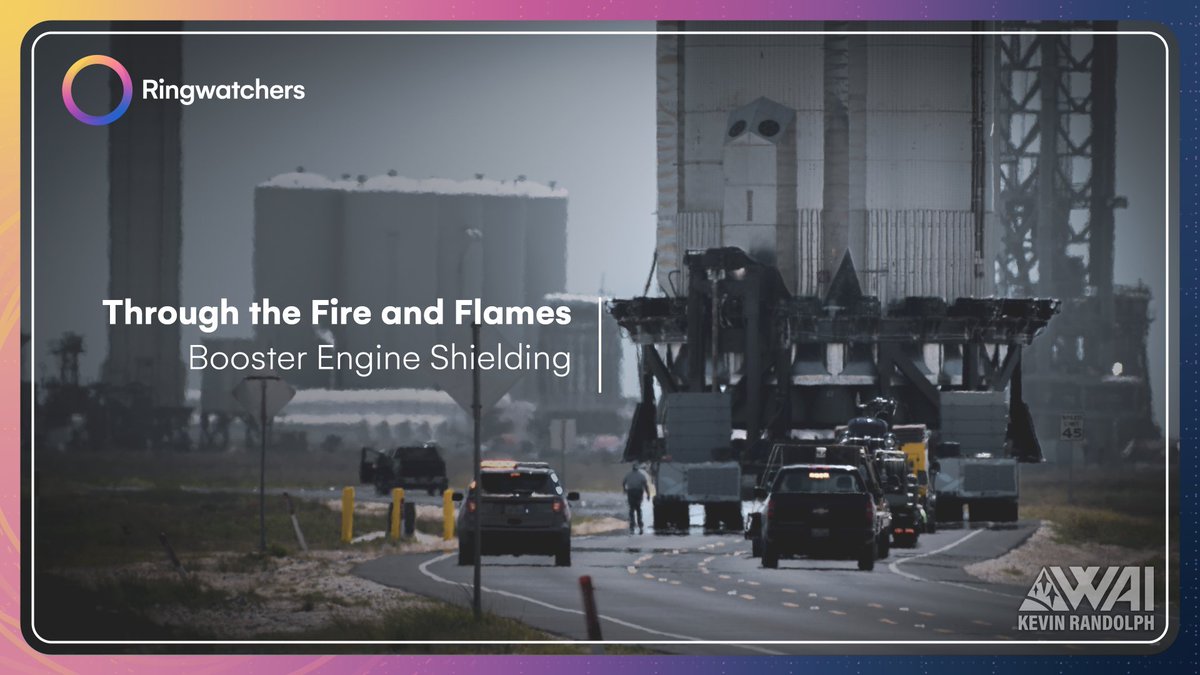
Super Heavy’s engine shielding is quite an impressive system, and Elon Musk has been talking a lot about this with Booster 9. Let’s take a closer look at how SpaceX isolates and protects all 33 engines on the Booster. (1/14)
@CosmicalChief@ChameleonCir Getting right into it, the covers are unsurprisingly made of stainless steel, and many areas beneath the vehicle are covered in this black material, which could be related to the extra heating in that area. (2/14)
@CosmicalChief@ChameleonCir@SpaceX@RGVaerialphotos These 13 circular pieces surrounding the center engine mounts get added to the aft section in the tents before stacking. SpaceX is always working towards reducing the number of tasks to be completed after final stacking. (3/14)
Starship's Flight Termination System is a crucial safety feature, allowing the vehicle to be remotely detonated if it deviates off course, or has a chance of putting people in danger. Let's take a look at our understanding of this system. (1/10)
@CosmicalChief There are 4 remote charges on the Full Stack. 2 on the Booster and 2 on the Ship. This creates a redundant system so if 1 charge fails on one of the stages, there is a 2nd to do the job. (2/10)
@CosmicalChief@RGVaerialphotos They are located over the common dome of both vehicles. When the detonation occurs, the common dome will be partially destroyed, allowing the Methane and Oxygen in the tanks to mix. They are ignited, and you can imagine what happens from here. (3/10)
Merry Christmas everybody! Many people have been wondering what exactly is new with Superheavy Booster 9, and while many of the revisions are understood, there are some details that haven't been covered yet. Let's take a look! (1/12)
@RGVaerialphotos The biggest change that has been noticed by the community was the removal of the Hydraulic Power Units on the side of the vehicle, which were used to power the Thrust Vector Control (gimbaling) system. On B9, electric TVC is now used. (2/12)
@RGVaerialphotos@StarshipGazer Hardware has been added to the thrust dome, which we believe is related to the electric TVC system, such as these black boxes. There appears to be one for each gimballing engine. (3/12)
Ship 29 is the newest oddity at the Production Site, but we may know what's happening this time around. Let's take a look at this new article that SpaceX is producing, and why we believe it may be a Structural Test Article. (1/13)
@ChameleonCir Starting off looking at S29's nosecone, we can see some TPS pins on the side. This is likely because S29 was intended to be a normal Ship. With the cone now outside of the tent and having other work done, the pins will likely not be finished. (2/13)
@ChameleonCir@nomadd13 Well then, it's probably just another S26, right? That was a possibility until SpaceX began properly developing the flap mounting surfaces. This typically happens after tiling, and if this nose has no tiles, it would burn up before needing flaps. (3/13)