
 Read on Twitter
The news is out! The @NANOGrav pulsar timing array collaboration has detected a background of cosmic gravitational waves rippling through our Universe! Let’s talk about it!
(Full press conference tomorrow, )
1/n https://t.co/5jd4mp989Wnanograv.org/news/2023Annou…

(Full press conference tomorrow, )
1/n https://t.co/5jd4mp989Wnanograv.org/news/2023Annou…
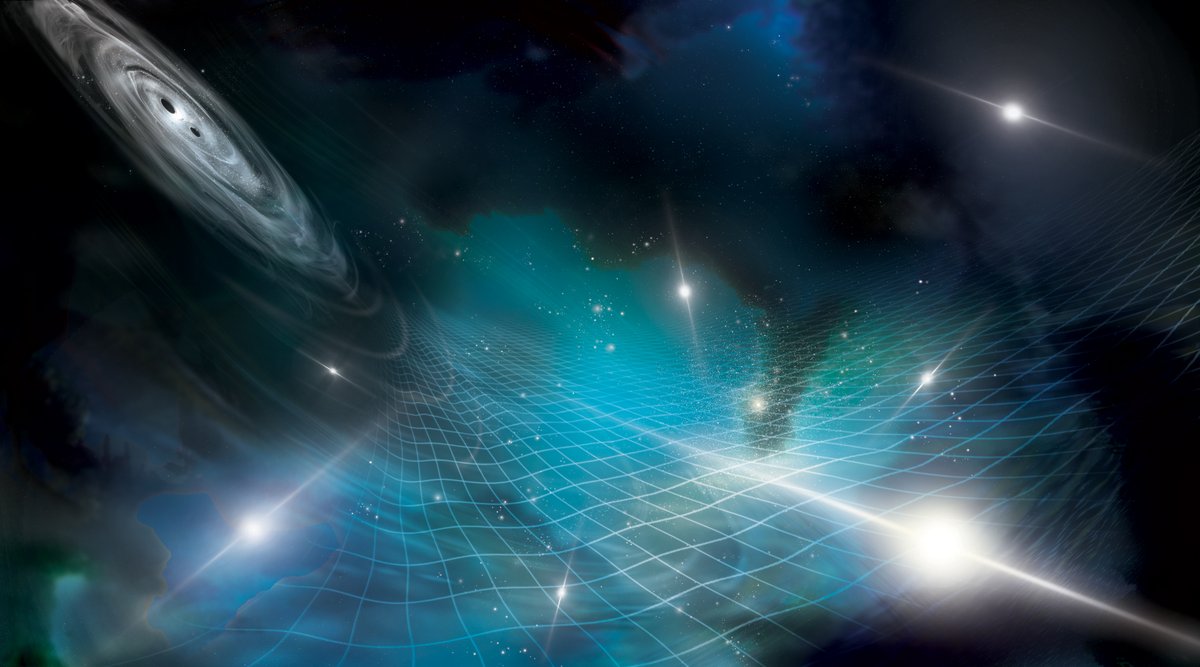
@NANOGrav Q: What does this mean?
A: Whenever violent gravitational events (like colliding black holes) happen in the cosmos, it causes ripples in space itself: gravitational waves. This is the 1st detection of a “stochastic background” of these waves, coming from all over the cosmos.
2/n
A: Whenever violent gravitational events (like colliding black holes) happen in the cosmos, it causes ripples in space itself: gravitational waves. This is the 1st detection of a “stochastic background” of these waves, coming from all over the cosmos.
2/n
@NANOGrav Q: What are pulsars?
A: Pulsars are ultra-dense neutron stars (remnants of dead stars) that have jets of radiation coming from their poles & rotate rapidly. Typically the jet isn’t aligned with the pole, so it sweeps around. When it hits us, we get a pulse.
3/n
A: Pulsars are ultra-dense neutron stars (remnants of dead stars) that have jets of radiation coming from their poles & rotate rapidly. Typically the jet isn’t aligned with the pole, so it sweeps around. When it hits us, we get a pulse.
3/n
@NANOGrav Q: What’s a pulsar timing array?
A: The pulsars in a PTA pulse at short (~millisecond) intervals, very regularly. If space is distorted between us & them by gravitational waves, it can delay pulses. By observing a LOT of pulsars, we can (in theory) tell waves are passing.
4/n
A: The pulsars in a PTA pulse at short (~millisecond) intervals, very regularly. If space is distorted between us & them by gravitational waves, it can delay pulses. By observing a LOT of pulsars, we can (in theory) tell waves are passing.
4/n
@NANOGrav Q: What did @NANOGrav see?
A: NANOGrav used 15 yrs of careful observations of the timing of 68 pulsars to figure out that the weirdnesses in pulse arrival times matched what you’d expect if gravitational waves - the kind from colliding supermassive black holes - fill space.
5/n
A: NANOGrav used 15 yrs of careful observations of the timing of 68 pulsars to figure out that the weirdnesses in pulse arrival times matched what you’d expect if gravitational waves - the kind from colliding supermassive black holes - fill space.
5/n
Q: How are PTAs different from LIGO/gravitational wave detectors on Earth?
A: LIGO sees GWs from star-mass black hole binaries, which orbit a few to thousands of times a second. PTAs can see extremely LOW frequency waves: supermassive BH pairs in orbits of months or years.
6/n
A: LIGO sees GWs from star-mass black hole binaries, which orbit a few to thousands of times a second. PTAs can see extremely LOW frequency waves: supermassive BH pairs in orbits of months or years.
6/n
Q: So did NANOGrav detect supermassive black holes colliding?
A: Well, maybe. Probably! But so far we can’t be sure exactly what the gravitational wave background is coming from. Supermassive BH binaries are the expected source, but we need more data to be certain.
7/n
A: Well, maybe. Probably! But so far we can’t be sure exactly what the gravitational wave background is coming from. Supermassive BH binaries are the expected source, but we need more data to be certain.
7/n
Q: What could it be if it’s not supermassive black hole collisions?
A: Technically the background is also consistent with weird stuff like ripples from cosmic inflation, phase transitions in the early universe, & even networks of defects in space. Could even be a combo!
8/n
A: Technically the background is also consistent with weird stuff like ripples from cosmic inflation, phase transitions in the early universe, & even networks of defects in space. Could even be a combo!
8/n
Q: If it’s supermassive black holes, what does that tell us?
A: At the moment, all we can say is there’s a background consistent with more-or-less what we expect SMBHs to be doing. BUT with more data, we can study the build-up of galaxies through mergers across cosmic time!
9/n
A: At the moment, all we can say is there’s a background consistent with more-or-less what we expect SMBHs to be doing. BUT with more data, we can study the build-up of galaxies through mergers across cosmic time!
9/n
Q: Is there anything surprising in the data?
A: The result (a gravitational wave background) isn't surprising - it was surely there! But if it's from supermassive BH binaries, best analysis suggests SMBHs might be more common &/or more massive than expected. Intriguing!
10/n
A: The result (a gravitational wave background) isn't surprising - it was surely there! But if it's from supermassive BH binaries, best analysis suggests SMBHs might be more common &/or more massive than expected. Intriguing!
10/n
Q: Is it REALLY a new way of seeing the universe? We already had gravitational waves.
A: LIGO etc see higher-frequency GWs, from star-mass objects; PTAs see low-frequency GWs, from supermassive BHs. It’s like observing with visible light vs radio: you see different stuff!
11/n
A: LIGO etc see higher-frequency GWs, from star-mass objects; PTAs see low-frequency GWs, from supermassive BHs. It’s like observing with visible light vs radio: you see different stuff!
11/n
Q: Give me a nice analogy.
A: The Earth is a ship on a cosmic sea. Every once in a while, we’re hit by a wave, and we know something went by. But now, for the first time, we can start to see the choppiness of the entire ocean, and we’re learning what else lives in our sea.
12/n
A: The Earth is a ship on a cosmic sea. Every once in a while, we’re hit by a wave, and we know something went by. But now, for the first time, we can start to see the choppiness of the entire ocean, and we’re learning what else lives in our sea.
12/n
Q: Is NANOGrav the only group doing this?
A: Not at all! There’s a huge international group of pulsar timing array collaborations (see: PPTA, EPTA, CPTA) all announcing results today. NANOGrav got the first detection but combining data from all is crucial for learning more.
13/n
A: Not at all! There’s a huge international group of pulsar timing array collaborations (see: PPTA, EPTA, CPTA) all announcing results today. NANOGrav got the first detection but combining data from all is crucial for learning more.
13/n
Q: How exciting is this, really?
A: Hugely exciting! We’re using RADIATION JETS from DEAD STARS to detect RIPPLES IN SPACE from the COLLISIONS OF SUPERMASSIVE BLACK HOLES ACROSS THE ENTIRE COSMOS. Honestly that’s just frickin’ awesome.
14/n
A: Hugely exciting! We’re using RADIATION JETS from DEAD STARS to detect RIPPLES IN SPACE from the COLLISIONS OF SUPERMASSIVE BLACK HOLES ACROSS THE ENTIRE COSMOS. Honestly that’s just frickin’ awesome.
14/n
Q: OK but does it change our understanding of the Universe in a fundamental way?
A: Well, not really, because we did expect this, & we don’t have enough data yet to say much about the origin of the gravitational waves. But it’s just our first glimpse! Who knows what's next‽
15/n
A: Well, not really, because we did expect this, & we don’t have enough data yet to say much about the origin of the gravitational waves. But it’s just our first glimpse! Who knows what's next‽
15/n
Q: What’s the most likely scientific breakthrough to come from this?
A: Other than the detection itself, we’ll learn a LOT about supermassive black holes, how galaxies merge/grow, & about the conditions at the centers of galaxies. It'll help us understand our cosmic origins!
16/n
A: Other than the detection itself, we’ll learn a LOT about supermassive black holes, how galaxies merge/grow, & about the conditions at the centers of galaxies. It'll help us understand our cosmic origins!
16/n
Q: How can I learn more?
A: Just about every science outlet has stories on it; here’s one from SETI: . For some physics-student-level details, see: https://t.co/XoEvQ7duYR. The full press conference is tomorrow, 1pm Eastern: https://t.co/7hsBd7IWdO
17/17seti.org/press-release/…
astrobites.org/2023/06/28/dro…
nanograv.org/news/2023Annou…
A: Just about every science outlet has stories on it; here’s one from SETI: . For some physics-student-level details, see: https://t.co/XoEvQ7duYR. The full press conference is tomorrow, 1pm Eastern: https://t.co/7hsBd7IWdO
17/17seti.org/press-release/…
astrobites.org/2023/06/28/dro…
nanograv.org/news/2023Annou…
• • •
Missing some Tweet in this thread? You can try to
force a refresh






