Read on Twitter
95% of people are reading balance sheets WRONG.
Stop wasting time with the ratios they taught you in business school.
Here’s how you read a balance sheet like a CFO.
Let's go! 👇
Stop wasting time with the ratios they taught you in business school.
Here’s how you read a balance sheet like a CFO.
Let's go! 👇
There are three key things to understand from the balance sheet:
1. Capital Structure
2. Working Capital Profile
3. Liquidity Headroom
Let's tackle them each in turn
1. Capital Structure
2. Working Capital Profile
3. Liquidity Headroom
Let's tackle them each in turn
1. Capital Structure.
The capital structure tells you how a business is funded / owned.
Is the business funded by debt or equity? What is the mix?
Who are the investors and what are their motives? And what are the rights and obligations attached to each?
The capital structure tells you how a business is funded / owned.
Is the business funded by debt or equity? What is the mix?
Who are the investors and what are their motives? And what are the rights and obligations attached to each?
Take each debt or equity instrument in the balance sheet and get clear on the following:
Who owns it?
How much have they put in?
What are they owed today?
What does their return look like if things go well
What are their rights if things don’t go well?
When does it mature?
Who owns it?
How much have they put in?
What are they owed today?
What does their return look like if things go well
What are their rights if things don’t go well?
When does it mature?
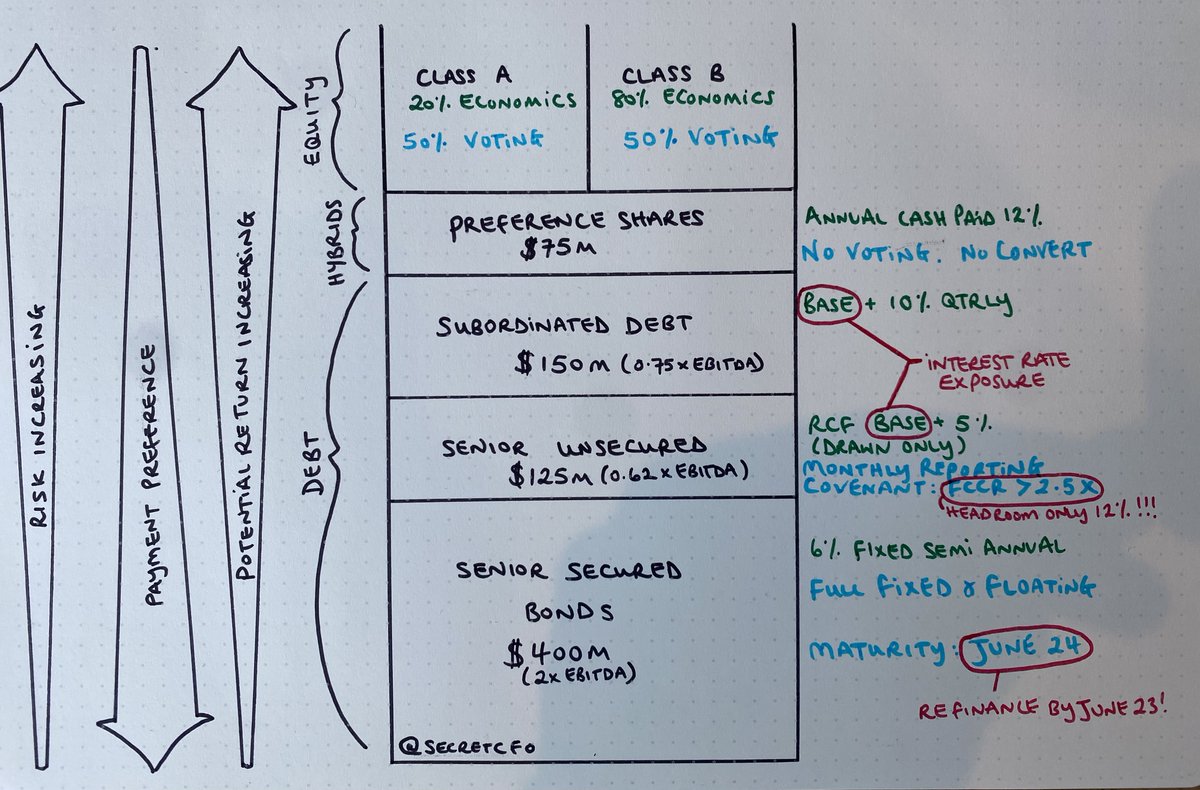
Visualize this in a table.
Put the most senior ranking debt at the bottom.
Yes, this is upside down to the way you may have seen this presented before.
What can I say, I'm a rebel 😎
Put the most senior ranking debt at the bottom.
Yes, this is upside down to the way you may have seen this presented before.
What can I say, I'm a rebel 😎

Those at the bottom of the chart get fed first.
If things go wrong. They get paid off first.
If there isn’t enough money to go round, imagine the visual like a bucket, filling up from the bottom first.
Those at the bottom take less risk, but also earn less return.
If things go wrong. They get paid off first.
If there isn’t enough money to go round, imagine the visual like a bucket, filling up from the bottom first.
Those at the bottom take less risk, but also earn less return.
The folk at the top of the list eat last.
But they get whatever is left over. And if the company is successful that could be a hell of a banquet.
Higher risk = higher return
But they get whatever is left over. And if the company is successful that could be a hell of a banquet.
Higher risk = higher return
Once you have the table, start to build a picture through the numbers, of what’s important.
Looking for:
a) Maturity.
b) Leverage for each class (Net Debt: EBITDA)
c) Covenant headroom
d) Interest Cover (& Sensitivity)
It should look something like this
Looking for:
a) Maturity.
b) Leverage for each class (Net Debt: EBITDA)
c) Covenant headroom
d) Interest Cover (& Sensitivity)
It should look something like this
Note: Beware of debt dressed up as something else.
For example ...
Many receivables finance are designed to be 'off balance sheet debt.'
This means rather than it looking like debt, it is presented like an early payment of a receivable.
For example ...
Many receivables finance are designed to be 'off balance sheet debt.'
This means rather than it looking like debt, it is presented like an early payment of a receivable.
F*ck the accounting treament.
If it looks and smells like sh*t... very rarely is it Nutella.
Beware pension deficits, and other debt-like things with clever balance sheet presentation.
If it looks and smells like sh*t... very rarely is it Nutella.
Beware pension deficits, and other debt-like things with clever balance sheet presentation.
Equally, do you understand the equity:
Is there more than one class of shares?
For each:
What are the voting rights?
Does anyone have effective control?
Effective blocking stakes?
Any dividend or liquidation preferences?
Who owns them?
What are their motives?
Is there more than one class of shares?
For each:
What are the voting rights?
Does anyone have effective control?
Effective blocking stakes?
Any dividend or liquidation preferences?
Who owns them?
What are their motives?
There’s more to say on capital strucure, but that’s how you get an overview of who actually owns the business, and where the real power lies.
Done well, you should be able to quickly see the immediate issues facing the business in the capital structure.
Done well, you should be able to quickly see the immediate issues facing the business in the capital structure.
2. Working Capital
This is important, because it tells you how cash cycles through the business.
But it tells you something else. Something that people oftentimes miss.
It tells you what it will cost to grow the business
I'll explain
This is important, because it tells you how cash cycles through the business.
But it tells you something else. Something that people oftentimes miss.
It tells you what it will cost to grow the business
I'll explain
Working capital cycle is often measured in days.
Not how I like to do it (I'll come back to that in a minute). But it is well understood and effective.
Lets say a company has 30 days of receivables 15 days of inventory 25 days of payables
Not how I like to do it (I'll come back to that in a minute). But it is well understood and effective.
Lets say a company has 30 days of receivables 15 days of inventory 25 days of payables
The cash conversion cycle is +20 days. (30 + 15 - 25)
That means you need to have 20 days of sales (in cash) tied up in your working capital cycle.
If your sales grow, so does that funding requirement.
Expensive.
That means you need to have 20 days of sales (in cash) tied up in your working capital cycle.
If your sales grow, so does that funding requirement.
Expensive.
Many profitable businesses with heavy working capital cycles have gone bust.
This happens when they grow sales too quickly without funding the working capital properly.
Tough for e-commerce businesses who often have to reinvest a large % of profits to fund inventory for growth.
This happens when they grow sales too quickly without funding the working capital properly.
Tough for e-commerce businesses who often have to reinvest a large % of profits to fund inventory for growth.
I once worked for a retailer once who had a cash conversion cycle of -60 days.
Yes that's a minus.
(zero receivables, 15 days inventory, 75 days payables).
They were growing aggressively.
Yes that's a minus.
(zero receivables, 15 days inventory, 75 days payables).
They were growing aggressively.
They would build two stores a week at a capex cost of $10m per store.
But the minute the doors opened they would get $5m back in working capital inflow (because of that - 60 days)
I.e. we were collecting cash for the first 60 days of opening before we had to pay anyone.
But the minute the doors opened they would get $5m back in working capital inflow (because of that - 60 days)
I.e. we were collecting cash for the first 60 days of opening before we had to pay anyone.
Cash on cash , the working capital profile DOUBLED our returns.
Or … it doubled the roll out speed based on capex availability
To put it another way. The suppliers were paying for half of the build cost of EVERY new store.
WUN-DER-FUL
Or … it doubled the roll out speed based on capex availability
To put it another way. The suppliers were paying for half of the build cost of EVERY new store.
WUN-DER-FUL
I love that story.
Anyway, how do I measure working capital?
Well the calc is like cash conversion cycle, except I don't express it in days.
I like to use 'cents in the dollar' in net working capital expressed in revenue
I’ll explain
Anyway, how do I measure working capital?
Well the calc is like cash conversion cycle, except I don't express it in days.
I like to use 'cents in the dollar' in net working capital expressed in revenue
I’ll explain
If receivables are $500m, payables are $350m, Inventory is $250mm and revenue is $10bn
Then net working capital is +$400m. Which is 4% of revenue.
OR ... For every $1 of marginal revenue we need to assume it will cost us 4 cents in working capital.
Then net working capital is +$400m. Which is 4% of revenue.
OR ... For every $1 of marginal revenue we need to assume it will cost us 4 cents in working capital.
I like this because it gives a quick short cut to understand the cash impact of growth.
Imagine a business with P&L contribution margin of 20% .
Then you know net CASH contribution from marginal sales (Assuming no capex required) is 16%
16% = 20% minus 4%
Imagine a business with P&L contribution margin of 20% .
Then you know net CASH contribution from marginal sales (Assuming no capex required) is 16%
16% = 20% minus 4%
I also find non-finance stakeholders connect better with a % or cents:$ metric.
It brings the cash impact of growth front and center in the business.
Note: This works best in fast moving businesses without complex revenue recognition considerations.
It brings the cash impact of growth front and center in the business.
Note: This works best in fast moving businesses without complex revenue recognition considerations.
3. Liquidity.
This is for the paranoid amongst us.
Job number 1, whether you are CFO, an Investor?
Make sure the business doesn’t go bust.
Don’t lose your money, or worse … someone else’s.
And remember it's only ever running out of cash that will send you bust.
This is for the paranoid amongst us.
Job number 1, whether you are CFO, an Investor?
Make sure the business doesn’t go bust.
Don’t lose your money, or worse … someone else’s.
And remember it's only ever running out of cash that will send you bust.
Now for any business, there is a set of circumstances at any given time, that could send that business bust.
No business has infinite cash resources.
So the question we need to answer, is: how much available cash does the business really have?
No business has infinite cash resources.
So the question we need to answer, is: how much available cash does the business really have?
The good news is that the cash number in the balance sheet is easy to find.
The bad news is that that number is only at a moment in time.
And if you are looking at an annual report, that point is the year end
The bad news is that that number is only at a moment in time.
And if you are looking at an annual report, that point is the year end
In many businesses the year end cash balance is higher than at any other point in the year.
I tackled why this is in detail in another thread.
But to give 1 simple example.
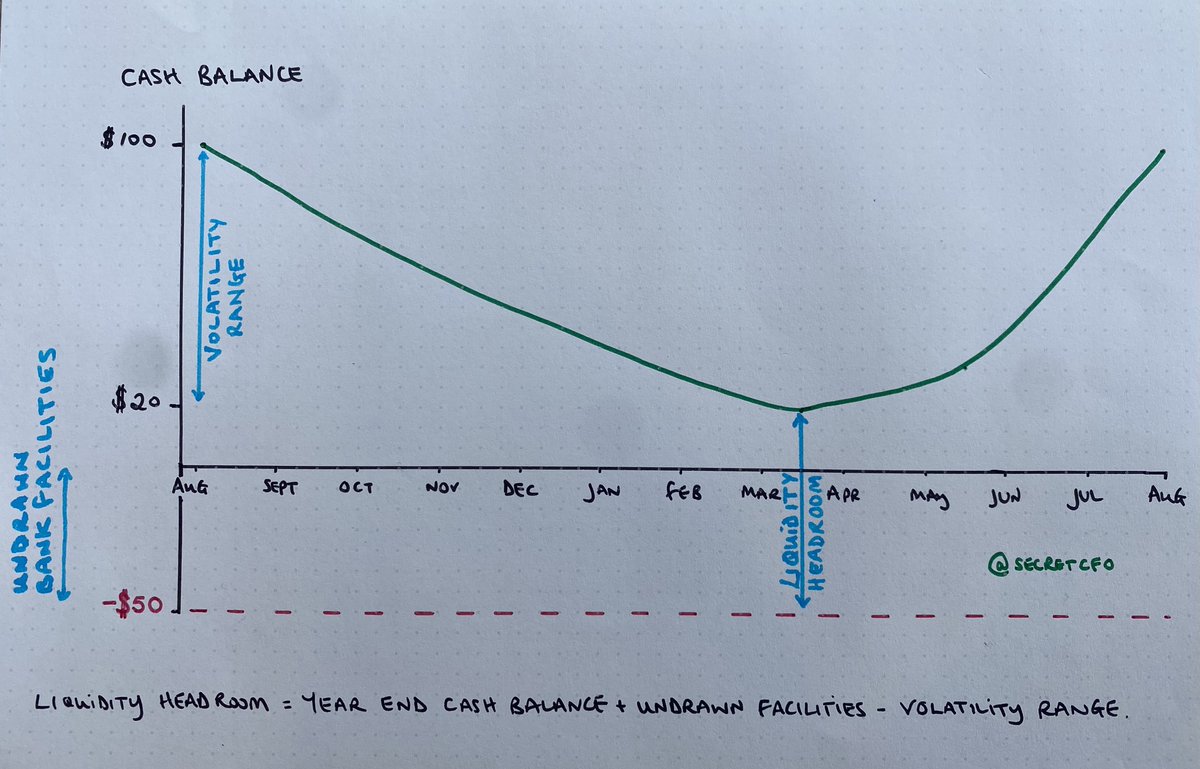
Let’s say we are in the ice cream business with an August year end...
I tackled why this is in detail in another thread.
But to give 1 simple example.
Let’s say we are in the ice cream business with an August year end...
By the end of August, our cash balance probably looks quite healthy.
A long balmy summer of selling sweet frozen treats.
But how about in March?
We've had 6 months of building stock (lots of cash out), with very little sales (no cash in)
A long balmy summer of selling sweet frozen treats.
But how about in March?
We've had 6 months of building stock (lots of cash out), with very little sales (no cash in)
So understanding how much cash is needed to allow for this volatility is really all that matters when considering how much liquidity is needed.
So we take the cash balance at the balance sheet date, deduct off whatever is a reasonable estimate for volatility.
Then....
So we take the cash balance at the balance sheet date, deduct off whatever is a reasonable estimate for volatility.
Then....
Add back any undrawn facilities. I.e. is there an overdraft, an RCF, or receivables facility that can be used if needed?
This is all liquidity headroom if needed. (And often can be used to fund the seasonality issued I described).
This illustration will explain
This is all liquidity headroom if needed. (And often can be used to fund the seasonality issued I described).
This illustration will explain
From this, calculate a best estimate of true liquidity headroom.
Then convert this to the number of days revenue.
I.e. for how many days could we go without any revenue before the business is bust?
I call this the Apocalypse Survival Buffer
Then convert this to the number of days revenue.
I.e. for how many days could we go without any revenue before the business is bust?
I call this the Apocalypse Survival Buffer
Apocalypse Survival Buffer = Liquidity Headroom / Avg Daily Revenue
This is a calculation many businesses did (having never done it before) at the start of COVID.
This is a calculation many businesses did (having never done it before) at the start of COVID.
I’ve been doing this calculation for as long as I’ve been a CFO.
If it sounds like I'm paranoid about running out of cash, it's because I am.
You should be too.
It's sucks.
If it sounds like I'm paranoid about running out of cash, it's because I am.
You should be too.
It's sucks.
That doesn’t mean the answer is to hold as much liquidity as possible.
That would be a highly inefficient use of capital.
This is why I dislike the Quick Ratio or Current Ratio as a measure.
It rewards capital inefficiency.
It’s far better having cheap back stop facilities.
That would be a highly inefficient use of capital.
This is why I dislike the Quick Ratio or Current Ratio as a measure.
It rewards capital inefficiency.
It’s far better having cheap back stop facilities.
The art of the CFO role is getting that mix just right.
I solve so I’m funded for a 95% range of outcomes over a long term period.
And have a clear idea on where I would go for money if a black swan comes along, so I can deal with the 5% if I need to.
I solve so I’m funded for a 95% range of outcomes over a long term period.
And have a clear idea on where I would go for money if a black swan comes along, so I can deal with the 5% if I need to.
That’s how to read a balance sheet like a CFO
TLDR
3 things:
1. Capital Structure - who owns the business, and how is it funded
2. Working Capital - what will happen to cash as I grow (or shrink)
3. Liquidity. How much available cash do I actually have?
TLDR
3 things:
1. Capital Structure - who owns the business, and how is it funded
2. Working Capital - what will happen to cash as I grow (or shrink)
3. Liquidity. How much available cash do I actually have?
Until next time …
If you enjoyed this thread:
1. Follow me @SecretCFO for more of these
2. RT the tweet below to share this thread with your audience
If you enjoyed this thread:
1. Follow me @SecretCFO for more of these
2. RT the tweet below to share this thread with your audience
https://twitter.com/1419038550931263491/status/1680572364931620864
If you need a refresher on balance sheet basics.
https://twitter.com/secretcfo/status/1676626464974729216
• • •
Missing some Tweet in this thread? You can try to
force a refresh