Michael Foran Profile picture
Jul 19 19 tweets 4 min read Twitter logo Read on Twitter
Some thoughts on this with the caveat that I’ve not seen the guidance nor the legal advice.

thetimes.co.uk/article/trans-…
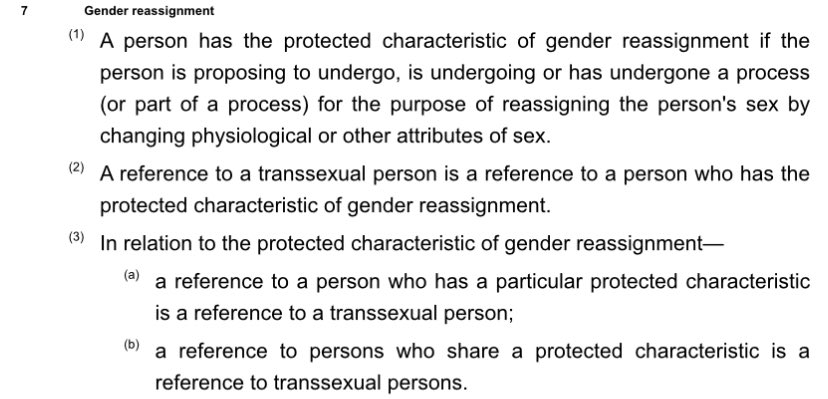
First some background. The Equality Act covers a list of protected characteristics. Gender reassignment is one of them. It’s not tied to the Gender Recognition Act, you don’t need to be in the process of obtains a GRC to be protected and it almost certainly covers minors. Image
This means that children who are experiencing gender distress are likely protected from gender reassignment based discrimination. There is a lot of confusion and misinformation about what being protected under GR means and this is likely affecting how guidance is being drafted.
Some advocates argue it means you are entitled to be treated as if you were the sex you identify with unless the policy passes a proportionality test. That’s incorrect. If you’re protected under gender reassignment you’re entitled not to be discriminated against on that ground.
The test for determining discrimination is called a comparator test: whether you would be treated less favourably than another person who is identical in all relevant respects except the protected characteristic in question.
We know from Green v Secretary of State for Justice that if you don’t have a GRC (no children have GRCs) your sex is your biological sex. So a trans boy is female for the purposes of the Equality Act. The comparator then is a girl without gender reassignment.
This is very important. It means that you need to ask whether other females would be required to wear the girls uniform or be referred to by she/her pronouns. They would be, so it’s not direct discrimination. Where this gets complicated is indirect discrimination.
Indirect discrimination occurs where persons who share a protected characteristic are put at a particular disadvantage and where there is no legal justification for doing so. I’ll return to that later.
So, continuing the background. Being protected under gender reassignment doesn’t entitle you to be treated as the sex one identifies with. But some very prominent advocacy groups have argued that it does. This has led to a lot of confusion.
Added to that, some have argued that the structure of the Equality Act is the reverse of what it actually is. The default is equal treatment. There are then exceptions built in that reverse this presumption in order to allow for single sex services, associations and schools.
But there is an exception to the exception which says in very rare circumstances, it may be disproportionate to have a single sex service - for example a men’s only barbers that refuses to cut the hair of a short haired woman.
So here’s the structure:

1. In general equal treatment
2. Some areas where presumption is revered to (in general) unequal treatment to allow single sex services
3. In very rare cases, an exception to the exception.

But some have argued very persistently the exact opposite.
Some have argued that Gender Reassignment means you’ve a right to be treated as if you had changed sex when you haven’t and they have argued that 3 (The exception to the exception) is actually the norm: that it’s the default when it isn’t. This has caused so much confusion.
So anyone drafting guidance for schools is going to be cognisant of the fact that if you say ‘X is the general rule but in very rare circumstances Y can be done’ there will likely be a concerted effort to make Y the general rule when it is suppose to be the exception.
I suspect the guidance has tried to avoid this because it wants to provide guidance and not add to more confusion. Add to this the fact the Cass report has indicated that social transition is a medical intervention that should be carefully considered before any action is taken.
Against that backdrop the guidance likely sought to provide clear rules with no exceptions. The problem is that rules without exceptions run into problems with proportionality and proportionality is triggered if a policy has a particular impact upon kids who share a PC.
So there’s an issue of indirect discrimination and a question of justification for blanket rules. It’s not impossible for them to be justified as proportionate, blanket rules have been proportionate.
But the fact a rule has no exception is very likely a black mark against it in proportionality analysis. And this is probably what the legal advice from the Attorney General concluded.
So there will either be new advice issued that tires to make it clear that the exceptional case really is the exceptional case and not the norm, or legislation will be introduced to make it clear that schools can have blanket rules here.

• • •

Missing some Tweet in this thread? You can try to force a refresh

 

Keep Current with Michael Foran

Michael Foran Profile picture

Stay in touch and get notified when new unrolls are available from this author!

Read all threads

This Thread may be Removed Anytime!

PDF

Twitter may remove this content at anytime! Save it as PDF for later use!

Try unrolling a thread yourself!

how to unroll video
  1. Follow @ThreadReaderApp to mention us!

  2. From a Twitter thread mention us with a keyword "unroll"
@threadreaderapp unroll

Practice here first or read more on our help page!

More from @michaelpforan

Jul 13
This thread seems to presume that the only purpose of equality law is to move to a position of equal treatment in all contexts. The equivalent of being colour blind, religion blind, sex blind, and so on. But that is not the purpose of the Equality Act.
Yes, the Act does set up a baseline presumption of non-discriminatory treatment. But that must be understood in light of other aspects of the Act, including indirect discrimination, positive measures, single characteristic services/associations/schools and the PSED
The Act isn’t just about individual claims, it’s also about group claims relating to combating particular disadvantage that those who share a PC might face and to ensure the rights of people to associate together and to be provided services on the basis of one PC or another
Read 12 tweets
Jul 6
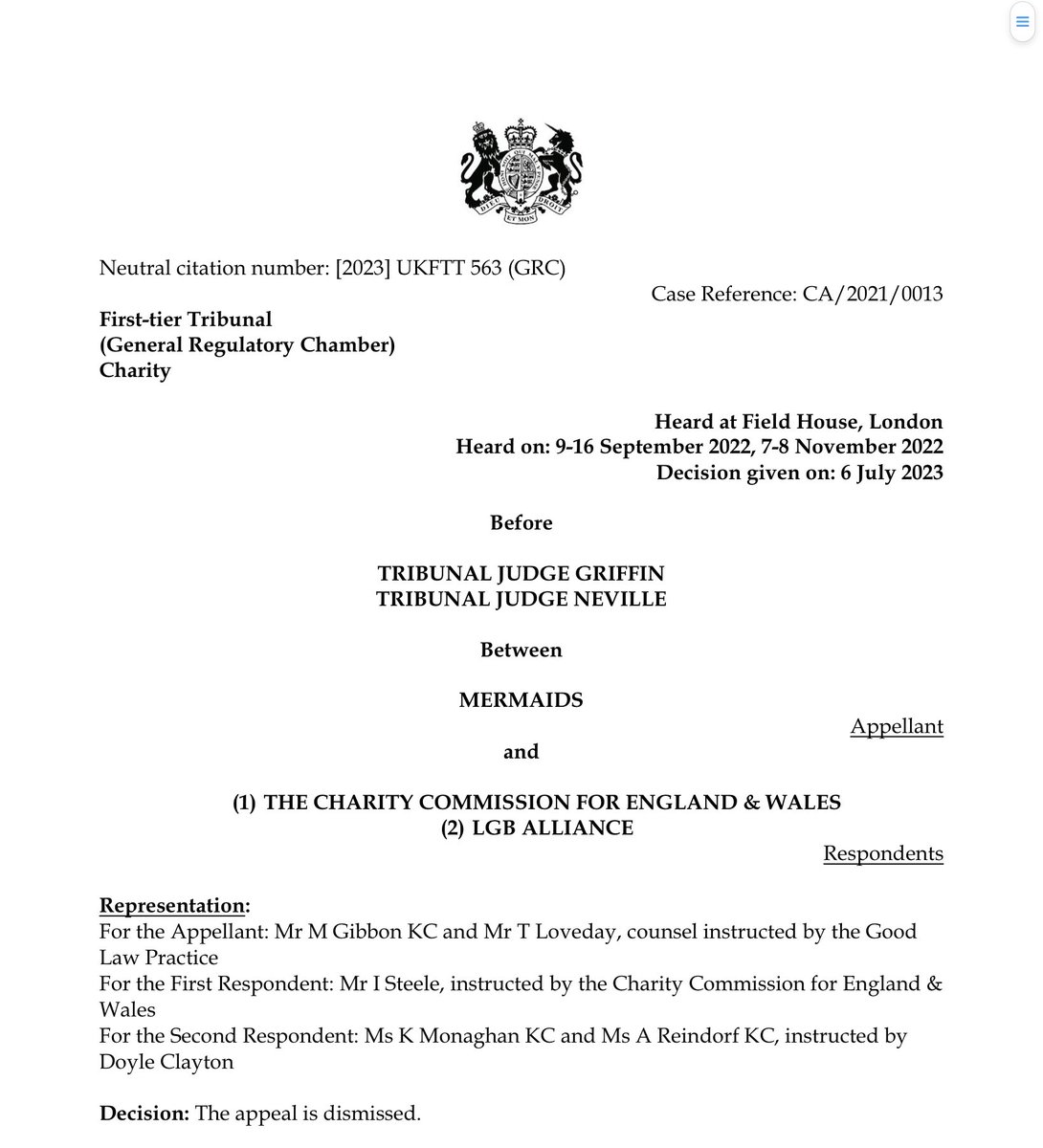
Suspending my Twitter break for a wee 🧵 on the Mermaids v LGB Alliance decision:
The first thing to note here is that the respondent is not principally LGB Alliance, it’s the Charity Commission for England and Wales. The core of this case is the decision of the Charity Commission to register LGB Alliance as a charity.
The Charity Commission is the expert body here and enjoys a presumption that it’s decisions are valid, lawful, and correct. But there is scope for some people to challenge a decision to register a charity IF (and only if) you have standing to do so.
Read 14 tweets
May 15
From an equality law perspective there is no one way that any religion perceives any topic. Nevertheless many religious women feel a religious prohibition on being undressed or in intimate contexts with men outside of their families.
The law will include those women and their beliefs within the characteristic of religion and will take that seriously when assessing discrimination against those women or the equality impact of policies on them.
The same is true of women in general. While some women may be perfectly happy sharing intimate spaces with or undressing in front of biological males, many - probably most - will not. That will matter for any legal analysis of the equality impact of such policies.
Read 6 tweets
May 15
Some thoughts on single-sex spaces and the question of whether they result in the exclusion of protected groups from public life. TLDR: this engages equality and inclusion concerns on both sides and that makes it complicated.
This picks up on some of what I've said in this thread. Basically, before you can decide who has been excluded and whether that is justified, you need to determine what the purpose of a single-sex space is in the first place.
Many people argue that confining single-sex spaces or services on the basis of biological sex rather than gender identity will exclude trans people from using spaces that correspond with their identity.
Read 17 tweets
May 14
A short 🧵on the legal tests for something being a protected philosophical belief under the Equality Act.
In Grainger v Nicholson, Burton J set out the relevant tests. This was done in the context of determining that a conviction that climate change exists is protected under 'belief' in the Equality Act.
1. The belief must be genuinely held - it can't be something someone is pretending to believe or is manifest in trolly comments with the purpose of getting a rise out of people.
Read 20 tweets
May 12
Aidan is taking some comments which in my view aren't protected under Forstater and it seems to me is using that to make some kind of guilt by association attack that I assume is aimed at undermining the beliefs which are protected: that sex is real, immutable and important.
I think there is heat, insult, smears, and disgusting comments on all sides of the sex/gender debate.

I think a lot of what is said by a lot of people arguing on twitter will not constitute protected manifestation of philosophical belief.
What that means is its not unlawful discrimination to be disciplined in work for calling someone a paedophile or a genocidaire or claiming (as happened to me) that someone is personally responsible for the murder of trans children.
Read 8 tweets

Did Thread Reader help you today?

Support us! We are indie developers!


This site is made by just two indie developers on a laptop doing marketing, support and development! Read more about the story.

Become a Premium Member ($3/month or $30/year) and get exclusive features!

Become Premium

Don't want to be a Premium member but still want to support us?

Make a small donation by buying us coffee ($5) or help with server cost ($10)

Donate via Paypal

Or Donate anonymously using crypto!

Ethereum

0xfe58350B80634f60Fa6Dc149a72b4DFbc17D341E copy

Bitcoin

3ATGMxNzCUFzxpMCHL5sWSt4DVtS8UqXpi copy

Thank you for your support!

Follow Us on Twitter!

:(