Thread #Karelia. #RussiaDecolonized
Today, we will explore the potential for the independence of Karelia.
Today, we will explore the potential for the independence of Karelia.

HISTORY
Before we delve into the details, it's worth noting that the Republic of Karelia (Russia) is not equivalent to the historical region of Karelia. This region is divided between Finland and Russia. /1
Before we delve into the details, it's worth noting that the Republic of Karelia (Russia) is not equivalent to the historical region of Karelia. This region is divided between Finland and Russia. /1

Wars for Karelia have been ongoing for many centuries, with Russia and Sweden being two significant states/empires that struggled to establish control over the region. /2
Sweden controlled significant parts of the area until 1721, when Imperial Russia gained a significant part of Karelia after the end of the Great Northern War. This event went down in history as Russia's "window into Europe" since it provided access to the Baltic Sea. /3

In 1743, the Russian Empire also received southern Karelia, according to the Åbo Treaty, which ended another war between Sweden and Russia. /4

After Sweden lost the Finnish War in 1808, the entire Finland was occupied by Russia. During the 19th century, some parts of Karelia were incorporated into the Grand Duchy of Finland. /5

Like many other nations in the Russian Empire, the Finns declared independence after the collapse of the empire in 1917. The Soviet Union officially recognized this territory according to the Treaty of Tartu (1920). /6

The civil war in Russia ended around 1922. In 1923, Karelian autonomy was established in the northeastern Karelian lands of the Soviet Union, despite the significant Karelian population in that region. /7

Karelian lands sadly became infamous for massive executions committed under Stalin. Many intellectuals and writers were buried in Sandormokh. /8
https://twitter.com/1082338523309633537/status/1588273442243190784
In 1939, the USSR initiated the Winter War through an unprovoked invasion of Finland. Finland bravely fought against a significantly larger army. The country lost some territories but managed to preserve its statehood. /9

Finland lost significant territories, especially in the south. Karelia was an important region for the economy and had a substantial population. 400,000 Finns, which accounted for 12% of the population, left the area and moved beyond the new border. /10

In 1940, the USSR established the Karelo-Finnish SSR, making it a new republic within the USSR, similar in status to the Ukrainian SSR or Georgian SSR. /11

In 1944, the republic lost important regions connecting it to the Baltic Sea, which were incorporated into the Leningrad Oblast. These changes in borders shaped the modern-day borders of the Karelian Republic. /12

The Karelian and Finnish population became insignificant, as many had left as mentioned before. This was the official reason why Karelo-Finnish SSR was incorporated back into the Russian FSSR in 1956, and the word "Finnic" was removed from the name. /13

Since then, thousands of Karelians and others have immigrated into Finland, especially in the last 30 years when immigration became easier, and the quality of life difference between Russian Karelia and Finland became very significant. /14
GEOGRAPHY
Karelia is located in the northwestern part of Russia, with around 25% of its area covered by lakes, rivers, and extensive forests, making it attractive for tourism. /15
Karelia is located in the northwestern part of Russia, with around 25% of its area covered by lakes, rivers, and extensive forests, making it attractive for tourism. /15


The republic shares a long border with Finland and has access to the White Sea. Interestingly, it is the sole Russian republic bordering NATO. The infrastructure is somewhat developed, mainly due to Karelia's strategic role in connecting Murmansk with southern regions. /16

Additionally, the White Sea-Baltic Canal, connecting the Baltic Sea and the White Sea, runs through a significant portion of the Karelia Republic. /17

ECONOMY
Karelia typically ranks near the top 30 federal subjects out of 81 in terms of GDP. However, this doesn't necessarily imply wealth, as there's a significant disparity in the quality of life compared to nearby St. Petersburg, not to mention Finland. /18
Karelia typically ranks near the top 30 federal subjects out of 81 in terms of GDP. However, this doesn't necessarily imply wealth, as there's a significant disparity in the quality of life compared to nearby St. Petersburg, not to mention Finland. /18
Karelia's minimum wages range from 20,000 to 25,000 rubles, approximately 250 dollars. /19
The wood processing sector plays a crucial role, and the region is abundant in natural resources, primarily metals. Unfortunately, local factories often neglect ecological rules, leading to incidents like the 2019 yellow snow and the death of many birds in Segezh. /20


Tourism has always been an important part of the economy with options on both eco- and cultural tourism. As of today, international tourism is likely minimal or nonexistent. /21
POPULATION
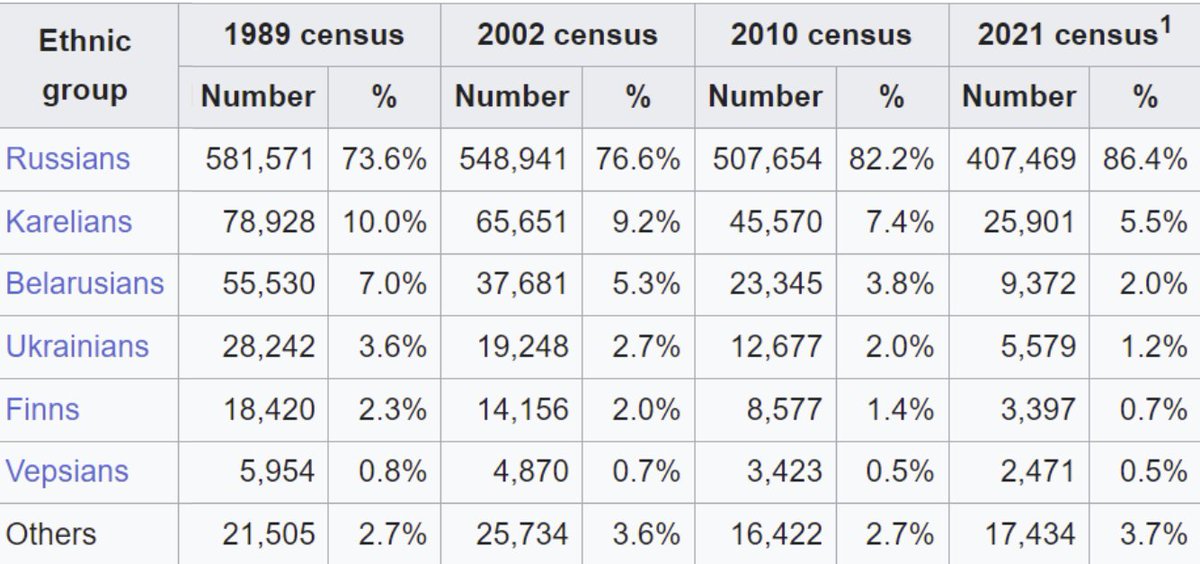
The region's demographics is not its strongest aspect. Many locals have had the chance to cross the Finnish border and were surprised by the higher living standards. /22
The region's demographics is not its strongest aspect. Many locals have had the chance to cross the Finnish border and were surprised by the higher living standards. /22
This motivated some to leave, and Finland provided easier ways to resettle for those with Finnish descent. /23
This is something unique to this region, as most areas we studied were quite isolated and had limited knowledge of what was happening beyond Russia's borders. /24
As a result, there aren't many Karelians left in the region. They mostly reside in two districts, making it challenging to find Karelians elsewhere. /25

Interesttingly, there is also some Karelian community in Tver oblast, residing there since 17 century. But due to Soviet Union policies there this now very small community. /26

As result from the processes mentioned above Karelian language is now definitely endangered according to UNESCO list. /27
FREEDOM MOVEMENTS
Discussions about Karelia's sovereignty emerged in the early 20th century, leading to the creation of the Republic of Uhtua from 1918 to 1920 as a stand against the Red Army. /28
Discussions about Karelia's sovereignty emerged in the early 20th century, leading to the creation of the Republic of Uhtua from 1918 to 1920 as a stand against the Red Army. /28

The East Karelian Uprising in 1921-1922 continued this resistance, with Karelians opting to secede from the Soviet Union and facing off against Soviet forces. Finland supported Karelia but didn't directly intervene to avoid war with Moscow. /29
Soviet forces emerged victorious, leading to the evacuation of 30,000 Karelians to Finland, marking the first of several major resettlements in the area in the 20th century. Despite the failure of the uprising, Karelians were granted autonomy in 1923. /30
Indeed, the Karelo-Finnish SSR existed from 1940 to 1956, which could be seen as de jure sovereignty, but its autonomy during that period was indeed very limited. /31

The Karelian National Movement was active in the late 80s and 1990s, taking measures to preserve the language and unique culture. /32
In modern times, the Karelian National Movement, headquartered in Tartu, has drawn attention. According to its leader, Dmitry Kuznetsov, there have been volunteers willing to join and form the Karelian Battalion as part of the foreign legion. /33

However, he states that after gathering in another country, they were not granted permission to enter Ukraine and commence their service, despite waiting for several months. /34
While the movement isn't extensive currently, it remains active. Kuznetsov spoke at @freenationsrf last year, held in the European parliament. /35
@freenationsrf There have been discussions about Karelia joining Finland. However, these talks have predominantly been initiated by Russian officials, likely as a means to further persecute Karelian activists. /36

@freenationsrf In countries with established democracies, the idea of expanding territory beyond internationally recognized borders is widely viewed as an unpopular initiative. /37
@freenationsrf CONCLUSION
Gaining independence for Karelia seems to be a more challenging story compared to other republics, primarily due to the relatively small number of Karelians. /38
Gaining independence for Karelia seems to be a more challenging story compared to other republics, primarily due to the relatively small number of Karelians. /38
@freenationsrf However, it feels that the overall population might be slightly less influenced by propaganda due to their proximity to Europe. Many have relatives in Finland and know more about life abroad. /39
@freenationsrf Karelia has a strategic location, especially if gaining access to Karelian Isthmus with the city of Vyborg. This would connect it to both the Baltic and White Seas (Arctic Ocean). Karelian activists also claim that region. /40

@freenationsrf Indeed, the path ahead remains uncertain, as it hinges on various events. However, we must not forget that Karelia's unique culture, along with many others, faces an existential threat due to #RussianColonialism. /41

@freenationsrf Thank you for reading and consider to support the project by buying me a coffee. Likes, retweets, and comments are also helpful. Thank you for your support!
/42buymeacoffee.com/VTretyak
/42buymeacoffee.com/VTretyak
@freenationsrf Please engage with and share these thread series. Even small actions like liking, commenting, and sharing can contribute to the cause of ending Russian imperialism. All the threads are available on the website:
/43russiadecolonized.com
/43russiadecolonized.com
• • •
Missing some Tweet in this thread? You can try to
force a refresh