
 Read on Twitter
NSW Health is urging people to be alert for signs and symptoms of measles after being notified of two confirmed cases of measles. Both cases are from the same family and acquired their infections overseas.
The cases visited several locations in Sydney while infectious.
The cases visited several locations in Sydney while infectious.
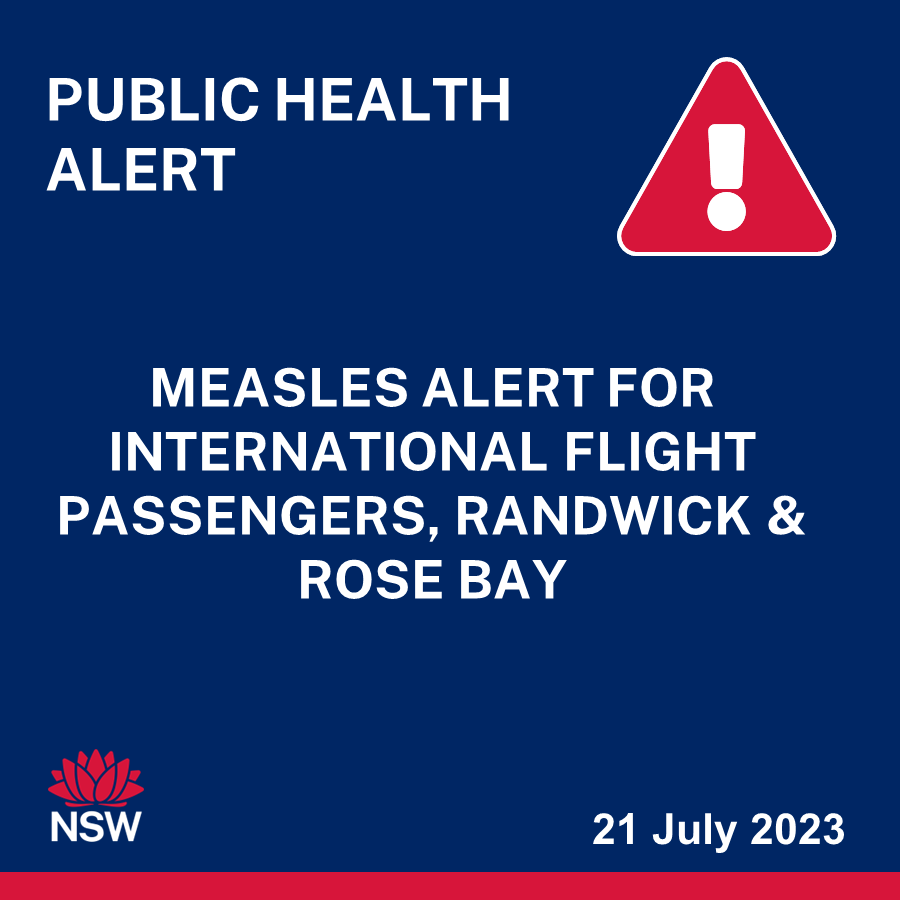
Dr Anthea Katelaris, A/Director, South Eastern Sydney Public Health Unit, said anyone who was in the same locations as the cases should be alert for signs and symptoms of measles until 7 August, and check their vaccination status.
People may have been exposed to the cases in the following locations:
• Qatar Airways flight QR908 from Doha to Sydney departing Doha on Thursday 13 July at 8pm, arriving in Sydney on Friday 14 July at 5:10pm.
• Qatar Airways flight QR908 from Doha to Sydney departing Doha on Thursday 13 July at 8pm, arriving in Sydney on Friday 14 July at 5:10pm.
• Sydney Airport – Terminal 1 International Arrivals (including baggage claim and customs) on the evening of Friday 14 July between 5:10pm and 7pm
• TerryWhite Chemmart Gaslight Rose Bay 484 Old South Head Rd Rose Bay on Saturday 15 July between 11:00am and 11:45am.
• TerryWhite Chemmart Gaslight Rose Bay 484 Old South Head Rd Rose Bay on Saturday 15 July between 11:00am and 11:45am.
• Prince of Wales Hospital Emergency Department on Wednesday 19 July between 9am to 2pm and 4pm to 11.15pm.
• Prince of Wales Hospital Randwick LifeGrain café on Wednesday 19 July from 11.15am to 12pm.
• Prince of Wales Hospital Randwick LifeGrain café on Wednesday 19 July from 11.15am to 12pm.
• Prince of Wales Hospital Foyer Pharmacy (Barker St entrance) on Wednesday 19 July from 12.45pm to 1.30pm
• Westpac bank, 49-51 Belmore Rd, Randwick 2031 on Thursday 20 July from 2.15pm to 2.45pm
• Westpac bank, 49-51 Belmore Rd, Randwick 2031 on Thursday 20 July from 2.15pm to 2.45pm
• Priceline Randwick, 49-51 Belmore Rd, Randwick 2031 on Thursday 20 July from 2.15pm to 3pm
• Blooms the Chemist, Royal Randwick, 26/73 Belmore Rd, Randwick 2031 on Thursday 20 July from 2.30pm to 3.15pm
• Blooms the Chemist, Royal Randwick, 26/73 Belmore Rd, Randwick 2031 on Thursday 20 July from 2.30pm to 3.15pm
• Royal Randwick Shopping Centre 73 Belmore Rd, Randwick 2031 on Thursday 20 July from 2pm to 3.15pm
• 7-Eleven Randwick 128 Barker St, Randwick NSW 2031 on Thursday 20 July from 12.30pm to 1.15pm
• 7-Eleven Randwick 128 Barker St, Randwick NSW 2031 on Thursday 20 July from 12.30pm to 1.15pm
These locations do not pose an ongoing risk to people.
Anyone born in or after 1966 who has not received two doses of measles vaccine should get a measles vaccine to prevent the infection.
Anyone born in or after 1966 who has not received two doses of measles vaccine should get a measles vaccine to prevent the infection.
"The measles-mumps-rubella vaccine is safe and effective protection against measles. It's free for anyone born during or after 1966 who hasn't already had two doses. If you're unsure whether you've had two doses, it's quite safe to have another," Dr Katelaris said.
“The measles-mumps-rubella (MMR) vaccine is available from GPs (all ages) and some pharmacies (people over 12 years of age). Children should receive the MMR vaccine at 12 and 18 months of age, as part of their routine childhood immunisations.
"Those most likely to be susceptible to measles are infants under 12 months of age who are too young to be vaccinated, anyone who is not fully vaccinated against the disease, which may include some adults, and people with a weakened immune system.
“Symptoms of measles include fever, sore eyes, and a cough followed three or four days later by a red, blotchy rash which typically spreads from the head and neck to the rest of the body.
“It can take up to 18 days for symptoms to appear after an exposure, so it is really important to stay vigilant if you’ve been in the above locations. If you develop symptoms, please call ahead to your GP to ensure you do not spend time in the waiting room with other...
patients,” Dr Katelaris said.
Measles is highly contagious and is spread in the air through coughing or sneezing by someone who is unwell with the disease.
Measles remains common in many parts of the world, with large outbreaks currently occurring in a number of locations...
Measles is highly contagious and is spread in the air through coughing or sneezing by someone who is unwell with the disease.
Measles remains common in many parts of the world, with large outbreaks currently occurring in a number of locations...
Measles has also been reported in other states in recent weeks. People returning from recent overseas travel should be alert for symptoms.
For more information on measles, visit here: health.nsw.gov.au/news/Pages/202…
For more information on measles, visit here: health.nsw.gov.au/news/Pages/202…
• • •
Missing some Tweet in this thread? You can try to
force a refresh






