
 Read on Twitter
1/15
I am very pleased to be taking part in the 2023 Festival of Archeology. For 12 years, I have created paintings of historic Liverpool (now c.30), using multiple sources, at various points throughout a c. 300 year period to try to bring the City’s past to life #ArchMol23
I am very pleased to be taking part in the 2023 Festival of Archeology. For 12 years, I have created paintings of historic Liverpool (now c.30), using multiple sources, at various points throughout a c. 300 year period to try to bring the City’s past to life #ArchMol23

2/15
For later dates, (e.g. L’pool Pier Head and surround 1907), greater accuracy is possible (100s of photos, mapping improves, more landscape art, and some buildings or fragments survive (though few). A new view, predating 3 graces & unseen since - emerges
#ArchMoL23
For later dates, (e.g. L’pool Pier Head and surround 1907), greater accuracy is possible (100s of photos, mapping improves, more landscape art, and some buildings or fragments survive (though few). A new view, predating 3 graces & unseen since - emerges
#ArchMoL23

3/15 Choosing a landscape to recreate combines historical/social importance, how obliterated unknown the past is, or as with ’s quarter shown here, just ‘what did it look like before?’
Multiple sources and artistic creativity combine to begin #ArchMol23 https://t.co/8zWAexhlz0St.George
Multiple sources and artistic creativity combine to begin #ArchMol23 https://t.co/8zWAexhlz0St.George

4/15 The surprising result of ‘what came before St. George’s Hall’.
1823 Liverpool. A mature Georgian township with mills, infirmary, seaman’s hospital and asylum. Sources allow good accuracy in a view not seen since then (only two years after Napoleon’s death).
#ArchMoL23
1823 Liverpool. A mature Georgian township with mills, infirmary, seaman’s hospital and asylum. Sources allow good accuracy in a view not seen since then (only two years after Napoleon’s death).
#ArchMoL23

5/15
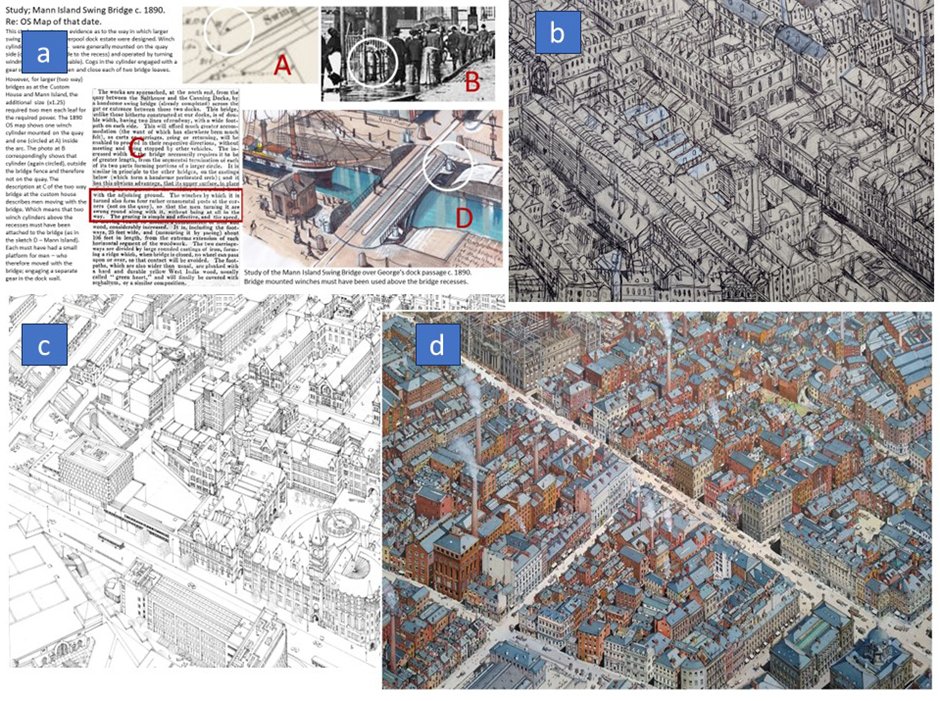
The broad process from 4 different paintings; a) Research notes/sketches; multiple sources/consultation (Nova Scotia 1890) b) Pencil research rough (pre Central Station 1860s) c) pen and ink ‘axonometric’ drawing of L’pool Uni d) final watercolour (Dale St. 1863)
#ArchMoL23
The broad process from 4 different paintings; a) Research notes/sketches; multiple sources/consultation (Nova Scotia 1890) b) Pencil research rough (pre Central Station 1860s) c) pen and ink ‘axonometric’ drawing of L’pool Uni d) final watercolour (Dale St. 1863)
#ArchMoL23
6/15
Where possible, research includes use of surviving buildings, groundworks and structures to solve ‘archeological’ problems, to recreate lost landscapes and to reverse engineer social and industrial functions. learning results and is imported into larger views
#ArchMoL23
Where possible, research includes use of surviving buildings, groundworks and structures to solve ‘archeological’ problems, to recreate lost landscapes and to reverse engineer social and industrial functions. learning results and is imported into larger views
#ArchMoL23

7/15
Materials (including legends as in this 1769 view) are shared on twitter. Comments, images and corrections result, from organisations, photographic collectors e,g, @angiesliverpool & local historians e.g. @Liverpool1207 and
#ArchMoL23 https://t.co/CgaKH06RpJbuild2understand.silvrback.com
Materials (including legends as in this 1769 view) are shared on twitter. Comments, images and corrections result, from organisations, photographic collectors e,g, @angiesliverpool & local historians e.g. @Liverpool1207 and
#ArchMoL23 https://t.co/CgaKH06RpJbuild2understand.silvrback.com

8/15
A watercolour showing an aerial view of the Custom House & Jacobean sailor’s home etc. Canning Street 1915. Bombing and subsequent demolition virtually obliterated this grand area. Today, it is the home of Liverpool One, the Hilton Hotel, Chavasse Park etc #ArchMoL23
A watercolour showing an aerial view of the Custom House & Jacobean sailor’s home etc. Canning Street 1915. Bombing and subsequent demolition virtually obliterated this grand area. Today, it is the home of Liverpool One, the Hilton Hotel, Chavasse Park etc #ArchMoL23

Slide 9/15
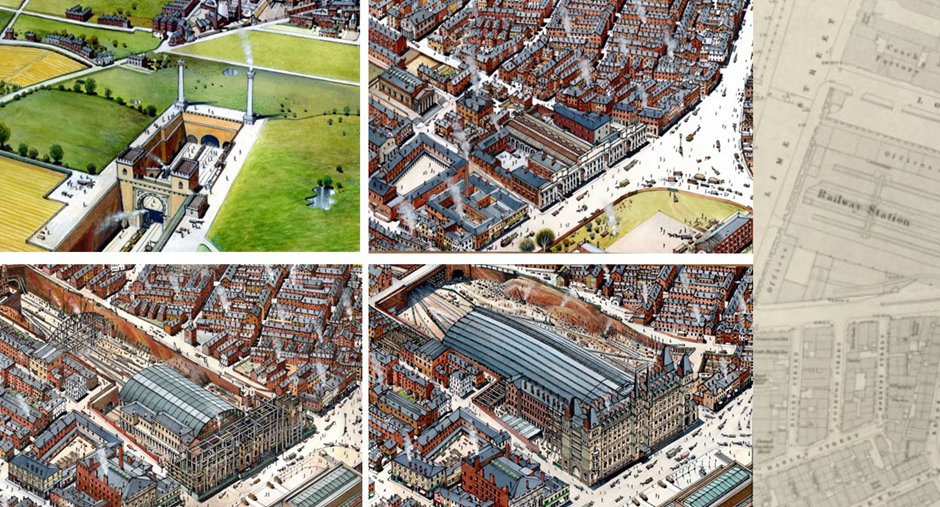
Liverpool and Manchester railway views (1830 to 1875). Top left Edge Hill cutting (now a monument) and 3 stages of Lime Street builds in sequence. Ordnance Survey maps are always key. With the help of the L’pool & Manchester Railway Trust @LMRailway.
#ArchMoL23
Liverpool and Manchester railway views (1830 to 1875). Top left Edge Hill cutting (now a monument) and 3 stages of Lime Street builds in sequence. Ordnance Survey maps are always key. With the help of the L’pool & Manchester Railway Trust @LMRailway.
#ArchMoL23
@LMRailway 10/15
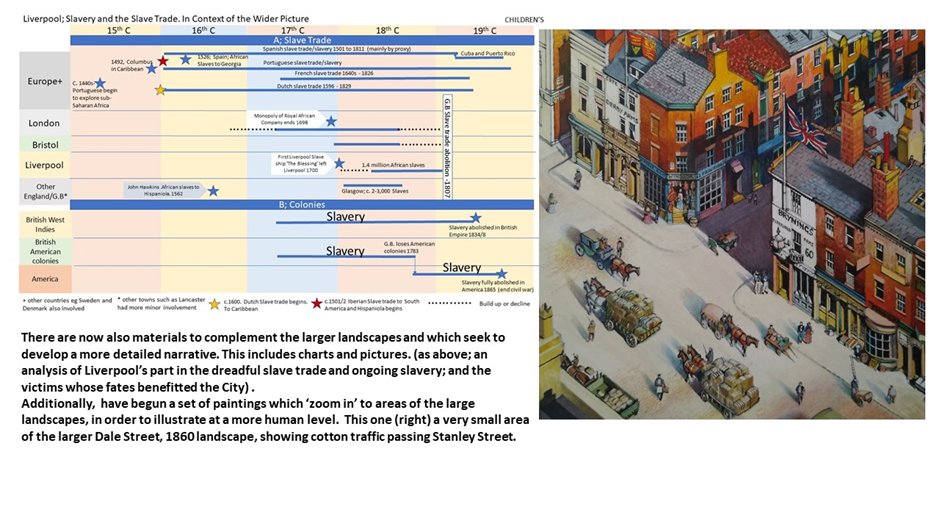
I have developed support materials to complement the reconstructions, forming a chronological historical narrative (e.g. left; context chart for the dreadful slave trade) and more detailed, human level ‘zoom ins’ (right - Dale Street/Stanley Street 1860)
#ArchMoL23
I have developed support materials to complement the reconstructions, forming a chronological historical narrative (e.g. left; context chart for the dreadful slave trade) and more detailed, human level ‘zoom ins’ (right - Dale Street/Stanley Street 1860)
#ArchMoL23
@LMRailway 11/15
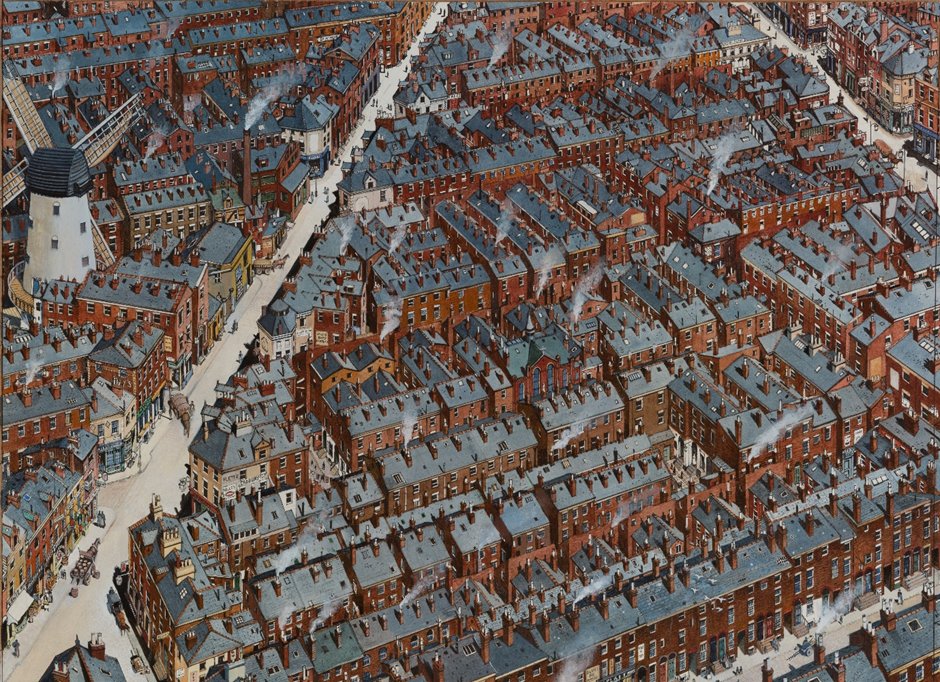
Intrigued by vast areas of ‘court housing’ shown in an OS map of the mid 18thcentury, I painted this landscape (Vauxhall/Marybone 1865) a tiny part of that dreadful place where working people suffered immeasurably, up to a century later. Nothing remains now
#ArchMoL23
Intrigued by vast areas of ‘court housing’ shown in an OS map of the mid 18thcentury, I painted this landscape (Vauxhall/Marybone 1865) a tiny part of that dreadful place where working people suffered immeasurably, up to a century later. Nothing remains now
#ArchMoL23
@LMRailway 12/15
One of a series of watercolours reconstructing sections of the 7 mile docks built in the mid 19th century; in this case, the North Docks along Regent Road, from Salisbury to Sandon Dock (1860s) and some sources/source sketches including residual buildings
#ArchMoL23
One of a series of watercolours reconstructing sections of the 7 mile docks built in the mid 19th century; in this case, the North Docks along Regent Road, from Salisbury to Sandon Dock (1860s) and some sources/source sketches including residual buildings
#ArchMoL23


13/15
The latest.
I hope this ‘open book’ creative process (art/history combined) adds something to Liverpool’s historic resources and civic memory. I think community memory reinforces identity and contributes importantly to the meaning of our lives.
#ArchMoL23
The latest.
I hope this ‘open book’ creative process (art/history combined) adds something to Liverpool’s historic resources and civic memory. I think community memory reinforces identity and contributes importantly to the meaning of our lives.
#ArchMoL23

14/15
What gives this process its interest, is the degree to which places have changed over time and what, therefore, makes the rediscovery of old landscapes more surprising, historically valuable and interesting.
#FestivalofArcheology
#ArchMoL23
What gives this process its interest, is the degree to which places have changed over time and what, therefore, makes the rediscovery of old landscapes more surprising, historically valuable and interesting.
#FestivalofArcheology
#ArchMoL23

15/16
.
Many thanks to @VanessaAOakden of @MuseumLiverpool for the privilege of presenting a paper for the 2023 Festival of Archeology.
@edwardrolf
#ArchMoL23 https://t.co/9zixaknE0opulse.ly/iy1yrubjda
.
Many thanks to @VanessaAOakden of @MuseumLiverpool for the privilege of presenting a paper for the 2023 Festival of Archeology.
@edwardrolf
#ArchMoL23 https://t.co/9zixaknE0opulse.ly/iy1yrubjda

• • •
Missing some Tweet in this thread? You can try to
force a refresh




