Read on Twitter
--The #Achaemenid Military Machine Part 8: Heavy Cavalry (Early Empire) --
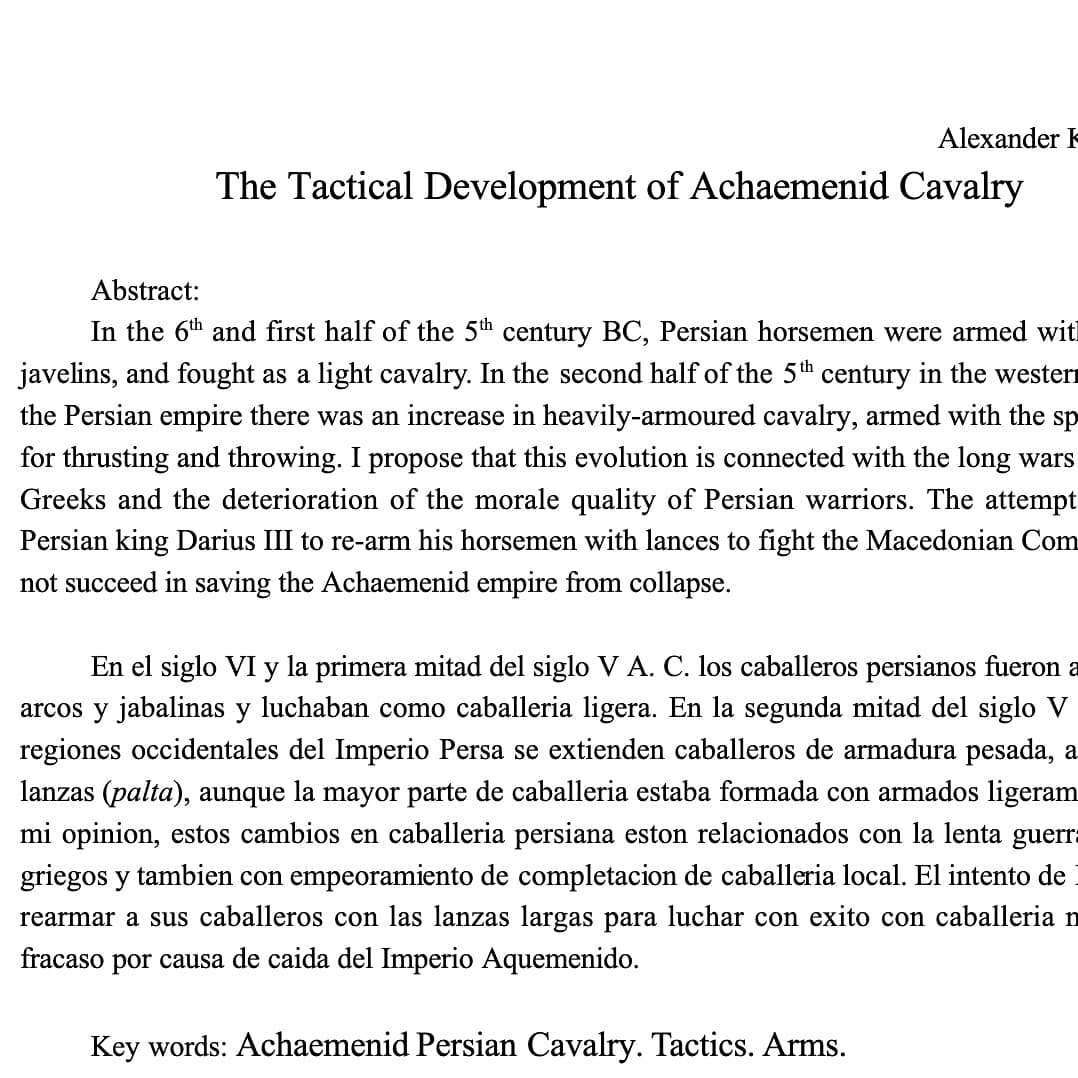
From "The Tactical Development of Achaemenid Cavalry" by Alexander Nefedkin:
From "The Tactical Development of Achaemenid Cavalry" by Alexander Nefedkin:

“The offensive weaponry of these riders consisted of the sword and two palta, often without a bow ... There is no firm evidence for Persian #horsemen using shields in the mid-5th century, as Duncan Head (1992: 37–38) and Nicholas Sekunda (1992: 21) suggest.

... Only #noble Achaemenid #cavalrymen possessed #armor. They were usually the guards of a governor or members of a landowner’s family.

In the later 5th / early 4th century BC, Achaemenid cavalry used to form into deep columns for the charge and more easily overwhelmed Greek #cavalry, but Persian horsemen did not usually charge the close #phalanx of the Hellenic hoplites...
“Square formations” (τετρ〈γωνοι τ〈ξεις) came to be considered by Greek tacticians as the usual deployment for Persian cavalry.
Contemporary cavalry #tactics are described by #Xenophon (Hell. 3.4.13-14) in his account of the engagement at Dascyleium in the 396 BC:
‘… The two squadrons saw one another, not so much as four plethra apart [around 120 m], at first both halted, the #Greek horsemen being drawn up four deep like a phalanx, and the barbarians with a front of not more than twelve, but many men deep.
Then, however, the barbarians charged. When they came to a hand-to-hand encounter, all of the #Greeks who struck anyone broke their spears, while the barbarians, being armed with palta of cornel-wood, speedily killed twelve men and two #horses.
Thereupon the Greeks were turned to flight. But when Agesilaus came to the rescue with the hoplites, the #barbarians withdrew again and one of them was killed’ (translated by C.L. Brownson).”
PC:
- Can't find the original artists, get at me if you know!
- And a picture of the Nefedkin article, of you're interested in this subject, a must-read
-
🛡️Want to learn more about #Ancient Military #History?
-
⚔️Follow @ancient.military.history -
-
-
- Can't find the original artists, get at me if you know!
- And a picture of the Nefedkin article, of you're interested in this subject, a must-read
-
🛡️Want to learn more about #Ancient Military #History?
-
⚔️Follow @ancient.military.history -
-
-
-
-
#tactics #spear #Persia #knight #ancientmilitaryhistory #ancienthistory #totalwar #Taktika #GreekHistory #xerxes #darius #sparta #Iran #hoplite
#cyrus #ancientwarfare
-
#tactics #spear #Persia #knight #ancientmilitaryhistory #ancienthistory #totalwar #Taktika #GreekHistory #xerxes #darius #sparta #Iran #hoplite
#cyrus #ancientwarfare
• • •
Missing some Tweet in this thread? You can try to
force a refresh