TODAY at the federal courthouse in DC:
Almost entirely Jan. 6 defendants, Donald Trump and Peter Navarro. (Plus trial of anti-abortion activists charged with barricading a clinic)
Almost entirely Jan. 6 defendants, Donald Trump and Peter Navarro. (Plus trial of anti-abortion activists charged with barricading a clinic)

Trump’s attorneys John Lauro and Todd Blanche are in the building. Hearing starts at 10 with a focus on setting a protective order governing evidence-sharing in the case.
About to get underway here. Blanch, Lauro and Lauro's colleague Gregory Singer are seated at defense table. Molly Gaston and Tom Windom at prosecution table. @libradunn is in the gallery. Paul Kamenar, a veteran of various Mueller fights, was spotted with Trump legal team earlier
CHUTKAN has taken the bench, at precise moment clock struck 10.
CHUTKAN starts by explaining her decision to shorten response time or Lauro/Trump team to respond to proposed protective order.
"I routinely depart from the 14 and 7 day time limits, as do many of my colleagues, when it serves the interest of justice and efficiency."
"I routinely depart from the 14 and 7 day time limits, as do many of my colleagues, when it serves the interest of justice and efficiency."
She said in this case, given the "brevity" of proposed protective order from prosecutors, "a shorter briefing schedule was appropriate."
CHUTKAN: "Mr. Trump, like every American, has a First Amendment right to free speech. But that right is not aboslute... Defendant’s free speech is subject to the release conditions imposed at arraignment and it must yield to the orderly administration of justice.”
WINDOM says Trump's proposed protective order is "tailored" to "try this case in the media." He cites Chutlan's own ruling in an earlier case — against Russian agent Maria Butina — in which she raised similar concerns.
Chutkan presses Windom what the line is.
Chutkan presses Windom what the line is.
WINDOM says there may be some non-sensitive discovery that is sensational and can pollute the jury pool.
CHUTKAN say "defense has a First Amendment right." Wants to know how much discovery is sensitive vs. nonsensitive.
Windom says "vast majority" is sensitive.
CHUTKAN say "defense has a First Amendment right." Wants to know how much discovery is sensitive vs. nonsensitive.
Windom says "vast majority" is sensitive.
CHUTKAN: "I don’t want this order to be overinclusive. I don’t want to just issue a blanket protective order over information that is not sensitive."
LAURO now up: "I think you hit the nail on the head," he said.
CHUTKAN: "I think that may be the last time you say that for awhile," she says to laughter in courtroom.
CHUTKAN: "I think that may be the last time you say that for awhile," she says to laughter in courtroom.
IMPORTANT — CHUTKAN: “What the defendant is currently doing — the fact that he’s running a political campaign has to yield to the orderly administration of justice. If that means he can’t say exactly what he wants to say about witnesses in this case, that’s how it has to be.”
LAURO: "My client will abide by the integrity of the process" but he "can’t be subject to some kind of contempt trap."
CHUTKAN says no one is talking about contempt but says Trump's speech rights must yield to pretrial release conditions and rules against witness intimidation.
CHUTKAN says no one is talking about contempt but says Trump's speech rights must yield to pretrial release conditions and rules against witness intimidation.
LAURO: Govt's proposed protective order woudl provide political "advantage" to Joe Biden.
“I cannot and will not factor into my decision” effect on political campaign, she says, "for either side."
“I cannot and will not factor into my decision” effect on political campaign, she says, "for either side."
LAURO: "The risk is that someone can say something in the course of a heated debate or a heated campaign and [prosecutors] are going to throw a flag."
He vows his client will follow precise letter of the court's order.
CHUTKAN: "I'm glad to hear that."
He vows his client will follow precise letter of the court's order.
CHUTKAN: "I'm glad to hear that."
MORE CHUTKAN: "The existence of a political campaign is not going to factor into my decision. I intend to keep politics out of this.”
WINDOM back up. Says he won't address the political considerations raised by Lauro. But he notes Trump's social media posts about potential witnesses in the case.
WINDOM again references Butina case. But Chutkan says it's not comparable, says wryly that that case "Now seems so small and quiet."
"There was no argument from the defense there that the defendant in that case needed to speak," she says.
"There was no argument from the defense there that the defendant in that case needed to speak," she says.
CHUTKAN is not buying Windom's argument to subject "non-sensitive" documents to the protective order. Most of Windom's arguments, she says, are "broad" but don't make clear why that material needs a special protection.
CHUTKAN sums up the arguments. "It is close."
"At this point, I'm not persuaded that the government ahs shown good cause to subject to the protective order all the inormation in this case." She adopts defense proposal.
"At this point, I'm not persuaded that the government ahs shown good cause to subject to the protective order all the inormation in this case." She adopts defense proposal.
CHUTKAN emphasizes Trump is subject to pretrial release conditions, which include bar on harassing or intimidating witnesses. "All his behavior and statements are governed by conditions of release.
CHUTKAN denies other changes proposed by defense about various exemptions from "sensitive" designations.
CHUTKAN says she's "not comfortable" with Trump team's proposal to allow volunteer attorneys or other non-retained lawyers to review discovery with Trump. She asks Lauro to submit a more narrowly tailored proposal.
CHUTKAN says she'll include language requiring anyone who reviews discovery for Trump to sign a statement promising to protect info.
LAURO: "This is a massive case and it's impossible to get readyy [on special counsel timeline] unless we're able to enlist the help" of others.
LAURO: "This is a massive case and it's impossible to get readyy [on special counsel timeline] unless we're able to enlist the help" of others.
CHUTKAN says defense definition is too broad.
"It allows just about anybody — I live in Washington. Anyone is a consultant." She notes language could permit unindicted coconspirators to see discovery.
"It allows just about anybody — I live in Washington. Anyone is a consultant." She notes language could permit unindicted coconspirators to see discovery.
WINDOM: "During the course of this invesigation it was the governemtn’s general pracice to audio record witness interviews conducted outside the grand jury ... There are hundreds of recordings of witness interviews."
They want to bar Trump from publicizing recordings.
They want to bar Trump from publicizing recordings.
CHUTKAN says Lauro is "conflating what your client need sto do to defend himself and what your client wants to do politically. Your client’s defense is supposed to happen in this courtroom, not on the internet."
LAURO, again: "President Trump will scrupulously abide by his conditions of release."
LAURO again says Trump is concerned his campaign trail comments will trigger complaints of witness intimidation even in normal camapign discourse.
CHUTKAN: "He’s a criminal defendant. He is going to have restrictions like every single other defendant.”
CHUTKAN: "He’s a criminal defendant. He is going to have restrictions like every single other defendant.”
CHUTKAN emphasizes Trump is bound by pretrial rules barring communication with any witness about facts of the case. But she says witness interviews/recordings should be deemed sensitive given potential for misuse.
NOTABLE — Windom says: "There are nonpublic items that hte [Jan. 6] select committee has provided to the government." That includes some transcripts that are not public, he says.
CHUTKAN won't require government to stamp every page of discovery as sensitive or nonsensitive based on Windom's representation that materials will be clearly marked in cover letters by Bates number. Lauro is fine with this.
CHUTKAN backs special counsel language requiring defense counsel to review Trump's notes on sensitive discovery materials to ensure there's no personally identifying information.
"That obligation is imperative," Chutkan says.
"That obligation is imperative," Chutkan says.
LAURO has concerns about requiring a attorney to sit with Trump while he reviews sensitive material. "We can put in procedures to get that information back immediately, but we have to have a situation where our client is allowed to review materials on his own."
Chutlan seems inclined to agree with Lauro, but Windom objects: “Defense counsel has a certain level of trust in the defendant that the government does not.”
Windom notes that order in docs case has similar restriction.
Windom notes that order in docs case has similar restriction.
WINDOM now notes that Trump and his lawyer are not always on the same page, alludes to Trump's call for Chutlan's recusal, which Lauro has not adopted.
Chutkan notes she was a defense lawyer and sometimes clients don't agree.
Chutkan notes she was a defense lawyer and sometimes clients don't agree.
WINDOM: "The defendant, when he only has the material to himself, could elect to photocopy or otherwise reproduce, take a picture of the sensitive materials ... He has shown a tenancy to desire to hold onto material he knows he should not have."
LAURO frustrated that government wants Trump's team to "babysit" the defendant. But Chutkan notes that Trump readily agreed to that condition in Florida so it undercuts defense argument here.
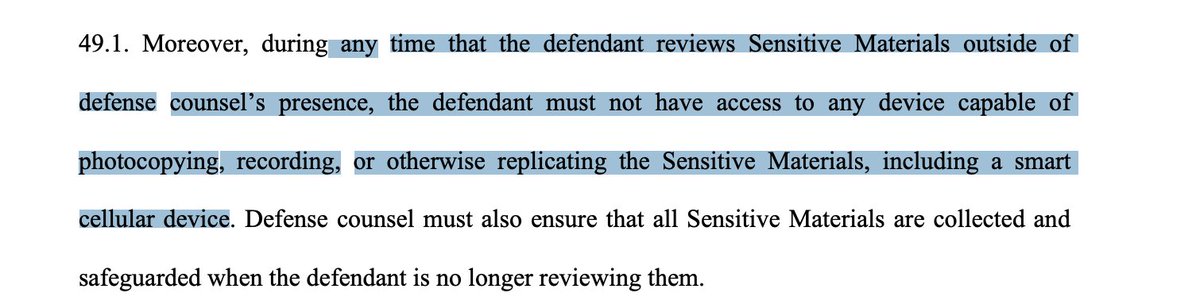
CHUTKAN says she will "compromise" here. Trump can review the materials by himself but says counsel must review any notes Trump takes to ensure no personal identifying information is kept. He can't have access, during review, to electronic devices or copy machine.
MORE: Chutkan says she intends for the case to be reflected on public docket and is inclined to reject efforts to seal documents without clear and persuasive reasoning.
CHUTKAN now ticking through some other business. But protective order debate is done.
Lauro now raising concerns that government is "hiding the ball" on how much discovery there is. He wants a hearing by Monday to understand volume of materials.
Lauro now raising concerns that government is "hiding the ball" on how much discovery there is. He wants a hearing by Monday to understand volume of materials.
WINDOM says first batch of discovery is "roughly 11.6 million pages or files, which are load ready." Plus some search warrant returns.
Roughly a quarter of those 11.6 million pages comes from entities like Trump's campaign and PAC that he might already have access to, Windom says.
WINDOM: "Our goal is to have discovery substnatially complete by August 28."
CHUTKAN, smiling, to Lauro: "I can just imagine your motion for a trial date now."
CHUTKAN, smiling, to Lauro: "I can just imagine your motion for a trial date now."
CHUTKAN: "While I intend to ensure that Mr. Trump is afforded all the rights that any citizen would have. I also take seriously my obligation to prevent [Supreme Court] has called a carnival atmosphere of unchecked publicity and trial by media."
"This case is no exception."
"This case is no exception."
Quite a close from CHUTKAN:
"I intend to ensure the orderly adminsitratio nof justice in this case as I would with any other case. Even arguably ambiguous statements from parties or their counsel … can threaten the process." (1/2)
"I intend to ensure the orderly adminsitratio nof justice in this case as I would with any other case. Even arguably ambiguous statements from parties or their counsel … can threaten the process." (1/2)
"In addition, the more a party makes inflammatory statements about this case which could taint the jury pool ... the greater the urgency will be that we proceed to trial quickly ... I will take whatever measures are necessary to safeguard the integrity of these proceedings."
NEW: Judge Tanya Chutkan vowed Friday to keep politics out of the Trump election case and treat him like any other defendant — which includes consequences for repeated "inflammatory" statements, she cautioned.
politico.com/news/2023/08/1…
politico.com/news/2023/08/1…
ONE OBSERVATION: Chutkan’s back-and-forth with Lauro seemed … conventional. If you stripped away the identity of the defendant and insane circumstances of this case, it was a very normal push and pull over the fine points of a protective order.
politico.com/news/2023/08/1…
politico.com/news/2023/08/1…
BREAKING: We have a protective order in U.S. v. Trump.
Prosecutors are now expected to begin sharing millions of pages of discovery.
storage.courtlistener.com/recap/gov.usco…
Prosecutors are now expected to begin sharing millions of pages of discovery.
storage.courtlistener.com/recap/gov.usco…
Here is the language barring Trump from having a phone or other electronics while reviewing sensitive discovery. https://t.co/6rIyhnZNf7storage.courtlistener.com/recap/gov.usco…
• • •
Missing some Tweet in this thread? You can try to
force a refresh