LLMs excel at code analysis / completion (e.g., Co-Pilot, Code Interpreter, etc). Part 6 of our initiative to improve @LangChainAI docs covers code analysis, building on contributions of @cristobal_dev + others:
https://t.co/2DsxdjbYeypython.langchain.com/docs/use_cases…
1/ Copilot and related tools (e.g., @codeiumdev) have dramatically accelerated dev productivity and shown that LLMs excel at code understanding / completion
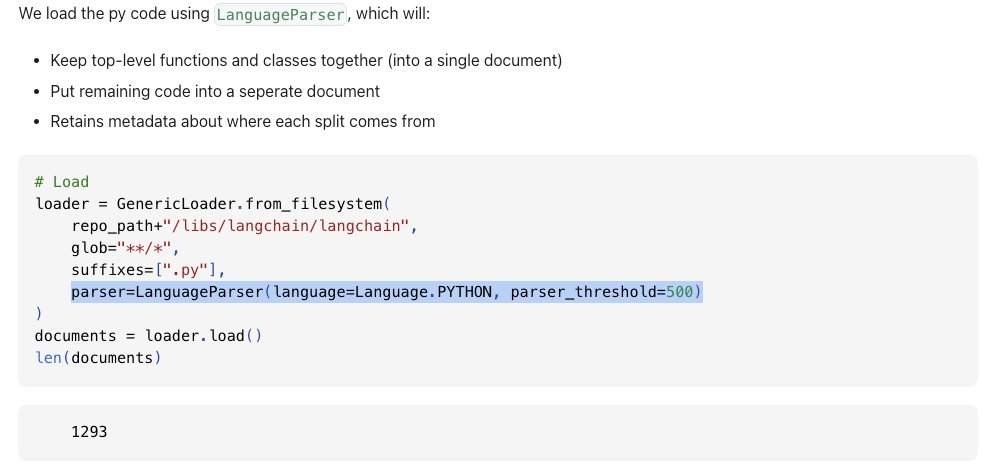
2/ But, RAG for QA/chat on codebases is challenging b/c text splitters may break up elements (e.g., fxns, classes) and fail to preserve context about which element each code chunk comes from.
3/ @cristobal_dev added context-aware code splitters to @LangChainAI, which preserve code structure (classes, fxns are loaded into docs) to support RAG for QA / chat: https://t.co/2AjOrjMrIu
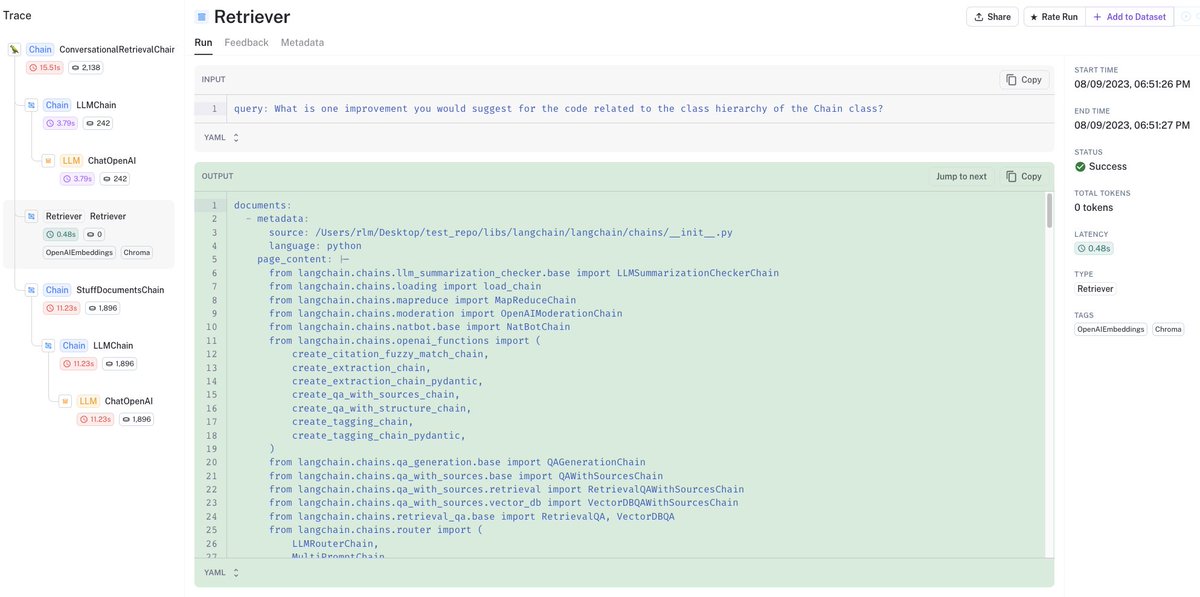
4/ Looking at LangSmith traces, we can see retrieved code from vectorDB related to the question retains fxn, cls structure and metadata (source file, etc):
https://t.co/KHszLjX05Jsmith.langchain.com/public/2b23045…
5/ For more on the community initiative to improve the docs, see Part 5 on tool use:
LLMs unlock a natural language interface with structured data. Part 4 of our initiative to improve @LangChainAI docs shows how to use LLMs to write / execute SQL queries w/ chains and agents. Thanks @manuelsoria_ for work on the docs:
https://t.co/CyOqp5I3TMpython.langchain.com/docs/use_cases…
1/ Text-to-SQL is an excellent LLM use-case: many ppl can describe what they want in natural language, but have difficultly mapping that to a specific SQL queries. LLMs can bridge this gap, e.g., see:
https://t.co/b0NMkHPe9xarxiv.org/pdf/2204.00498…
2/ create_sql_query_chain( ) maps from natural language to a SQL query: pass the question and the database into the chain, and get SQL out. Run the query on the database easily:
Getting structured LLM output is hard! Part 3 of our initiative to improve @LangChainAI docs covers this w/ functions and parsers (see @GoogleColab ntbk). Thanks to @fpingham for improving the docs on this:
2/ Functions (e.g., using OpenAI models) have been a great way to tackle this problem, as shown by the work of @jxnlco and others. LLM calls a function and returns output that follows a specified schema. wandb.ai/jxnlco/functio…
We've kicked off a community driven effort to improve @LangChainAI docs, starting w/ popular use cases. Here is the new use case doc on Summarization w/ @GoogleColab notebook for easy testing ...
https://t.co/e6QYl8pEsHpython.langchain.com/docs/use_cases…
1/ Context window stuffing: adding full documents into LLM context window for summarization is easiest approach and increasingly feasible as LLMs (e.g., @AnthropicAI Claude w/ 100k token window) get larger context windows (e.g., fits hundreds of pages).
https://t.co/aClREUqtPd
2/ Embed-cluster-sample: @GregKamradt demod a cool approach w/ @LangChainAI to chunk, embed, cluster, and sample representative chunks that are passed to the LLM context window. A nice approach to save cost by reducing tokens sent to the LLM.
... there's a new loader for etherscan transactions. Folks like @punk9059 may have a pulse on applications w/in the larger crypto community. Always interesting to learn about: python.langchain.com/docs/integrati…
Web research is a great LLM use case. @hwchase17 and I are releasing a new retriever to automate web research that is simple, configurable (can run in private-mode w/ llamav2, GPT4all, etc), & observable (use LangSmith to see what it's doing). Blog:
https://t.co/LU0PWDmrBEblog.langchain.dev/automating-web…
Projects like @assaf_elovic gpt-researcher are great example of research agents; we started with an agent, but landed on a simple retriever that executes LLM-generated search queries in parallel, indexes the loaded pages, and retrieves relevant chunks. LangSmith trace:
The retriever is compatible w/ private workflows. Here's a trace running on my laptop (~50 tok/sec) w/ Llama-v2 and @nomic_ai GPT4all embeddings + @trychroma: LLM will generate search queries and also be used for the final answer generation. See docs: https://t.co/I5V51LVdOFpython.langchain.com/docs/modules/d…
Document splitting is common for vector storage / retrieval, but useful context can be lost. @LangChainAI has 3 new "context-aware" text splitters that keep metadata about where each split came from. Works for code (py, js) c/o @cristobal_dev, PDFs c/o @CorranMac, and Markdown ..
.. the newest @LangChainAI release (v0.0.220) has a contribution from @CorranMac that uses Grobid for context-aware splitting of PDFs; great for scientific articles or large docs. Each text chunks retains the section of the paper it came from. See here .. https://t.co/tqKedGTwLCpython.langchain.com/docs/modules/d…
.. earlier this week, @cristobal_dev added context aware splitting for .js and .py, which will keep the class or function that each split comes from. He also added helpful documentation on usage here .. python.langchain.com/docs/modules/d…