The Paperclip Profile picture
Aug 14 17 tweets 3 min read Twitter logo Read on Twitter
It was the year 1921. A young filmmaker named Kanjibhai Rathod was determined to bring the Mahabharata to the big screen in colonial India. Yet, cloaked within the Mahabharata, it was Gandhi who danced in secret, looking eye to eye at the British Empire. A thread. 1/14 Image
Kanjibhai believed that cinema could spark a cultural renaissance among the Indian populace by depicting subjects from their ancient heritage. 2/14
Rathod boldly cast the revered stage actor Dwarkadas Sampat in the role of Vidur, the wise uncle and counsellor to the Pandavas in the Mahabharata. 3/14
When completed in 1921, the previews profusely praised Kanjibhai’s dream project, Bhakta Vidhur, for its grand sets, costumes, and thoughtful portrayal of the epic tale. However, trouble loomed ahead for Rathod's ambitious project. 4/14 Image
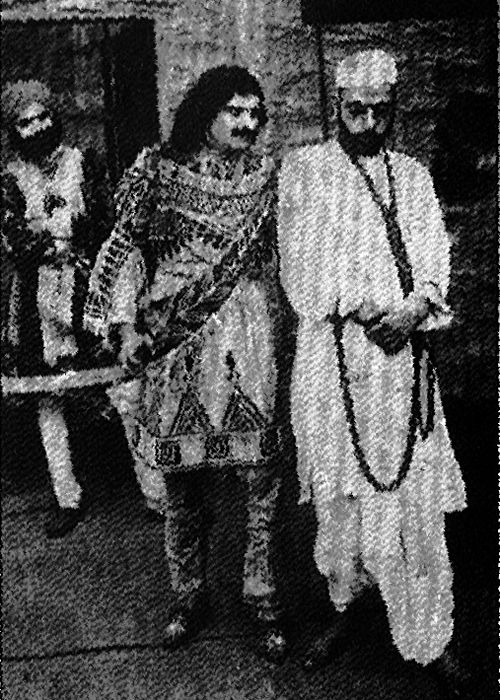
The government suddenly deemed the film to be potentially inciting resentment, leading to a ban in Madras, Karachi, and some other provinces. However, the motive behind this decision was not made clear at the time. 5/14
In time, they revealed their true political motive, stating, "It is not Vidur, it is Gandhiji. We won't allow it." By subtly yet unmistakably evoking the emerging spirit of Gandhi's peaceful resistance, Bhakta Vidhur was made to challenge imperial propaganda & censorship. 6/14
Vidur, the wise man, appeared in the film spinning the wheel, donning a Gandhi cap and Khadi shirt, while a nationalist music score played in the background extolling the charkha. The ingenuous masquerade was enough to unsettle the British censor board. 7/14
Remember, this was amid the protests against the Rowlatt Act, intended to suppress the growing nationalist movement. Mahatma Gandhi had called for satyagraha in response. And Bhakta Vidur was the ideal film to symbolize the great man who had shaken the empire. 8/14
Dwarkadas Sampat, the thespian who played Vidur, also produced the film. He instructed the artists to treat him just as the officials treated Gandhi and disregard his position as their boss. 9/14
They were also advised to use rocks and stones on the actor in specific sequences to add realism. No wonder the British were nervous. 10/14
When the movie arrived in Hyderabad (Sind), the British administration imposed a ban on it. The Majestic Cinema in Bombay screened Bhakta Vidur, drawing such huge crowds that the police had to use force to disperse them. 11/14
But by then, Bhakta Vidhur had achieved the real objective. Its empathetic portrayal of Gandhi’s dignity, wisdom, and sense of justice, under the veil of Vidur, deeply resonated with Indians from all walks of life. 12/14
Rathod's clever ploy to circumvent the censors to inspire progressive social change through Bhakta Vidur was remarkably foresighted for its time. He clearly grasped the power of cinema to shape society and introduced the nation to the remarkable potential of the medium. 13/14
The draconian censorship of Bhakta Vidur became a powerful symbol of the arrogance of imperial rule in curbing creative freedom and the film became a case study of the power of cultural connectedness, ultimately triumphing over such attempts 14/14
Sources: Pauwels, Heidi R.M. Indian Literature and Popular Cinema. Routledge, 2007.
Woods, Jeannine. Visions of Empire and Other Imaginings. Peter Lang, 2011.
Manishita Dass, Outside the Lettered City: Cinema, Modernity, and the Public Sphere in Late Colonial India, Oxford University Press
Image attributes: @WikiCommons

• • •

Missing some Tweet in this thread? You can try to force a refresh

 

Keep Current with The Paperclip

The Paperclip Profile picture

Stay in touch and get notified when new unrolls are available from this author!

Read all threads

This Thread may be Removed Anytime!

PDF

Twitter may remove this content at anytime! Save it as PDF for later use!

Try unrolling a thread yourself!

how to unroll video
  1. Follow @ThreadReaderApp to mention us!

  2. From a Twitter thread mention us with a keyword "unroll"
@threadreaderapp unroll

Practice here first or read more on our help page!

More from @Paperclip_In

Aug 12
While many of us who are privileged live within a bubble of entitlement, convinced that caste-based discrimination is non-existent, "Goopy Gyne Bagha Byne" had something to say that you may have completely missed. 1/15 Image
The 6 & a half minutes long psychedelic ghost dance sequence from Satyajit Ray's timeless masterpiece, serves as a subtle yet profound social commentary. Through an eclectic display of visual choreography, it offers a raw reminder of our deeply ingrained feudal caste system. 2/15
For those unfamiliar, "Goopy Gyne Bagha Byne" is a 1969 Indian fantasy-adventure-comedy film written and directed by Satyajit Ray, based on a story by his grandfather, Upendrakishore Ray Chowdhury. The film was a cult classic and a staple in every Bengali household. 3/15 Image
Read 16 tweets
Aug 10
Have you ever wondered how the absolutely fabulous @kalkikanmani is linked to the Eiffel Tower and the Statue of Liberty – two of the world's most iconic landmarks? And there's more to the story. Here is a history puzzle that might just blow your mind. 1/19 Image
In February 2009, Anurag Kashyap came up with his modern day adaptation of Sarat Chandra Chattopadhyay's 1917 Bengali novel "Devdas." Interestingly, the novel had previously been adapted 12 times and in 7 different languages for movies. 2/19
Kashyap's dark, psychedelic interpretation bagged a National Award and 6 Filmfare Awards, with the Best Supporting Actress award going to debutant French-Indian actor Kalki Koechlin, who played a modern-day version of "Chandramukhi." 3/19
Read 22 tweets
Aug 8
In 1903, at King Edward VII's coronation celebrations in Delhi, what caught the Chicago Tribune's eye was a dazzling dress and the woman who stood out in it. Why did this dress make headlines and who was the woman in it? A thread. 1/16 Image
Amidst the glitz, glamor and beautiful chaos of the festivities, a lady shone in the most beautiful dress - shimmering and glittering under the sky, its peacock feather motifs stitched together with deft accuracy with a hint of gold on them. 2/16
Wearing the dress was Mary Victoria Leiter, a six-feet tall native of Chicago. But, more importantly, she was the Lady Viceroy, wife of George Nathaniel Curzon, and had a rather keen interest in Indian craftsmanship. 3/16 Image
Read 18 tweets
Aug 6
The Annual Convocation ceremony of Calcutta University in 2012 was rather special: The University awarded two special graduation certificates to recipients who had passed out 80 years earlier: A thread on this unique affair (1/20)
Image
Image
The year 1911 was a momentous one for the subcontinent. This was the year when the capital of British India was shifted from Calcutta to Delhi. It was also the year when Mohun Bagan club made history by becoming the 1st Indian team to win the prestigious IFA Shield (2/20)
1911 also witnessed the birth of two girls in two parts of Bengal, within a few months of each other. On May 5, the Waddedar family of Dhalghat village in Chittagong was blessed with a girl who they named Pritilata (3/20) Image
Read 25 tweets
Aug 5
As a child, perhaps you vividly recall the red grammar book that graced your school desk. Yes, the famous "High School English Grammar and Composition" by Wren & Martin. But did you know that one of its creators also inspired a Hollywood film banned by Mussolini? A thread. 1/17 Image
P.C. Wren's work, along with his co-author H. Martin, became a cornerstone of English language education in India and Pakistan, offering a comprehensive guide to mastering the complexities of grammar. But what about the man behind the pages of the book? 2/17 Image
Born Percival Christopher Wren in 1875, in the East End of London to a school teacher, his life's journey took him across continents and through myriad experiences. And, to say the least he is a man of mystery. 3/17
Read 20 tweets
Aug 3
On September 14, 1908 Bande Mataram, an English weekly paper from Calcutta, published an article titled ‘Traitor in camp’. It was a detailed account of the Alipore bomb case and mentioned a traitor among the Indian revolutionaries. Who was it? Read on to know. 1/20 Image
Among other things, the article stated “Kanai has killed Narendra. No more shall the wretch of an Indian who kisses away the hands of his comrades reckon himself safe from the avenging hand. 'The first of the avengers' history shall write of Kanai.” 2/20
What could have led to Kanai Lal Dutt killing Narendra Nath Gossain? To know that, we have to go back to 1905 when the partition of Bengal led to a slew of revolutionary activities all across the province. 3/20
Read 21 tweets

Did Thread Reader help you today?

Support us! We are indie developers!


This site is made by just two indie developers on a laptop doing marketing, support and development! Read more about the story.

Become a Premium Member ($3/month or $30/year) and get exclusive features!

Become Premium

Don't want to be a Premium member but still want to support us?

Make a small donation by buying us coffee ($5) or help with server cost ($10)

Donate via Paypal

Or Donate anonymously using crypto!

Ethereum

0xfe58350B80634f60Fa6Dc149a72b4DFbc17D341E copy

Bitcoin

3ATGMxNzCUFzxpMCHL5sWSt4DVtS8UqXpi copy

Thank you for your support!

Follow Us on Twitter!

:(