Thanks, @edwest, for highlighting the chapter of BOOMERS on white flight. There were many anecdotes of school integration in DC that I included in early drafts of the book but later cut for reasons of space. Here are a few. /1 edwest.co.uk/p/the-great-am… x.com/edwest/status/…
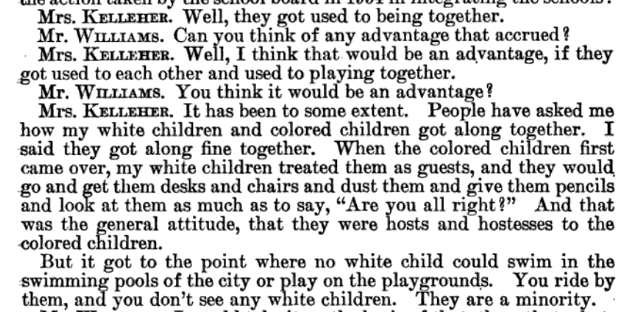
“People have asked me how my white children and colored children got along together… When the colored children first came over, my white children treated them as guests, and they would go and get them desks and chairs and give them pencils and look at them as if to say, ‘Are you all right?’ That was the general attitude, that they were hosts and hostesses to the colored children. But it got to the point where no white child could swim in the swimming pools of the city or play on the playgrounds. You ride by them and you don’t see any white children… I think there was force exerted. Threats, and I think there was some violence. I don’t know personally, except the children said, ‘We can’t go over there, we get beat up.’”
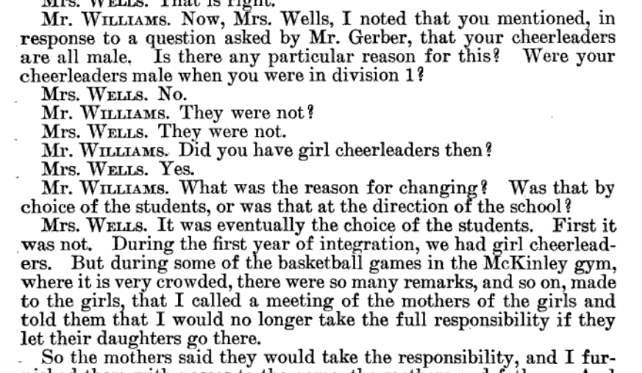
“During the first year of integration, we had girl cheerleaders. But during some of the basketball games in the McKinley gym, where it is very crowded, there were so many remarks, and so on, made to the girls, that I called a meeting of the mothers of the girls and told them that I would no longer take the full responsibility if they let their daughters go there.
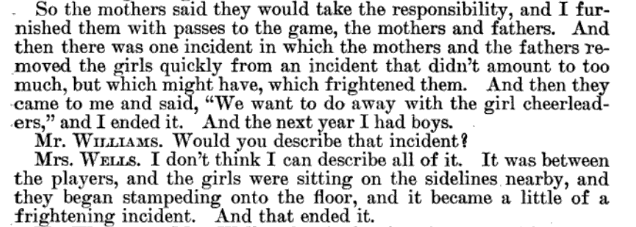
The mothers said they would take responsibility. I furnished them with passes to the game, the mothers and fathers. And then there was one incident in which the mothers and fathers removed the girls quickly from an incident that didn’t amount to too much, but which might have, which frightened them. And then they came to me and said, ‘We want to do away with the girls cheerleaders,’ and I ended it.”
“Would you describe the incident?”
“I don’t think I can describe all of it. It was between the players, and the girls were sitting on the sidelines nearby, and they began stampeding onto the floor, and it became a little of a frightening incident.”
The mothers said they would take responsibility. I furnished them with passes to the game, the mothers and fathers. And then there was one incident in which the mothers and fathers removed the girls quickly from an incident that didn’t amount to too much, but which might have, which frightened them. And then they came to me and said, ‘We want to do away with the girls cheerleaders,’ and I ended it.”
“Would you describe the incident?”
“I don’t think I can describe all of it. It was between the players, and the girls were sitting on the sidelines nearby, and they began stampeding onto the floor, and it became a little of a frightening incident.”
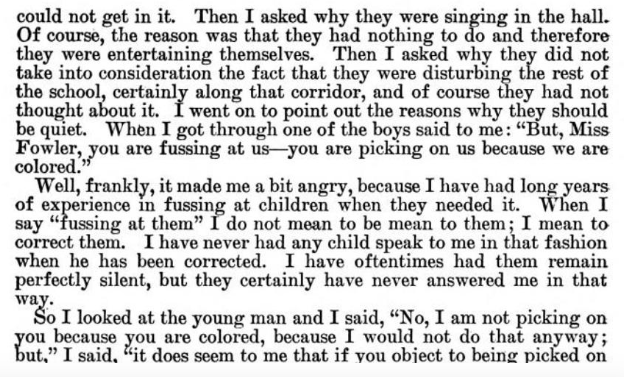
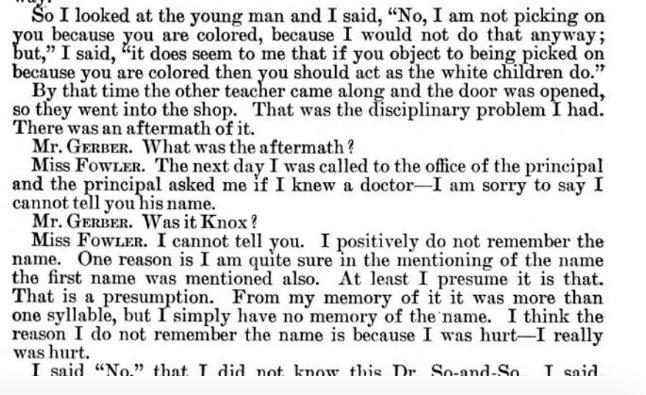
“I asked why they were singing in the hall. Of course, the reason was that they had nothing to do and therefore were entertaining themselves. Then I asked why they did not take into consideration the fact that they were disturbing the rest of the school, certainly along that corridor… One of the boys said to me, ‘But Miss Fowler, you are fussing at us, you are picking on us because we are colored.’ Well, frankly it made me a bit angry… I said, ‘No, I am not picking on you because you are colored, because I would not do that anyway, but it does seem to me that if you object to being picked on because you are colored then you should act as the white children do.’
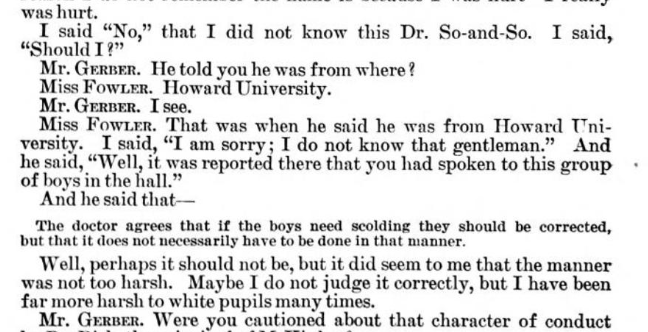
“The next day I was called to the office of the principal and the principal asked me if I knew a doctor, I am sorry to say I cannot tell you his name… He said he was from Howard University. I said, I am sorry, I do not know the gentleman. He said, well, it was reported that you had spoken to this group of boys in the hall, and he said: ‘The doctor agrees that if the boys need scolding they should be corrected, but that it does not necessarily have to be done in that manner.’”
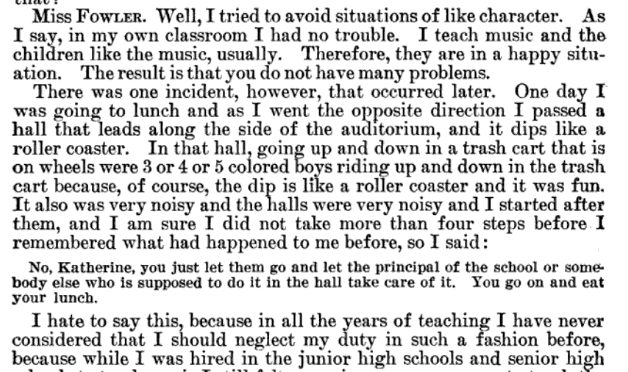
“One day I was going to lunch and as I went in the opposite direction, I passed a hall that leads along the side of the auditorium and it dips like a roller coaster. In that hall, going up and down in a trash cart that is on wheels were 3 or 4 or 5 colored boys riding up and down in the trash cart… It was very noisy and I started after them, and I am sure I did not take more than four steps before I remembered what had happened to me before so I said, No, Katherine, you just let them go and let the principal of the school or somebody else who is supposed to do it in the hall take care of it. You go on and eat your lunch.
I hate to say this, because in all the years of teaching I have never considered that I should neglect my duty in such a fashion before.”
“The next day I was called to the office of the principal and the principal asked me if I knew a doctor, I am sorry to say I cannot tell you his name… He said he was from Howard University. I said, I am sorry, I do not know the gentleman. He said, well, it was reported that you had spoken to this group of boys in the hall, and he said: ‘The doctor agrees that if the boys need scolding they should be corrected, but that it does not necessarily have to be done in that manner.’”
“One day I was going to lunch and as I went in the opposite direction, I passed a hall that leads along the side of the auditorium and it dips like a roller coaster. In that hall, going up and down in a trash cart that is on wheels were 3 or 4 or 5 colored boys riding up and down in the trash cart… It was very noisy and I started after them, and I am sure I did not take more than four steps before I remembered what had happened to me before so I said, No, Katherine, you just let them go and let the principal of the school or somebody else who is supposed to do it in the hall take care of it. You go on and eat your lunch.
I hate to say this, because in all the years of teaching I have never considered that I should neglect my duty in such a fashion before.”
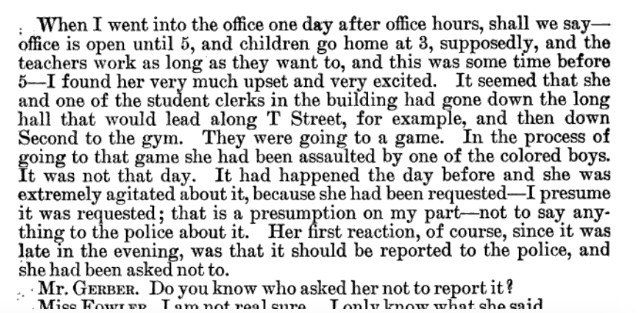
“I found her very much upset and very excited. It seemed that she and one of the student clerks in the building had gone down the long hall that would lead along T Street, for example, and then down Second to the gym. They were going to a game. In the process of going to the game she had been assaulted by one of the colored boys. It was not that day. It had happened the day before and she was extremely agitated about it, because she had been requested—I presume it was request, that is a presumption on my part—not to say anything to the police about it. Her first reaction, of course, since it was late in the evening, was that it should be reported to the police, and she had been asked not to.”
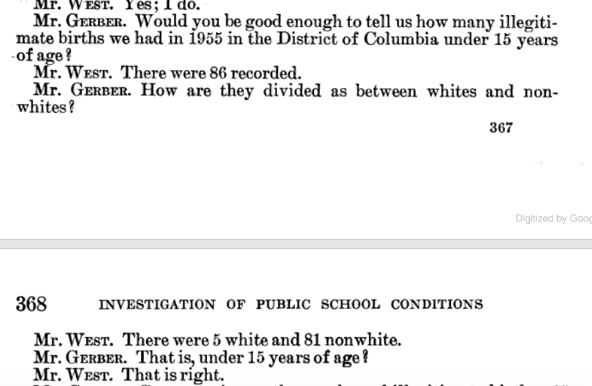
“Would you be good enough to tell us how many illegitimate births we had in 1955 in the District of Columbia under 15 years of age?”
“There were 86 recorded.”
“How were they divided as between whites and non-whites?”
“There were 5 white and 81 nonwhite.”
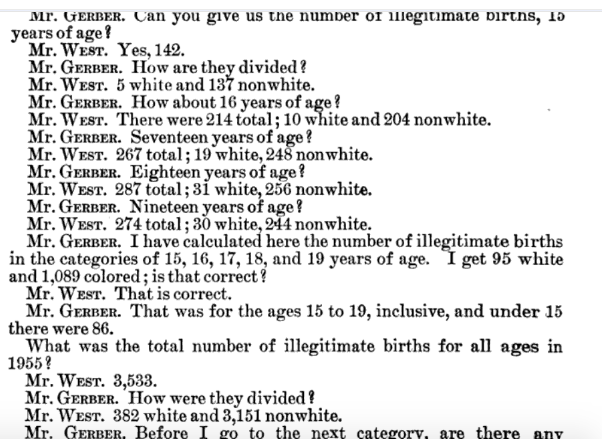
“I have calculated here the number of illegitimate births in the categories of 15, 16, 17, 18, and 19 years of age. I get 95 white and 1,089 colored, is that correct?
“That is correct.”
“There were 86 recorded.”
“How were they divided as between whites and non-whites?”
“There were 5 white and 81 nonwhite.”
“I have calculated here the number of illegitimate births in the categories of 15, 16, 17, 18, and 19 years of age. I get 95 white and 1,089 colored, is that correct?
“That is correct.”
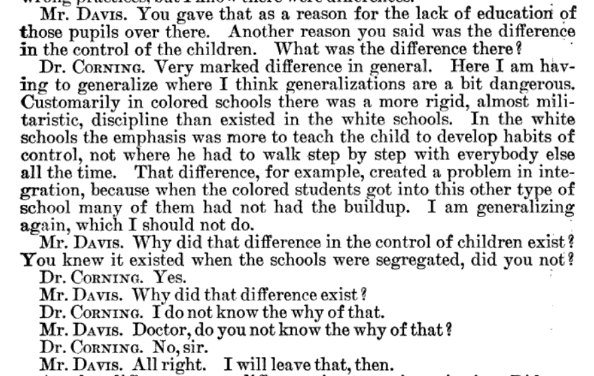
“The standards which existed in Division 1 and Division 2 [white and nonwhite] prior to integration of the schools, you stated that they had the same curriculum and the same requirements for teachers…”
“I said the same curriculum, the same allotment per pupil for textbooks and supplies, the same textbook list….”
“The same salaries?”
“That is right.”
“Efforts were made to provide equal facilities?”
“Very definitely.”
“What was the difference?”
“Here I am having to generalize where I think generalizations are a bit dangerous. Customarily in colored schools there was a more rigid, almost militaristic discipline than existed in the white schools. In the white schools the emphasis was more to teach the child to develop habits of control, not where he had to walk step by step with everybody else all the time. That difference, for example, created a problem integration, because when the colored students got into this other type of school many of them had not had the buildup.”
“I said the same curriculum, the same allotment per pupil for textbooks and supplies, the same textbook list….”
“The same salaries?”
“That is right.”
“Efforts were made to provide equal facilities?”
“Very definitely.”
“What was the difference?”
“Here I am having to generalize where I think generalizations are a bit dangerous. Customarily in colored schools there was a more rigid, almost militaristic discipline than existed in the white schools. In the white schools the emphasis was more to teach the child to develop habits of control, not where he had to walk step by step with everybody else all the time. That difference, for example, created a problem integration, because when the colored students got into this other type of school many of them had not had the buildup.”

“The former assistant principal, Miss Stewart, informed the teachers that stealing had become so bad that we were instructed not to report any more stealing to her.”
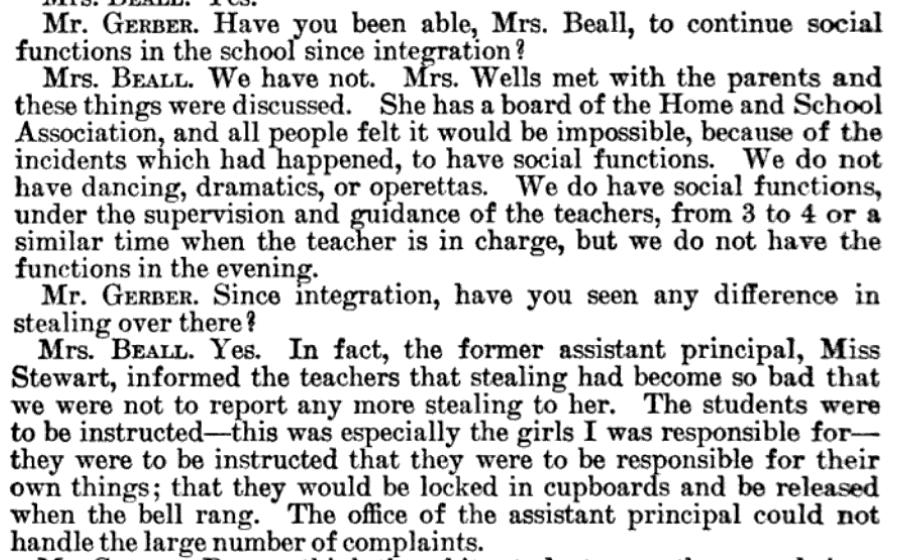
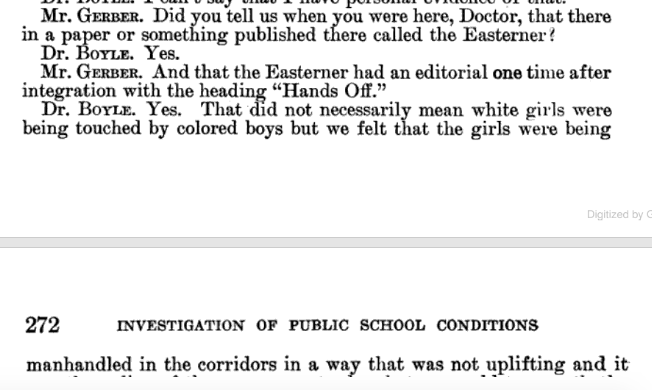
“The Easterner [the student paper] had an editorial one time after integration with the heading ‘Hands Off’?”
“Yes. That did not necessarily mean white girls were being touched by colored boys, but we felt that the girls were being manhandled in the corridors in a way that was not uplifting…
We had a survey in our building of every student. We handed out a mimeographed questionnaire asking what the student—it was unsigned and returned—what the student felt were the problems they were facing as a result of integration… That particular issue dealt with boys who were manhandling, shall we say.”
“How did they manhandle?”
“Well, they were touching certain parts, certain areas that one wouldn’t expect to be touched in public.”
“Was it an obscene handling? Was it vulgar, lewd, or give some better indication please. Was it suggestive?”
“Yes, definitely.”
“What portions of the body were they touching, if you can tell us that?”
“I prefer to let you use your own imagination.”
“Yes. That did not necessarily mean white girls were being touched by colored boys, but we felt that the girls were being manhandled in the corridors in a way that was not uplifting…
We had a survey in our building of every student. We handed out a mimeographed questionnaire asking what the student—it was unsigned and returned—what the student felt were the problems they were facing as a result of integration… That particular issue dealt with boys who were manhandling, shall we say.”
“How did they manhandle?”
“Well, they were touching certain parts, certain areas that one wouldn’t expect to be touched in public.”
“Was it an obscene handling? Was it vulgar, lewd, or give some better indication please. Was it suggestive?”
“Yes, definitely.”
“What portions of the body were they touching, if you can tell us that?”
“I prefer to let you use your own imagination.”

I’ll end the thread on that unforgettable phrase, “manhandled in a way that was not uplifting.” More at Ed’s post (for subscribers; surely you are one?). edwest.co.uk/p/the-great-am…
• • •
Missing some Tweet in this thread? You can try to
force a refresh