
 Read on Twitter
Prior to Schomerus, see G U Pope, who tried to present Tamizh Siddhānta through a Pretamata lens in his translation of the great Śaiva hymn, “Tiruvācakam”. Such efforts became possible due to Tamizh Śaiva texts being cut off from its root, the Sam̐skṛta Āgama textual tradition.
https://twitter.com/Herran_Ukkonen/status/1700345174772130182
Like it or not, it’s predominantly & sadly “Mleccha-led” research that has completely overturned the myth of Siddhānta’s tamizh origin (the position taken by likes of Pope, Schomerus & others) & has established, once & for all, the pan- Bhāratīya & SE-Asian presence of Siddhānta.
This has served to undermine the use of Siddhānta as a “prefiguration” of Xtianity at least in Western Academic circles, where the sheer competitiveness-fueled rigour will shut off any such output.
However, the damage done in Bhārata, where most Bhāratīyas have little to zero idea of how to evaluate what they read, continues to accrue & shape discourse. Add to this the successful co-opting of some Ādhīnams by the Draviḍianists.
Even Ādhīnams, which are not co-opted to the same extent by the Draviḍianista, & which may affirm the deep & obvious link between Siddhānta & the larger Hindu Dharma & the Veda, may not betray much knowledge of the Siddhānta’s “Northern” origins.
Therefore, on the ground, much work remains to be done to redeem the Siddhānta from the mud it is stuck in, even as the Kiraṇāgama calls upon Dīkṣitas to ever save cows trapped in mud. 🙂
To that end, a few pointers follow:
To that end, a few pointers follow:
1. As far as Ādiśaivas, Mahāśaivas & others who have their heads & hearts in the right place, the Siddhānta cannot afford to be seen as a “Tamizh-only” phenomenon.
2. Such Śaivas need to focus their energies on the propagation of Skt Siddhānta works in English & other Bhāratīya bhāṣa-s. This means that Ādiśaivas, Mahāśaivas & others have to step up with Sam̐skṛta scholarship & generate output in other Bhāratīya languages.
Examples of Siddhānta works from the original school, independent of the “Tamizh tradition”: x.com/ghorangirasa/s…
3. For whatever reason Sāmānya-Granthas (mainstream texts of the larger Hindudharma, such as Veda, Itihāsas, Purāṇas, Smṛtis, etc) were relatively ignored, Ādiśaivas & Mahāśaivas cannot afford to do that today & need to furnish interpretations of the same in a Siddhānta light.
4. There is no scriptural (or even historical) foundation for the present set-up where Ādiśaivas are restricted to temple worship (parārtha-arcana & a watered-down version at that) have to be beholden to any institution which post-dates them.++
4. Cont’d: Ādiśaivas have their own Ācāryatvam & sovereignty & must work towards a future where they can interact with said institutions as equals & not as clients in a patron-client relationship. The role of Mahāśaivas in helping Ādiśaivas here will be critical & indispensable.
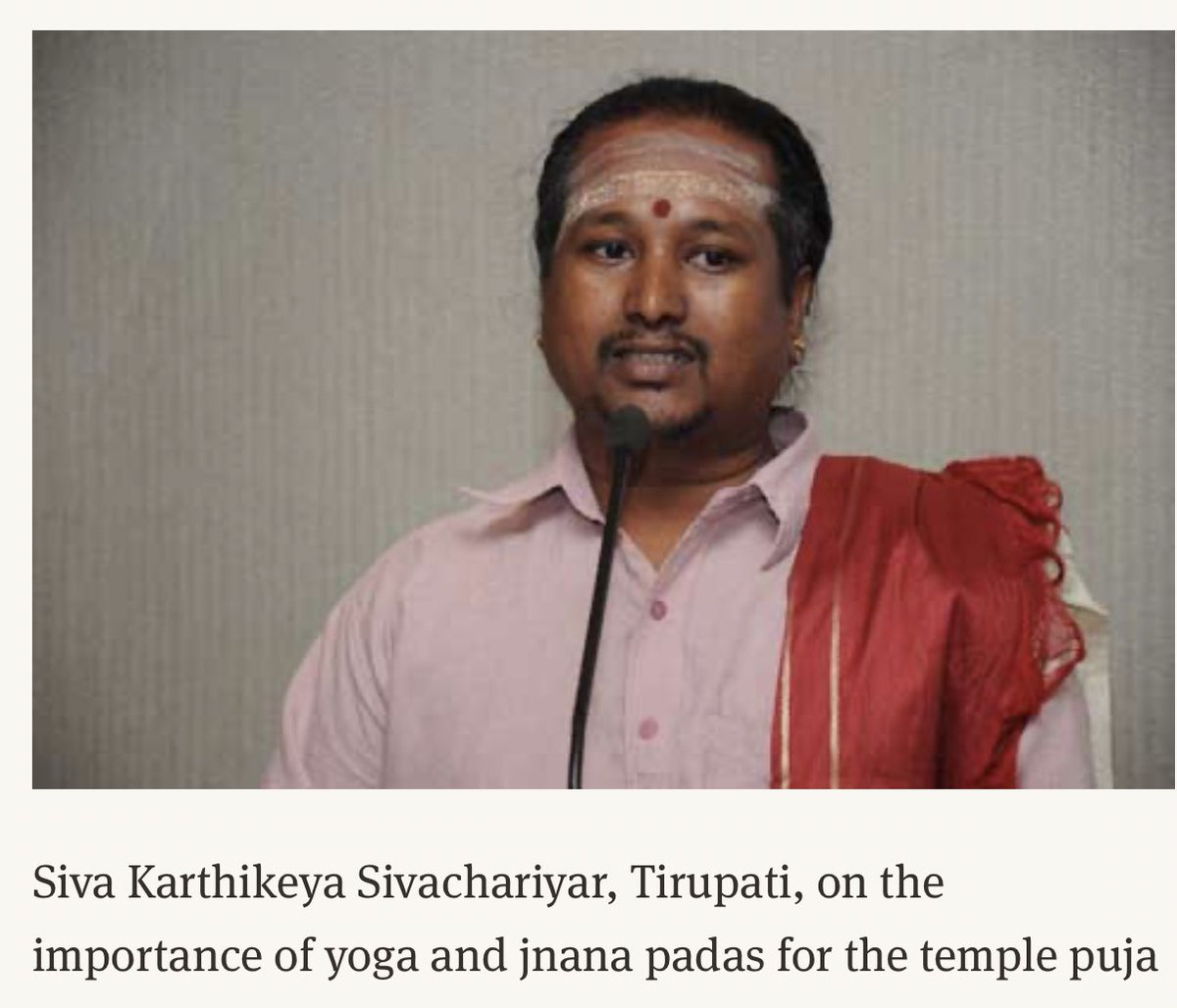
5. As much as ppl may dislike this, Ādiśaivas suffer from a perception problem & their Ācāryatvam remains undervalued. To a great extent, the neglect of Vidyāpādas & Yogapādas (Tattvajñāna & Sādhana) plus a watered-down Kriyāpāda have resulted in this. 
6. This may not be limited to Ādiśaivas but it remains critical for them.
Nobody will take you seriously if you can’t substantiate the legitimacy, & explain the meaning, of the smallest steps of the rituals you do.
Nobody will take you seriously if you can’t substantiate the legitimacy, & explain the meaning, of the smallest steps of the rituals you do.
7. To a great extent, the current quality of pedagogy (not everywhere) is to blame & the low quality of pedagogy is driven by the need for Arcakas’ children to join the divine vocation as young as possible.
8. While a complete rectification for this deep-rooted problem (that goes back centuries to institutional disenfranchisement of Ādiśaivas, rendering them dependents & making proper scholarship unaffordable) will take a long time, one can start small.
9. By starting small, I mean that a small, selected group of Ādiśaiva children can be put through a more robust & complete curriculum/syllabus, one that is privately sponsored by like-minded Mahāśaivas & other well-wishers.
9. Cont’d: There should be a healthy combination of both Śāstra & modern education, with the boy’s family’s needs taken care of so that nobody is in a rush to join a temple to become an Arcaka at 18/19 or even 22. The idea is to prepare them to be fully worthy of Ācāryatvam.
10. To become an Arcaka requires basic Dīkṣās, marriage & Ācāryābhiṣeka but rushing the Dīkṣās & Ācāryābhiṣeka (just because it is a practice, albeit non-scriptural) does very little good. In fact, it has tangibly harmed Ādiśaivas’ interests.
Dīkṣā absolutely requires a ripeness of मल/mala (spiritual maturity) & there are signs to infer this. It cannot be compromised & if it is, there will be consequences for Ādiśaivas, Śaivam & Dharma as a whole.
Ācāryābhiṣeka is a testament to a high level of competency, intellectual & spiritual accomplishments. This too should not be compromised. Quality priesthoods could once be nurtured because of an excellent system of royal patronage.
11. With such patronage long gone, the duty falls on Dhārmikas (but especially on Mahāśaivas & Adīkṣita Māheśvara Brāhmaṇas) to provide support to Ādiśaivas & the larger cause of reclaiming the Siddhānta.
12. In line with the above, Ādiśaivas, along with Mahāśaivas, need to take up teaching of Āgamas, in different ways for Dīkṣitas & Adīkṣitas. And for this, a solid grasp of Sāmānya-Śāstras listed above as well as all 4 pādas of the Āgamas are absolutely compulsory.
13. There are zero substitutes for Tattvajñāna & Sādhana. Following this, Śaivas need to pay attention to problems & issues, which have been given scant attention in Dharma (the place of “Aśāstriya devatas”, non-Hindu religions, etc) & offer rich, Siddhānta narratives for them.
@Saiva_Siddantam Ādiśaivas have lost their hold on the world of Śāstras for a couple of centuries & this has immensely affected their standing & self-confidence. This situation will not improve without a drastic change in environment for them or without help from the “Śāstrīya ecosystem”.
• • •
Missing some Tweet in this thread? You can try to
force a refresh




