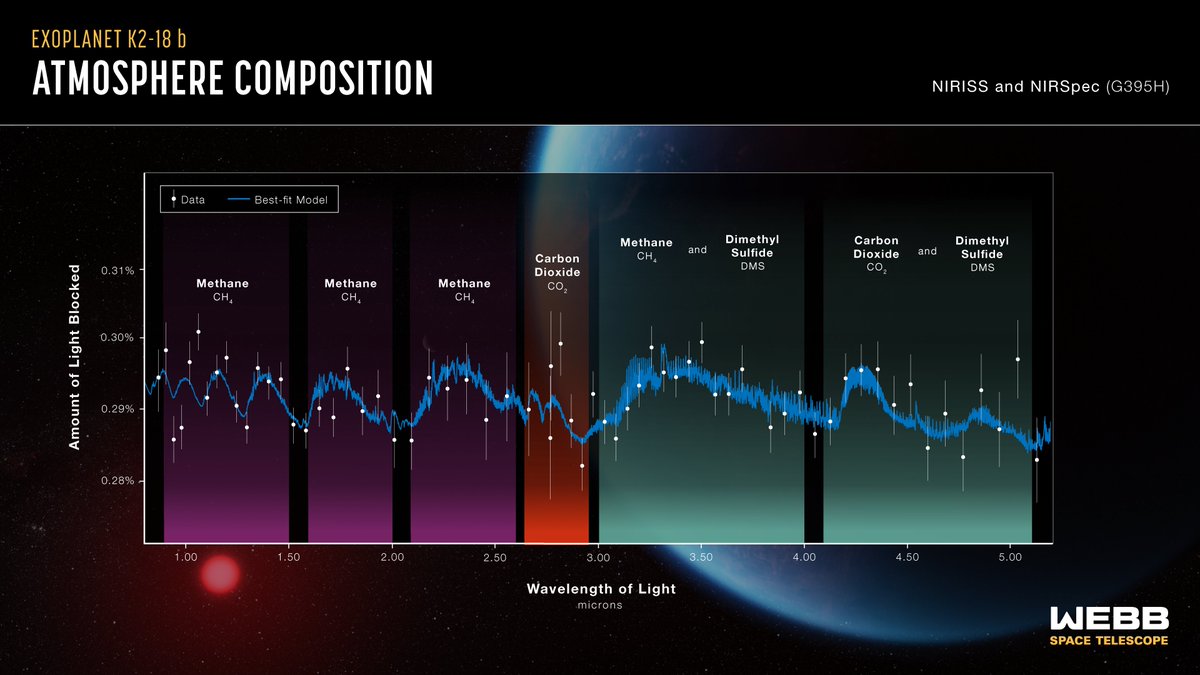
The Webb telescope has detected carbon dioxide and methane in the atmosphere of exoplanet K2-18 b, a potentially habitable world over 8 times bigger than Earth. Webb’s data suggests the planet might be covered in ocean, with a hydrogen-rich atmosphere: go.nasa.gov/3sGKNLe
Webb also hinted at a detection of dimethyl sulphide (DMS) on K2-18 b. On Earth, this molecule is only produced by microbial life. Because the detection needs to be confirmed, the team plans to follow up and look for additional evidence of biological activity on the planet.
While K2-18 b is in the habitable zone (where conditions are right for liquid water to exist), that does not necessarily mean it can support life. For instance, it may have a hostile environment due to its active star. Its ocean may also be too hot to be habitable.
• • •
Missing some Tweet in this thread? You can try to
force a refresh

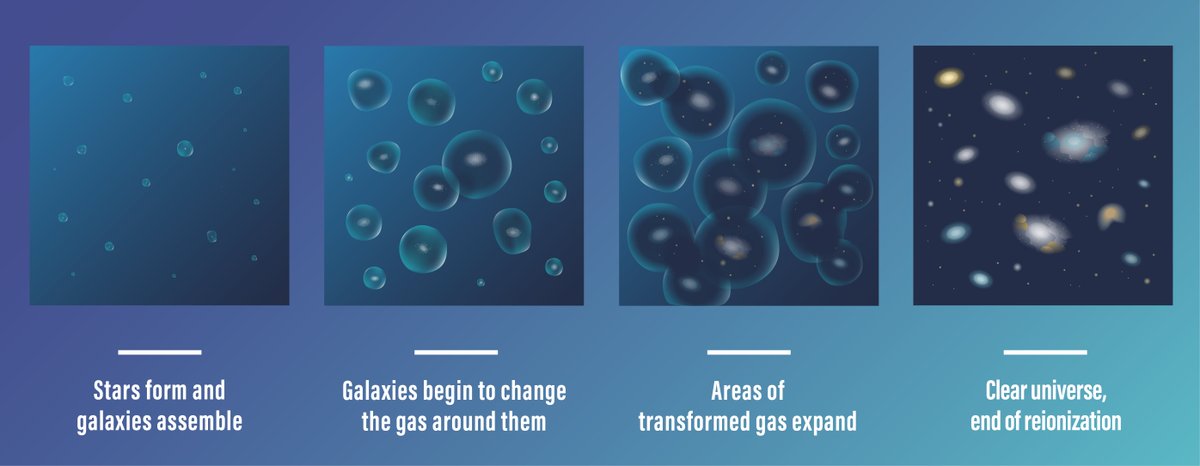
Early in our cosmic history, gas in the universe shifted (over hundreds of millions of years) from opaque to transparent, allowing light to travel freely. But how? Webb proves the answer lies in galaxies from the early universe: go.nasa.gov/43TriMV
Let's clear this up 👇
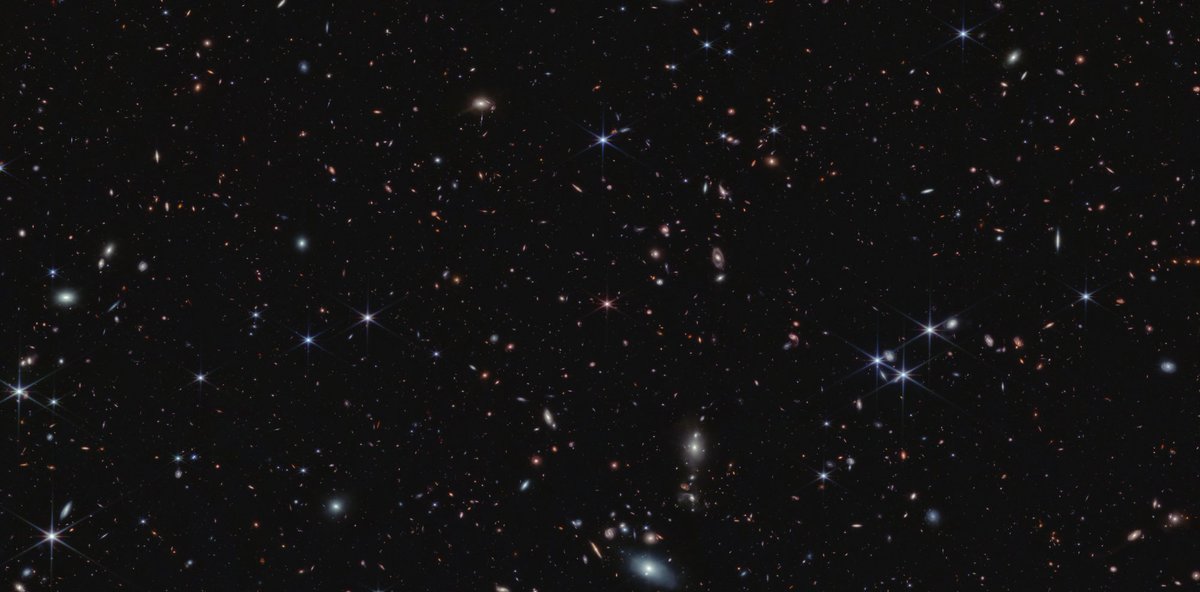
Astronomers looked into galaxies so far away that their light took almost 13 billion years to reach us. That made these galaxies the perfect window into what the universe was like about 900 million years after the big bang, just before it became fully transparent.
Webb witnessed these galaxies ionizing and thus clearing the gas around them. The transparent regions surrounding the galaxies were about 2 million light-years in radius! Scientists believe these bubbles eventually grew & merged, creating a transparent universe.
Webb confirmed the 1st detection of water vapor around a rare type of comet in the main asteroid belt. This suggests that ice from the early solar system can be preserved there—a breakthrough for studying the origins of water on Earth: go.nasa.gov/3BucEzm
This comet is called a main belt comet, a fairly new classification. Unlike most comets, found in areas beyond the orbit of Neptune, main belt comets reside in the asteroid belt between Mars and Jupiter. And unlike asteroids, they periodically display a halo and tail.
Surprisingly, no carbon dioxide (CO2) was detected for this comet. (CO2 usually makes up 10% of a comet's volatile material!) Scientists theorize its CO2 got lost over time due to the main belt's relatively warm temperatures, or it formed in an area where no CO2 was available.
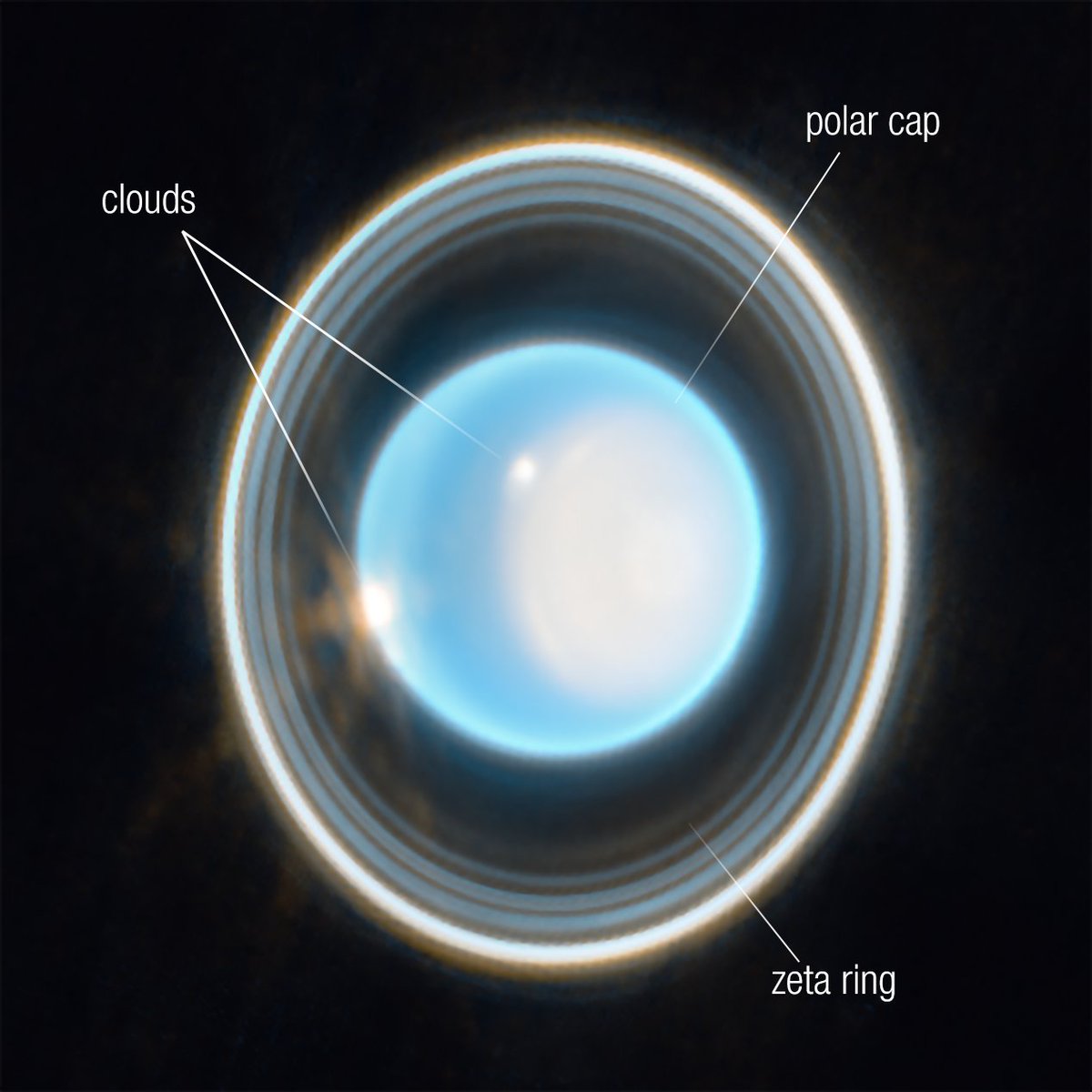
Only Voyager 2 and Keck (with adaptive optics) have imaged the planet's faintest rings before, and never as clearly as Webb’s first glimpse at this ice giant, which also highlights bright atmospheric features. go.nasa.gov/3nTo3oO
Uranus rotates on its side, causing its poles to experience 42 years of sunlight & 42 years of darkness. (It takes 84 years to orbit the Sun.) Voyager flew by Uranus in 1986 when it was summer at its south pole. Now the south pole is out of view, facing the darkness of space.
Check out the polar cap (bright white area) on the right side! Webb reveals, for the first time, a subtle enhanced brightening at its center. This polar cap appears in the direct sunlight of summer and vanishes in the fall. Webb's data will help us to understand this mystery.
Shown here is M92, a cluster of thousands of stars located 27,000 light-years away in our Milky Way. One of Webb’s first science observations, this was taken as part of a program designed to help scientists make the most of Webb: go.nasa.gov/3ILMCMB
M92 is a classic target for studying how stars evolve. Not only is it so close that Webb can single out individual stars, but it contains some of the oldest stars in the Milky Way. We can take what we learn from M92 to know more about distant stars in the ancient universe.
This cluster was a great way to demonstrate Webb’s abilities. The stars in M92 are super dense, testing how well Webb measures stars that are close together. In addition, Webb’s longer infrared wavelengths are ideal for observing extremely small, faint stars in very little time.
Preliminary Webb science shows galaxies confirmed by spectroscopy to date back to less than 400 million years after the big bang. Finding and confirming early galaxies is a continuous process, and Webb is just getting started: go.nasa.gov/3uB4npV
We need spectroscopy to confirm how far away a galaxy is, as closer galaxies can “masquerade” as distant ones. Spectroscopy refers to breaking light into its components to create spectra, or “barcodes.” On a "barcode," elements and molecules have distinct signatures we can read.
Because the universe is expanding, the light from distant galaxies is stretched — or redshifted — into longer, infrared wavelengths. We can figure out galaxies’ distances by measuring how much the signatures of elements in their spectra have shifted due to this effect.
Hidden in the neck of this “hourglass” of light are the very beginnings of a new star — a protostar. The clouds of dust and gas within this region are only visible in infrared light, the wavelengths that Webb specializes in: go.nasa.gov/3TKluzI
This protostar is a hot, puffy clump of gas that’s only a fraction of the mass of our Sun. As it draws material in, its core will compress, get hotter, and eventually begin nuclear fusion — creating a star!
See that dark line at the very center? That’s an edge-on view of a protoplanetary disk — the disk of material being pulled into the star as it forms. It’s about the size of our solar system & may eventually clump into planets, giving us a window into our solar system’s history.